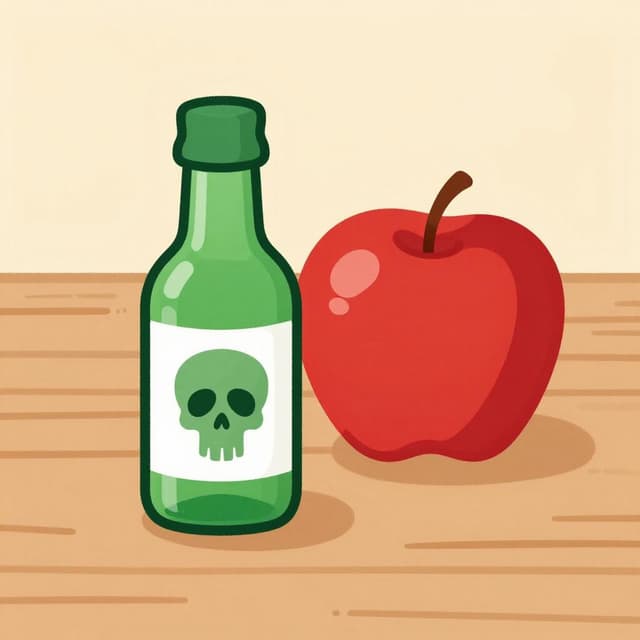
envenenar Negative Imperative Conjugation
envenenar — to poison
Negative commands for envenenar use 'no' + present subjunctive: no envenenes (tú), no envenene (usted), no envenenemos (nosotros), no envenenen (ustedes), no envenenéis (vosotros).
envenenar Negative Imperative Forms
When to Use the Negative Imperative
Use the negative imperative to tell someone NOT to do something. For 'envenenar', this means instructing someone not to poison something.
Notes on envenenar in the Negative Imperative
This tense is formed by adding 'no' before the present subjunctive forms of 'envenenar'. The present subjunctive for regular -ar verbs like 'envenenar' is derived from the 'yo' form of the present indicative ('enveneno'), dropping the '-o' and adding the opposite vowel ending (-e for -ar verbs). So, 'enveneno' becomes '-e', giving us 'envenene' for él/ella/usted, 'envenenes' for tú, 'envenenemos' for nosotros, 'envenenéis' for vosotros, and 'envenenen' for ellos/ellas/ustedes.
Example Sentences
No envenenes la comida de tu amigo.
Don't poison your friend's food.
tú
Por favor, no envenene el estanque.
Please, don't poison the pond.
usted
No envenenemos esta oportunidad.
Let's not poison this opportunity.
nosotros
¡No envenenéis las redes sociales con odio!
Don't poison social media with hate!
vosotros
No envenenen el ambiente con sus quejas.
Don't poison the atmosphere with your complaints.
ustedes
Common Mistakes
Mistake: Using the infinitive after 'no'.
Correct: Use 'no' + the correct present subjunctive form (e.g., 'no envenenes').
Why: The negative imperative requires the subjunctive mood, not the infinitive.
Mistake: Forgetting the 'no' in negative commands.
Correct: Always include 'no' before the verb in negative commands.
Why: The 'no' is essential to make the command negative.
Master Spanish verbs in context
Memorizing tables only gets you so far. Read 200+ illustrated and narrated Spanish stories to see verbs like 'envenenar' used naturally — in the tenses you're learning.
Related Tenses
Present
yo: enveneno
The present tense of envenenar (enveneno, envenenas, envenena...) describes habitual actions or things happening now.
Preterite
yo: envenené
The preterite of envenenar is regular: envenené, envenenaste, envenenó, envenenamos, envenenasteis, envenenaron.
Imperfect
yo: envenenaba
The imperfect of envenenar (envenenaba, envenenabas...) describes ongoing or habitual past actions.
Future
yo: envenenaré
The future tense of envenenar (envenenaré, envenenarás...) indicates actions that will happen.
Conditional
yo: envenenaría
The conditional of envenenar (envenenaría, envenenarías...) expresses 'would' actions, politeness, or future-in-the-past.
Present Subjunctive
yo: envenene
The present subjunctive of envenenar (envenene, envenenes, etc.) is used after expressions of doubt, desire, emotion, and uncertainty.
Imperfect Subjunctive
yo: envenenara
The imperfect subjunctive of envenenar (envenenara/envenenase) is used for past hypotheticals, wishes, or doubts.
Affirmative Imperative
yo: envenena
The imperative of envenenar uses regular -ar endings: envenena (tú), envenene (usted), envenenemos (nosotros), envenenen (ustedes), envenenad (vosotros).