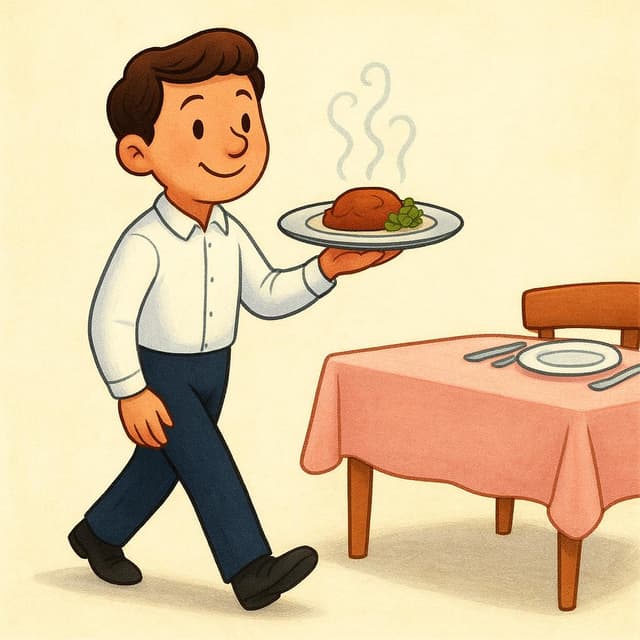
servir Preterite Conjugation
servir — to serve
Servir has a 'slipper' stem change (e > i) in the third-person forms: sirvió and sirvieron.
servir Preterite Forms
When to Use the Preterite
Use the preterite to describe a specific time someone served a meal or when an object functioned for a specific purpose in the past.
Notes on servir in the Preterite
This is a stem-changing -ir verb. While most forms are regular, the third-person singular (él/ella/usted) and plural (ellos/ellas/ustedes) change the 'e' to 'i'.
Example Sentences
El camarero nos sirvió la comida muy rápido.
The waiter served us the food very quickly.
él/ella/usted
Ayer serví la cena a las ocho.
Yesterday I served dinner at eight.
yo
Los asistentes sirvieron bebidas durante el evento.
The assistants served drinks during the event.
ellos/ellas/ustedes
Common Mistakes
Mistake: servió
Correct: sirvió
Why: The stem change e > i must happen in the third-person preterite for -ir verbs.
Master Spanish verbs in context
Memorizing tables only gets you so far. Read 200+ illustrated and narrated Spanish stories to see verbs like 'servir' used naturally — in the tenses you're learning.
Related Tenses
Present
yo: sirvo
Servir is a stem-changer (e > i) in all forms except nosotros and vosotros.
Imperfect
yo: servía
Servir is regular in the imperfect: servía, servías, servía, servíamos, servíais, servían.
Future
yo: serviré
Servir is completely regular in the future tense; just add the endings to the infinitive.
Conditional
yo: serviría
The conditional of servir is regular: serviría, servirías, serviría, serviríamos, serviríais, servirían.
Present Subjunctive
yo: sirva
Servir changes e > i in all forms of the present subjunctive, including nosotros.
Imperfect Subjunctive
yo: sirviera
The imperfect subjunctive is based on the 'sirvieron' stem: sirviera, sirvieras, sirviera...
Affirmative Imperative
yo: sirve
Use 'sirve' (tú) or 'sirva' (usted) to tell someone to serve or function.
Negative Imperative
yo: no sirvas
Negative commands use 'no' + the present subjunctive: no sirvas, no sirva.