Inklingo

comprobar

/kom-proh-BAR/

to check

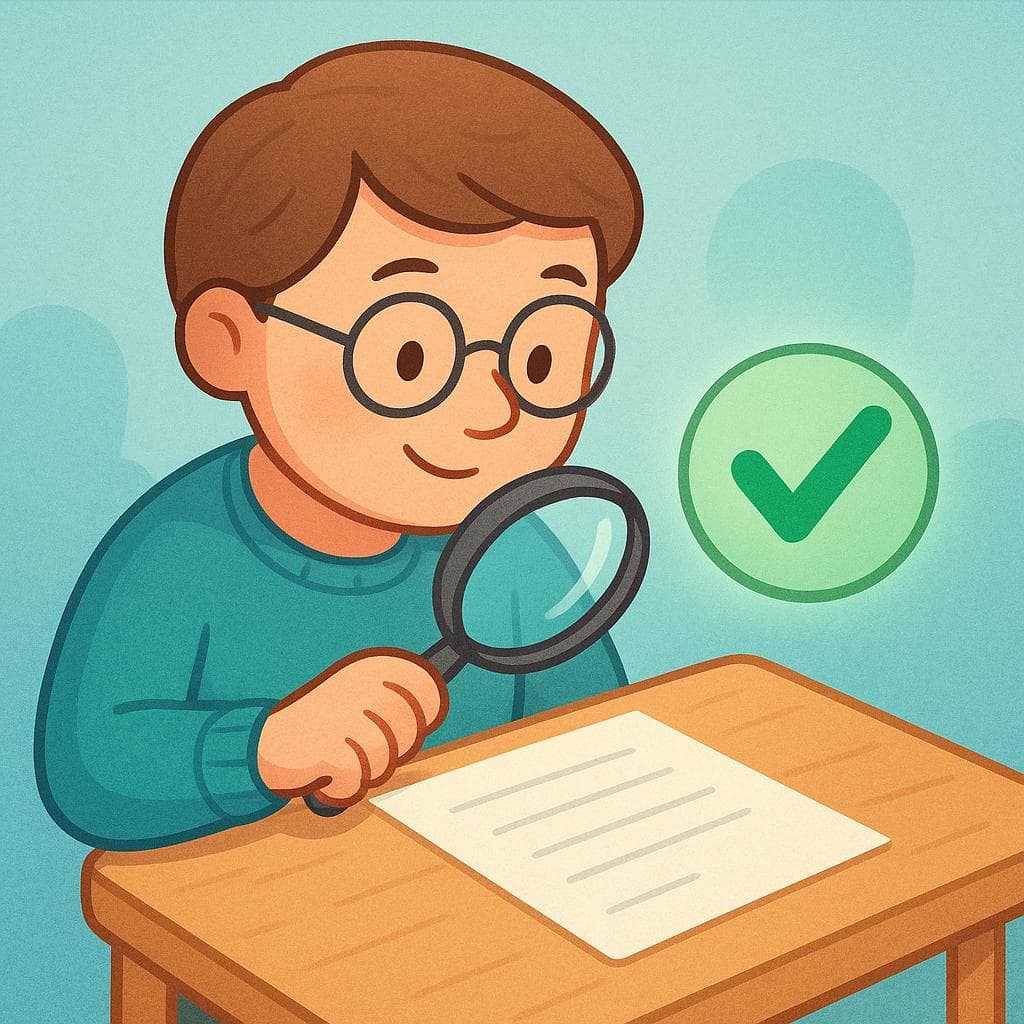
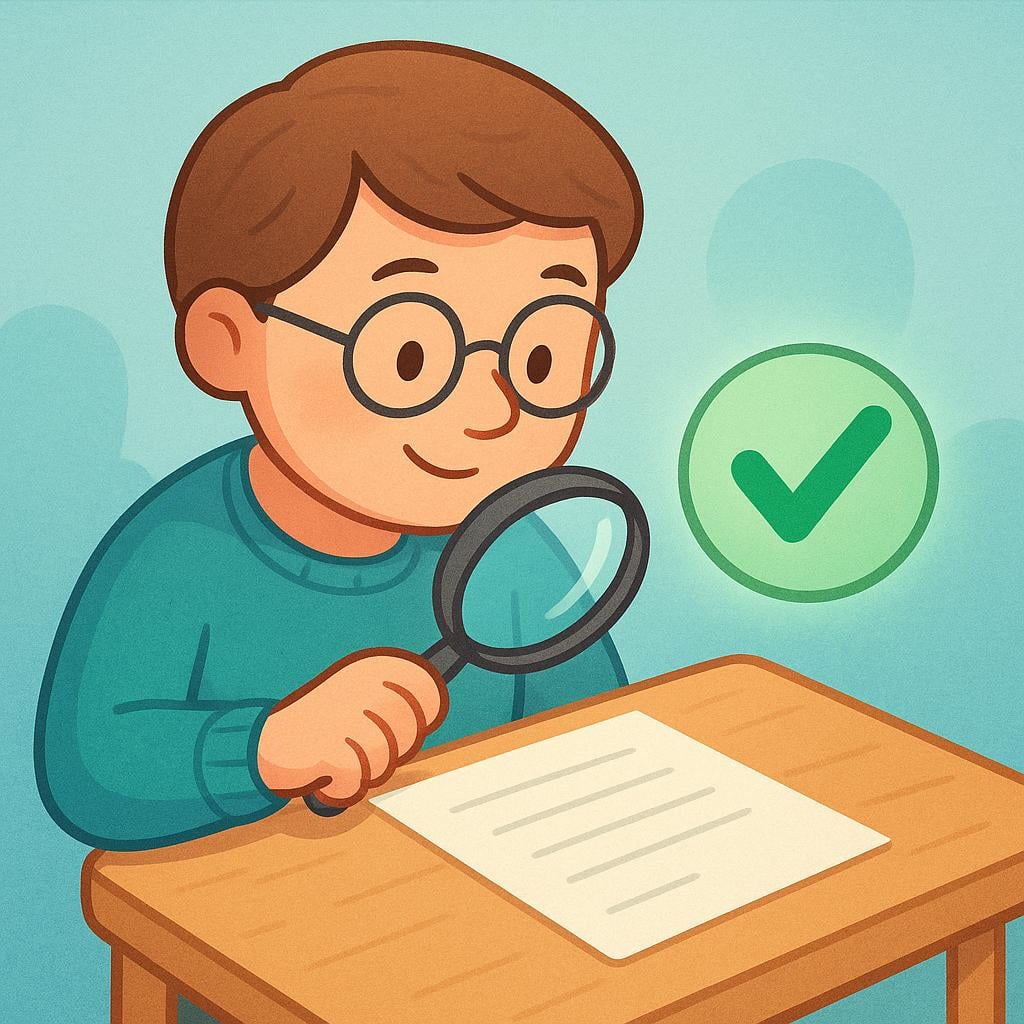
A friendly character wearing glasses, holding a magnifying glass, carefully examining a single sheet of paper on a desk, symbolizing verification.

Use 'comprobar' to mean 'to check' or 'to verify' documents or facts.

comprobar(verb)

A2stem-changing (o > ue in specific forms) ar

to check

?

to verify information or documents

,

to verify

?

to confirm accuracy

Also:

to examine

?

to look closely at something

📝 In Action

Necesitas comprobar la hora de salida del tren en la pantalla.

A2

You need to check the train's departure time on the screen.

El policía comprobó mi identidad antes de dejarme pasar.

B1

The police officer verified my identity before letting me pass.

Compruebo dos veces el correo electrónico antes de enviarlo.

B1

I double-check the email before sending it.

Word Connections

Synonyms

  • verificar (to verify)
  • revisar (to review/check)

Common Collocations

  • comprobar la cuentato check the bill/account
  • comprobar sito check if

💡 Grammar Points

Stem Change 'O' to 'UE'

In the present tense, the 'o' changes to 'ue' when the stress falls on the root word (e.g., 'yo compruebo'). This change skips the 'nosotros' and 'vosotros' forms.

❌ Common Pitfalls

Confusing 'comprobar' and 'chequear'

Mistake: "Using 'chequear' (a Spanglish verb) when 'comprobar' is more formal and appropriate for verifying facts or documents."

Correction: Use 'comprobar' when the action involves confirming accuracy or validity; use 'revisar' or 'mirar' for a simple look-over.

⭐ Usage Tips

Formal vs. Informal Check

Use 'comprobar' when you are officially verifying a fact or testing a theory. Use 'revisar' for checking homework or looking over a list.

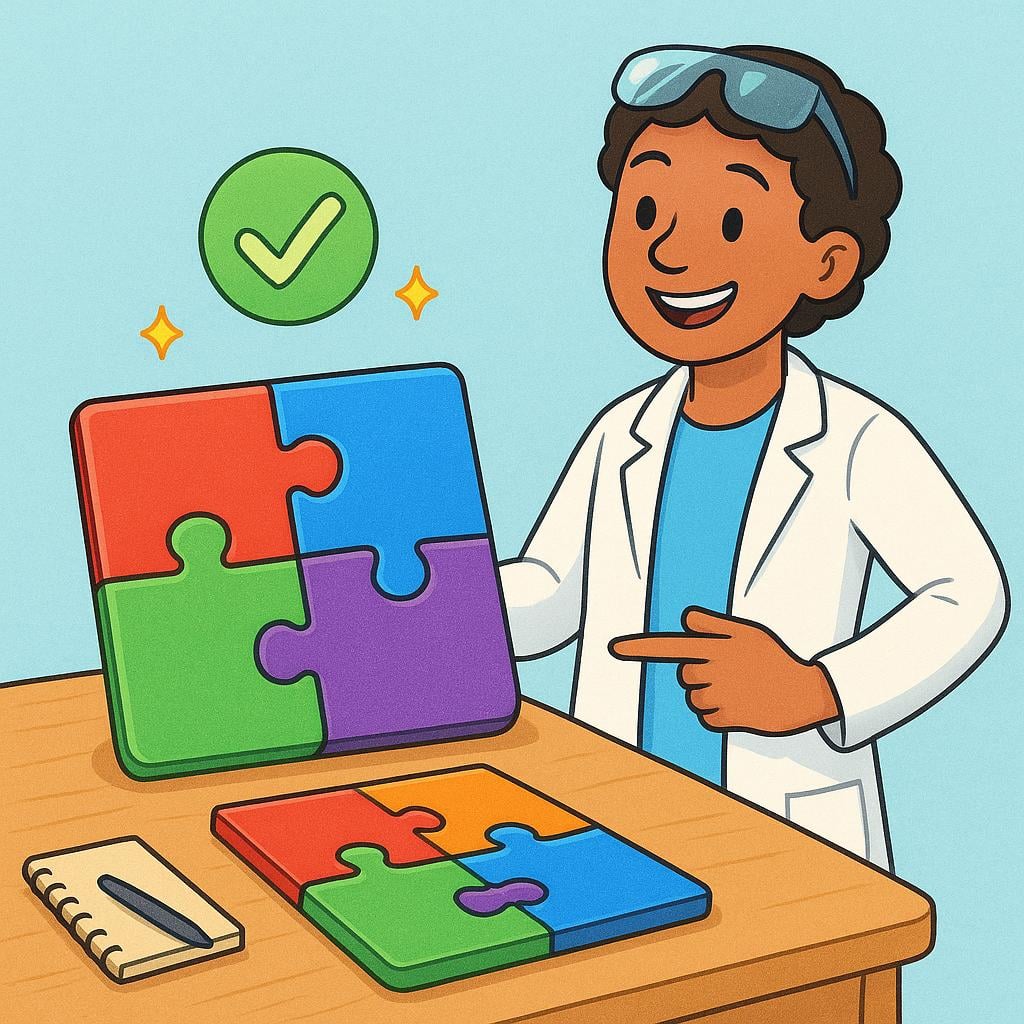
A smiling scientist character pointing triumphantly at a fully completed, brightly colored jigsaw puzzle resting on a table, symbolizing successfully proving a concept or truth.

When you 'comprobar' something, you 'prove' its validity or truth.

comprobar(verb)

B1stem-changing (o > ue in specific forms) ar

to prove

?

to demonstrate validity or truth

,

to show

?

to provide evidence

Also:

to substantiate

?

formal context of proof

📝 In Action

El experimento comprobó la teoría del científico.

B2

The experiment proved the scientist's theory.

La nueva evidencia comprueba su inocencia.

B1

The new evidence proves his innocence.

No pudieron comprobar que el coche era robado.

B2

They couldn't prove that the car was stolen.

Word Connections

Synonyms

  • demostrar (to demonstrate)
  • atestiguar (to testify/attest)

Antonyms

  • refutar (to refute)

Common Collocations

  • comprobar la hipótesisto prove the hypothesis
  • comprobar un resultadoto prove a result

💡 Grammar Points

Followed by 'que'

When 'comprobar' means 'to prove' or 'to confirm a fact,' it is usually followed by 'que' and the verb in the normal indicative (non-special) form: 'Comprobamos que está aquí.' (We confirmed that he is here.)

⭐ Usage Tips

Proof vs. Check

If you are trying to convince someone of the truth of a statement, use 'comprobar' in this sense. If you are just making sure your keys are in your pocket, use 'revisar' or 'check' (meaning 1).

🔄 Conjugations

indicative

present

él/ella/ustedcomprueba
yocompruebo
compruebas
ellos/ellas/ustedescomprueban
nosotroscomprobamos
vosotroscomprobáis

imperfect

él/ella/ustedcomprobaba
yocomprobaba
comprobabas
ellos/ellas/ustedescomprobaban
nosotroscomprobábamos
vosotroscomprobabais

preterite

él/ella/ustedcomprobó
yocomprobé
comprobaste
ellos/ellas/ustedescomprobaron
nosotroscomprobamos
vosotroscomprobasteis

subjunctive

present

él/ella/ustedcompruebe
yocompruebe
compruebes
ellos/ellas/ustedescomprueben
nosotroscomprobemos
vosotroscomprobéis

imperfect

él/ella/ustedcomprobara
yocomprobara
comprobaras
ellos/ellas/ustedescomprobaran
nosotroscomprobáramos
vosotroscomprobarais

✏️ Quick Practice

💡 Quick Quiz: comprobar

Question 1 of 1

Which sentence uses 'comprobar' in the sense of 'to prove'?

📚 More Resources

Word Family

Frequently Asked Questions

Is 'comprobar' the same as 'chequear'?

'Comprobar' is the standard, traditional Spanish verb for verifying or proving something. 'Chequear' is a loanword from English ('to check') and is used informally, especially in Latin America, but 'comprobar' is always the safer and more formal choice, especially for official verification.

Is 'comprobar' regular?

No, it's slightly irregular! It is an '-ar' verb, but it has a stem change where the 'o' becomes 'ue' in most forms of the present tense (e.g., 'yo compruebo'), similar to the verb 'probar' (to try).