sentarte
“sentarte” means “to sit down (you, informal)” in Spanish (Used when addressing a single person informally (tú)).
to sit down (you, informal)
Also: to take a seat (you, informal)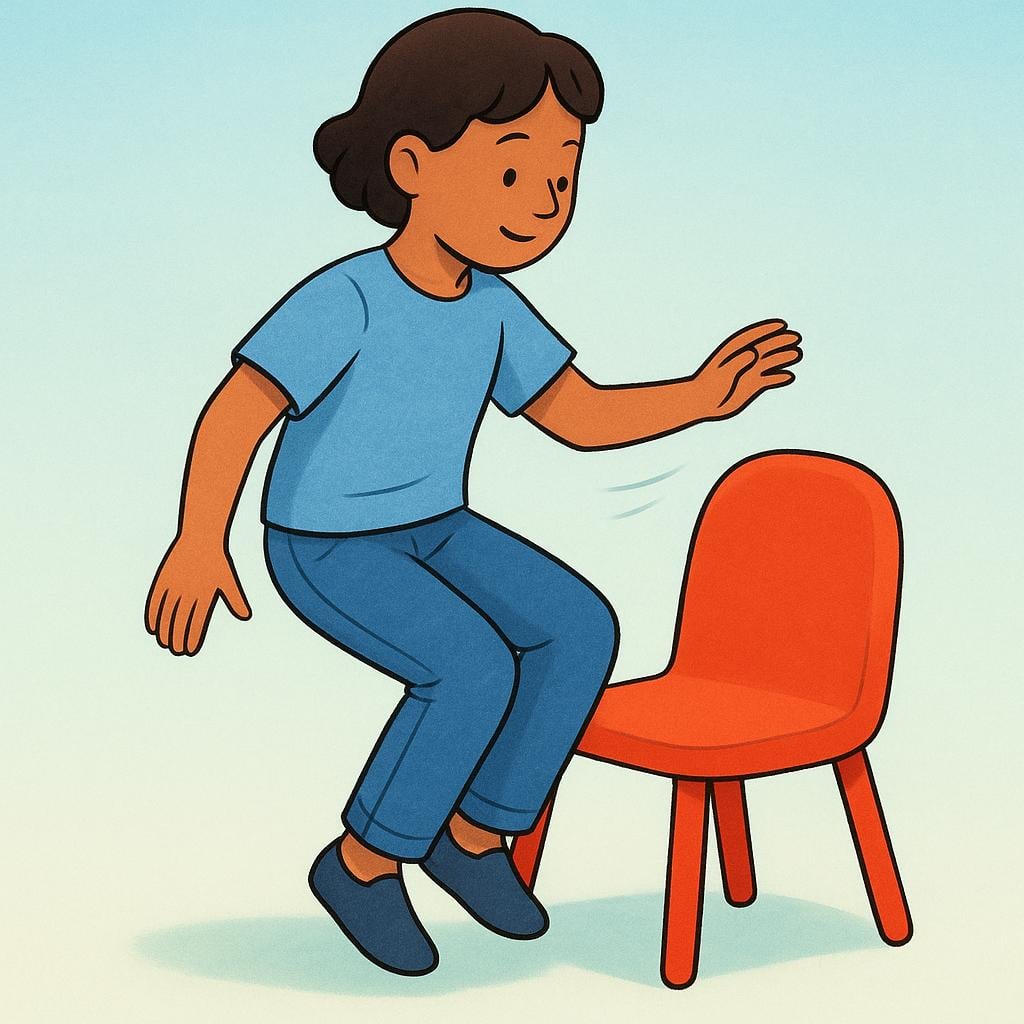
📝 In Action
Necesitas sentarte un rato.
A1You need to sit down for a while.
Puedes sentarte donde quieras.
A2You can sit wherever you want.
Si vas a esperar, te recomiendo sentarte.
B1If you are going to wait, I recommend you sit down.
🔄 Conjugations
indicative
present
imperfect
preterite
subjunctive
present
imperfect
✏️ Quick Practice
Quick Quiz: sentarte
Question 1 of 2
Which sentence correctly uses the equivalent of 'sentarte' in a formal context (usted)?
📚 More Resources
👥 Word Family▼
🎵 Rhymes▼
📚 Etymology▼
The verb *sentar* comes from the Latin word *sedentare*, which is related to the idea of placing or settling. When you add the reflexive pronoun *se* (making it *sentarse*), the meaning changes from 'seating someone else' to 'seating oneself'—or simply, 'sitting down'.
First recorded: Around the 13th century
Cognates (Related words)
💡 Master Spanish
Take your Spanish to the next level. Read 200+ illustrated and narrated Spanish stories tailored to your level with the Inklingo app!
Frequently Asked Questions
Why does 'sentarte' have the 'te' attached to the end?
This is a common feature in Spanish! When the verb 'to sit down' (*sentarse*) follows another conjugated verb (like 'want' or 'need'), we attach the reflexive pronoun ('te' for *tú*) directly to the end of the infinitive. It's just a rule for reflexive verbs in this position.
Is 'sentarte' a command?
No, 'sentarte' is the infinitive form, meaning 'to sit down (you)'. The command form (imperative) for 'tú' is *siéntate* (Sit down!).