




Confusing 'Parientes' and 'Padres'
Mistake: “Saying 'Mis parientes son de Cuba' when you mean 'My parents are from Cuba'.”
Correction: Mis padres son de Cuba.
lah fah-MEE-lee-ah
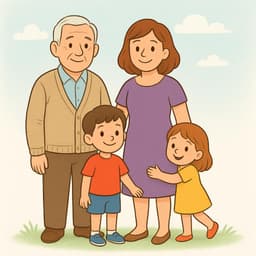
This is the universal Spanish word for 'family.' It's the essential starting point for talking about your relatives, loved ones, and personal life.

In many Spanish-speaking cultures, 'la familia' is the center of social life and often includes grandparents, aunts, uncles, and cousins in the core unit.
Family & Relationships — in Spanish
lohs pah-ree-EHN-tehs
This means 'relatives' or 'kin.' It's a broad term that includes your entire extended family, not just your immediate household.
lohs PAH-drehs
This word means 'parents.' Interestingly, even though 'padre' means father, the plural form 'padres' refers to both your mother and father together.
lohs ehr-MAH-nohs / lahs ehr-MAH-nahs
'Hermanos' means 'siblings' or 'brothers.' If you have a mix of brothers and sisters, you use the masculine plural 'hermanos.' 'Hermanas' is used only for a group of sisters.
lohs EE-hohs / lahs EE-hahs
This means 'children.' 'Hijos' can mean 'sons' or a mix of sons and daughters. 'Hijas' refers specifically to daughters.
el NOH-bee-oh / lah NOH-bee-ah
This is the most common way to say 'boyfriend' (novio) or 'girlfriend' (novia). It implies a serious, committed relationship.
el ehs-POH-soh / lah ehs-POH-sah
The standard and most common words for 'husband' (esposo) and 'wife' (esposa). Another common word for husband/wife is 'marido/mujer'.
lah pah-REH-hah
This means 'partner' or 'couple.' It's a very useful and inclusive term that can refer to a boyfriend, girlfriend, spouse, or long-term partner, regardless of marital status or gender.
lah fah-MEE-lee-ah poh-LEE-tee-kah
This literally means 'political family' and is the standard way to refer to your 'in-laws.' For example, your mother-in-law is 'suegra' and father-in-law is 'suegro'.
Choosing the right term for a romantic partner depends on the seriousness and context of the relationship. Here’s a quick guide:
| Phrase | Formality | Best For | Avoid When |
|---|---|---|---|
| Novio / Novia | Informal / Neutral | An established, committed boyfriend or girlfriend. | Referring to a very casual date or just a friend. |
| Pareja | Neutral | Long-term partners, married or unmarried, and same-sex couples. It's modern and inclusive. | The relationship is brand new or not yet serious. |
| Esposo / Esposa | Neutral / Formal | Your husband or wife. It's the standard term for a spouse. | You are not legally married. |
| Marido / Mujer | Neutral / Informal | Another very common way to say husband ('marido') or wife ('mujer'). | In very formal documents, where 'esposo/a' is often preferred. |
Most words are phonetic. The main challenges are the rolled 'r' in words like 'parientes' and the soft 'h' sound (like in 'loch') for the 'j' in 'hijos'.
The main grammatical challenge is gender and number agreement. You have to remember if a family member is masculine or feminine and make sure articles and adjectives match.
The concept of family is deeply cultural. Understanding its broad scope, the importance of extended family, and appropriate topics of conversation is key to navigating social situations well.
Mi familia es muy grande, tengo cuatro hermanos y muchos primos.
My family is very big, I have four siblings and a lot of cousins.
¿Cómo se llaman tus padres?
What are your parents' names?
Voy a presentarle mi novio a mis abuelos este fin de semana.
I'm going to introduce my boyfriend to my grandparents this weekend.
Mi esposa es de Colombia, pero todos sus parientes viven en Estados Unidos.
My wife is from Colombia, but all her relatives live in the United States.
Nosotros no estamos casados, pero somos pareja desde hace diez años.
We aren't married, but we've been a couple for ten years.
In many Spanish-speaking cultures, 'la familia' is a much broader concept than in the Anglophone world. It often includes not just the nuclear family but also grandparents, aunts, uncles, and cousins, who can be deeply involved in one's daily life. Family gatherings are frequent, large, and a cornerstone of social life.
A key feature of Spanish is that masculine plural nouns are used for mixed-gender groups. 'Los padres' means 'the parents' (mother and father), not just 'the fathers.' Similarly, 'los hermanos' means 'siblings,' and you'd only use 'las hermanas' if everyone in the group is female.
It's traditional in most of the Hispanic world for a person to have two last names: the first from their father (apellido paterno) and the second from their mother (apellido materno). This beautifully reflects the importance of both sides of the family in a person's identity.
It's very common to hear affectionate terms like 'mijo'/'mija' (a contraction of 'mi hijo'/'mi hija', my son/daughter) or 'papi'/'mami' used not just by parents to children, but also between partners or even by elders to younger people as a sign of affection.
Mistake: “Saying 'Mis parientes son de Cuba' when you mean 'My parents are from Cuba'.”
Correction: Mis padres son de Cuba.
Mistake: “Describing your sister as 'Mi hermano es alta'.”
Correction: Mi hermana es alta.
Mistake: “Saying 'Mi familiar es grande' to mean 'My family is big'.”
Correction: Mi familia es grande.
Mistake: “Saying 'Estoy embarazada' when you've made a social mistake in front of your partner's family.”
Correction: Estoy avergonzado/a. OR ¡Qué vergüenza!
Focus on learning your immediate family first: padres, hermanos, hijos, esposo/a. Once you have those down, expand outwards to abuelos (grandparents), tíos (aunts/uncles), and primos (cousins). This builds a strong foundation.
Get comfortable using 'mi' (my), 'tu' (your, informal), and 'su' (his/her/your formal). Talking about family is all about relationships, so saying 'mi hermano' (my brother) or 'sus padres' (his/her/their parents) is essential.
In most Spanish-speaking cultures, asking about family is a warm and welcome way to get to know someone. Simple questions like '¿Tienes hermanos?' (Do you have siblings?) or '¿De dónde es tu familia?' (Where is your family from?) are perfect for small talk.
The term 'pareja de hecho' refers to a legally recognized domestic partnership, which is quite common. The use of 'vosotros' for the informal plural 'you' is unique to Spain and will be used when talking to multiple family members informally.
Family is the absolute center of society. Large family gatherings for birthdays, holidays, and even just Sundays are extremely common. The term 'ahorita' is often used when talking about family plans, meaning anything from 'right now' to 'in a little while'.
The use of 'vos' instead of 'tú' is universal and comes with its own set of verb patterns. Family ties are strong, and it's common for adult children to live with their parents until marriage.
Mucho gusto en conocerte.
Nice to meet you.
Igualmente.
Likewise.
Sí, tengo una hermana mayor y un hermano menor.
Yes, I have an older sister and a younger brother.
¡Qué bueno! ¿Se llevan bien?
That's great! Do you get along well?
¿Cuánto tiempo llevan juntos?
How long have you been together?
Llevamos tres años juntos.
We've been together for three years.
This little story links the sound of the English words 'pair' and 'aunts' to the Spanish word 'parientes', helping you remember it means extended family, not just parents.
The sound 'her-man-o' is close enough to the English phrase 'Hey, man, bro' to create a memorable link for the word 'brother'.
The biggest difference is the scope of 'familia,' which is much more inclusive of extended relatives than the typical English concept of 'family.' The use of masculine plural nouns (like 'hermanos' for siblings) for mixed-gender groups is a core grammatical difference. Finally, the two-surname tradition in most Hispanic countries is a significant cultural distinction that reflects family heritage.
Talking about family is a very common and welcome topic for small talk in Spanish-speaking cultures, often more so than in some English-speaking contexts. It's seen as a way to build a personal connection and is not usually considered too private for a new acquaintance.
Why it''s different: While they mean the same thing, English speakers often default to 'family' when talking about extended kin. In Spanish, 'parientes' is a very common and specific word for this group.
Use instead: Use 'familia' for your family unit (however you define it) and 'parientes' when you want to specifically refer to your broader network of relatives.
Why it''s different: This is a classic 'false friend.' 'Parientes' looks like 'parents,' but it means 'relatives.'
Use instead: Always use 'padres' for 'parents' and 'parientes' for 'relatives'.
by Disney/Pixar
Abuelita Elena, the family matriarch, is reminding the main character, Miguel, of the family's long-standing ban on music.
Why it matters: This quote and the entire film perfectly illustrate the power and importance of 'la familia' and its traditions, showing how family rules and history shape the lives of younger generations.
📺 Available on Disney+
by Disney
This is a recurring line used to introduce the magical family at the heart of the story.
Why it matters: The film explores the pressures and blessings of belonging to a special family, with each member having a unique role. It's a great vocabulary builder for terms like 'hermana', 'prima', 'abuela', and 'tía'.
📺 Available on Disney+
Once you know the words for family members, the next logical step is to learn how to describe them (e.g., 'Mi hermana es alta').
This is essential for expressing affection to family and partners. You'll learn the difference between 'te quiero' and 'te amo'.
Knowing how to greet your new 'familia política' (in-laws) or family friends is a crucial social skill.
Learning how to form questions will allow you to engage in conversations and learn about other people's families.
Question 1 of 4
Your friend tells you he's going to a big party with his aunts, uncles, cousins, and grandparents. Which Spanish word best describes this group?
Knowing a phrase is one thing — using it at the right moment is another. Read 200+ illustrated and narrated Spanish stories to see phrases in the contexts where they actually belong.
This is a common point of confusion! 'Padres' specifically means 'parents' (your mother and father). 'Parientes' is a much broader term that means 'relatives' and includes your entire extended family like cousins, aunts, uncles, etc.
You use the masculine plural form: 'hermanos'. In Spanish, whenever a group includes at least one male, the masculine plural is used for the whole group. So, 'dos hermanos' could mean two brothers, or one brother and one sister.
Generally, no! In most Hispanic cultures, asking about family is a friendly and normal part of getting to know someone. It's seen as a way to show interest and build a connection. Simple questions like '¿Tienes familia aquí?' (Do you have family here?) are great icebreakers.
'Novio' is a boyfriend. 'Esposo' is a husband (someone you are legally married to). 'Pareja' is a neutral term for 'partner' and can be used for a long-term boyfriend/girlfriend, a spouse, or a partner in a domestic partnership. It's a very useful and inclusive word.
It's a cultural tradition to carry on the heritage of both sides of the family. A person's first last name (apellido paterno) comes from their father's first last name, and their second last name (apellido materno) comes from their mother's first last name.
The collective term is 'la familia política'. Individually, they are: 'suegro' (father-in-law), 'suegra' (mother-in-law), 'cuñado' (brother-in-law), and 'cuñada' (sister-in-law).
Strengthen the grammar behind this phrase:
Dive deeper into related topics:
Find similar phrases to expand your Spanish vocabulary:
Browse our complete collection of Spanish phrases organized by situation, from basic greetings to advanced conversations. Perfect for travelers, students, and anyone learning Spanish.
View All Spanish Phrases →