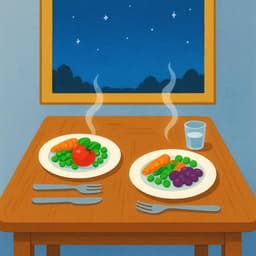


Using the Noun Instead of the Verb
Mistake: “A common error is saying '¿Quieres cena conmigo?'”
Correction: The correct way is '¿Quieres cenar conmigo?'
lah SEH-nah
This is the most common and standard word for 'dinner' (the evening meal). It's understood everywhere in the Spanish-speaking world.
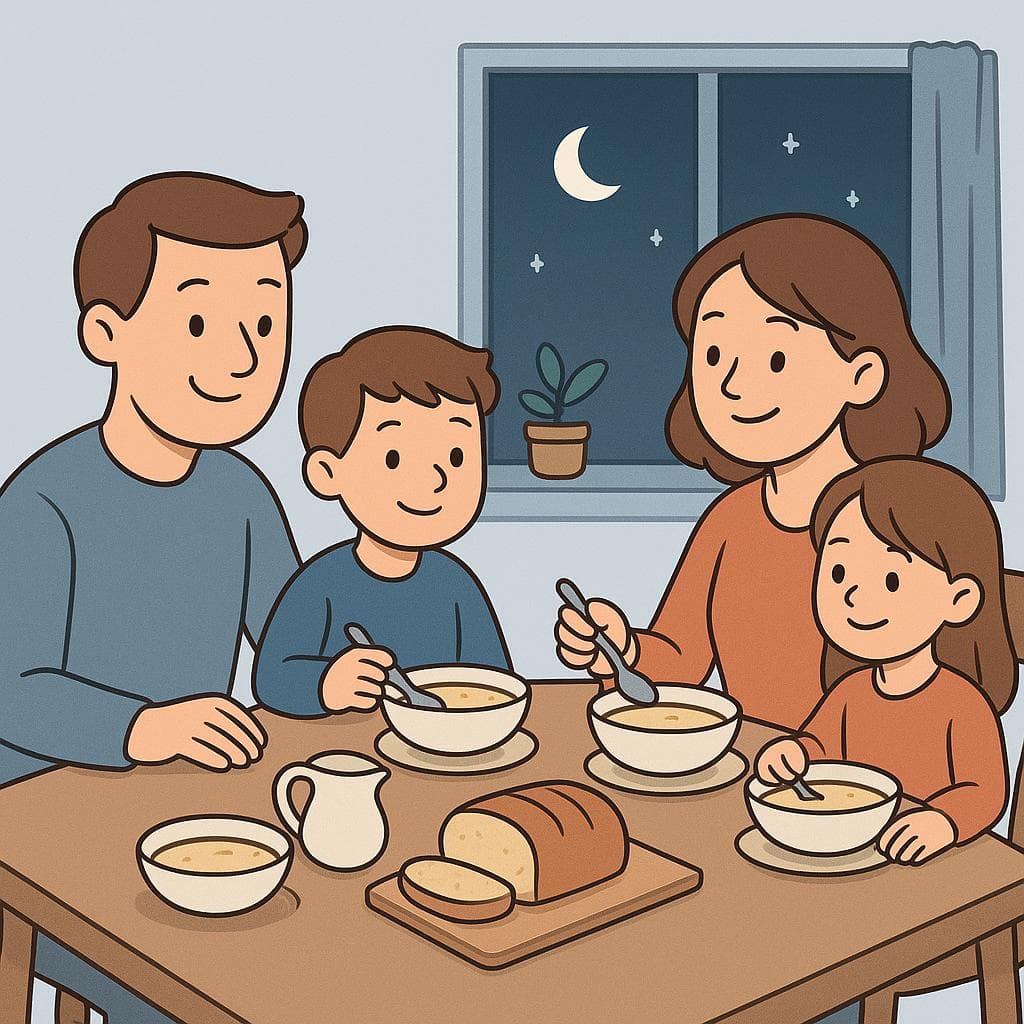
Whether it's a big event or a quiet meal at home, 'la cena' is the evening meal that brings the day to a close.
Dinner — in Spanish
seh-NAHR
This is the verb 'to have dinner' or 'to eat dinner.' You use it to talk about the action of eating the evening meal, which is much more common than saying 'tener cena' (to have dinner).
lah koh-MEE-dah
This word is tricky! In Spain and many parts of Latin America, 'la comida' specifically means 'lunch,' the main meal eaten in the afternoon. However, it can also mean 'food' in general. It rarely means 'dinner' unless the context makes it absolutely clear.
lah meh-ree-EHN-dah SEH-nah
A unique concept in Spain, this combines the afternoon snack ('merienda') with a light dinner ('cena'). It's a single, substantial late-afternoon or early-evening meal that replaces a more formal, later dinner.
el bahn-KEH-teh
This means 'banquet' or 'feast.' It refers to a large, formal, and often celebratory meal, which could be a dinner.
Here's a quick comparison of the main terms related to evening meals and their context.
| Phrase | Meaning | Best For | Region |
|---|---|---|---|
| La cena | Referring to the evening meal itself. | ||
| Cenar | Talking about the action of eating dinner. | ||
| La comida | The main meal of the day, almost always in the afternoon. | ||
| La merienda-cena | An informal, early, and light evening meal. |
Fairly easy. The 'c' is soft like an 's' in Latin America ('SEH-nah') but like 'th' in most of Spain ('THEH-nah'). The stress is straightforward.
The main grammatical point is remembering to use the verb 'cenar' instead of trying to translate 'to have dinner' literally with 'tener cena'.
The cultural aspect is the most complex part. Understanding meal times, meal importance (lunch vs. dinner), and regional vocabulary is key to avoiding confusion.
¿A qué hora es la cena?
What time is dinner?
Vamos a cenar a las nueve.
We are going to have dinner at nine.
La cena de anoche estuvo deliciosa.
Last night's dinner was delicious.
Tengo una cena de negocios el viernes por la noche.
I have a business dinner on Friday night.
Get ready to adjust your body clock! In Spain and Argentina, dinner rarely starts before 9 PM, and 10 PM is perfectly normal, especially on weekends. In Mexico and other Latin American countries, it might be a bit earlier, around 8 PM, but it's still significantly later than in the U.S. or UK.
In many Spanish-speaking cultures, the midday meal ('la comida' or 'el almuerzo') is the largest and most important meal of the day. This means 'la cena' is often a much lighter affair, perhaps consisting of a sandwich, a salad, yogurt, or tapas. This is a major contrast to the English-speaking world where dinner is often the main meal.
Dinner isn't just about eating; it's about connecting. After the meal is finished, people often stay at the table talking for hours. This cherished tradition is called the 'sobremesa' (literally 'over the table') and is a fundamental part of the dining culture, emphasizing conversation and relationships over rushing off.
Mistake: “A common error is saying '¿Quieres cena conmigo?'”
Correction: The correct way is '¿Quieres cenar conmigo?'
Mistake: “Saying 'Yo voy a tener cena'.”
Correction: Say 'Yo voy a cenar'.
Mistake: “Inviting someone for 'la cena' at 2 PM in Spain.”
Correction: You should invite them for 'la comida'.
A simple trick: if you can replace 'dinner' with 'to eat dinner' in your English sentence, you almost always need the verb 'cenar' in Spanish. For example, 'Time for dinner!' is '¡Hora de la cena!', but 'Let's eat dinner' is 'Vamos a cenar'.
A polite and common way to ask someone to dinner is, '¿Te gustaría cenar conmigo esta noche?' (Would you like to have dinner with me tonight?). For a more casual invitation, you can simply ask, '¿Cenamos juntos?' (Shall we have dinner together?).
When you're traveling, pay close attention to how locals talk about meals. If you hear everyone talking about 'la comida' in the middle of the afternoon, you'll know that 'la cena' will be a lighter, later meal. This context is key to sounding natural.
Dinner is very late, rarely before 9 PM, and is often a much lighter meal than lunch ('la comida'). The 'merienda-cena' is a common concept for a less formal, earlier evening meal that serves as a light dinner.
'La comida', the main meal, is eaten mid-afternoon (2-4 PM). 'La cena' is consequently a much lighter meal eaten late in the evening, often something simple like tacos, quesadillas, or sweet bread with coffee.
Similar to Spain, dinner is a late affair, often starting at 9 or 10 PM, especially on weekends. It is a very social event and can last for hours, often followed by a long 'sobremesa' (after-dinner chat). Barbecues, known as 'asados', are a very common form of dinner gathering.
¿A qué hora quedamos?
What time shall we meet?
A las nueve, ¿te parece bien?
At nine, does that work for you?
¡Buen provecho!
Enjoy your meal!
Gracias, igualmente.
Thank you, you too.
¿Quieres un poco más?
Would you like a little more?
No gracias, todo estuvo delicioso. ¡Estoy lleno/a!
No thank you, everything was delicious. I'm full!
This visual and sound association helps connect the English concept to the Spanish word.
Grouping 'cenar' with other '-ar' verbs reinforces its function as an action word, distinguishing it from the noun 'la cena'.
The most significant difference is cultural, not linguistic. In the English-speaking world, 'dinner' is often the main, heaviest meal of the day. In many Spanish-speaking countries, dinner ('la cena') is a lighter, smaller meal because the main meal ('la comida' or 'el almuerzo') is eaten in the afternoon. This shift in meal structure and timing is the biggest concept to grasp.
The words themselves are direct translations, but the cultural weight is different. An invitation to 'dinner' in English often implies a main social event. An invitation to 'la cena' can be just as important, but it might also be a very light, casual affair, with the real 'main event' meal having already happened that afternoon.
Understanding the crucial difference between 'la cena' and 'la comida' is your most important next step.
This completes the set of the three main daily meals.
It's a natural phrase to use when it's time for 'la cena'.
A practical skill for when you plan to 'cenar' at a restaurant.
A polite and essential phrase to know in any dining situation.
Question 1 of 3
You're in Madrid and a friend invites you to 'la comida' on Saturday. What time should you expect to eat?
Knowing a phrase is one thing — using it at the right moment is another. Read 200+ illustrated and narrated Spanish stories to see phrases in the contexts where they actually belong.
'La cena' is the noun, meaning the meal itself ('Dinner is ready!'). 'Cenar' is the verb, meaning the action of eating the meal ('Let's go have dinner'). If you can say 'to eat dinner' in English, you need the verb 'cenar' in Spanish.
This is a great regional question! In Spain, 'la comida' is the common word for lunch. In much of Latin America, 'el almuerzo' is the more common word for lunch. Both refer to the main midday meal, so they are often used interchangeably depending on where you are.
It's not necessarily rude, but it's very unusual and you might find that restaurants aren't even open for dinner service at 6 or 7 PM. If you're invited to someone's home, showing up for dinner at 7 PM when they were expecting you at 9:30 PM would be a social faux pas. It's best to adapt to the local schedule.
Since lunch is so substantial, a typical Spanish 'cena' is very light. It could be a simple 'tortilla española' (potato omelet), a salad, some cured ham and cheese with bread, a bowl of soup, or even just a yogurt and fruit. It's generally much smaller than what an American or Brit would consider 'dinner'.
You can say 'la hora de la cena'. For example, a parent might call to their kids, '¡Es la hora de la cena!' (It's dinnertime!).
Yes, absolutely. You can say 'Tengo una cena elegante esta noche' (I have an elegant dinner tonight). If it's a very large, formal event like for a wedding, you might also use the word 'el banquete' (the banquet), but 'la cena' works perfectly for a dinner party.
Strengthen the grammar behind this phrase:
Dive deeper into related topics:
Find similar phrases to expand your Spanish vocabulary:
Browse our complete collection of Spanish phrases organized by situation, from basic greetings to advanced conversations. Perfect for travelers, students, and anyone learning Spanish.
View All Spanish Phrases →