





Singular 'Cumpleaño'
Mistake: “Saying 'Feliz cumpleaño' with a singular 'o' at the end.”
Correction: Always say 'Feliz cumpleaños' with an 's'.
feh-LEES koom-pleh-AHN-yohs
This is the standard, universally understood way to say 'Happy Birthday' in Spanish. It's appropriate for everyone, from close friends to formal acquaintances.
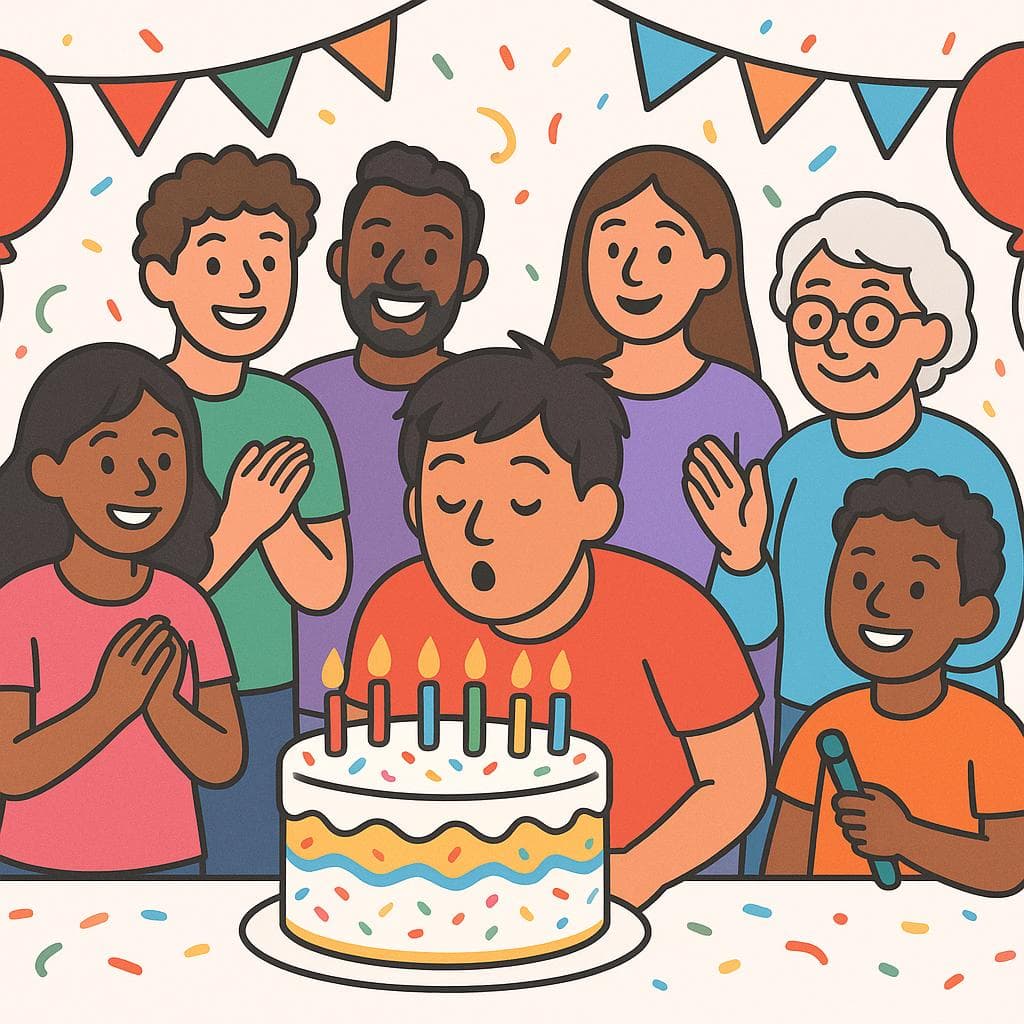
Saying '¡Feliz cumpleaños!' is the perfect way to share in the joy of someone's special day, no matter where you are in the Spanish-speaking world.
Happy Birthday — in Spanish
feh-LEES KOOM-pleh
A very common, casual abbreviation of 'Feliz cumpleaños', similar to saying 'Happy B-day' in English.
keh KOOM-plahs MOO-chohs mahs
Means 'May you have many more!' It's a warm, traditional wish said right after 'Feliz cumpleaños' to wish someone a long life.
feh-lee-see-DAH-dehs
Literally 'Congratulations!' It's a common, slightly less specific way to wish someone well on their birthday, anniversary, or other special occasion.
keh PAH-sehs oon feh-LEES DEE-ah
Means 'Have a happy day!' It's a nice sentiment to add after the main birthday wish, focusing on their special day.
feh-LEES VWEHL-tah ahl sohl
Literally 'Happy turn around the sun.' A poetic, modern, and slightly bohemian way to wish someone a happy birthday.
feh-LEES SAHN-toh
Means 'Happy Saint's Day!' In many Catholic traditions, people celebrate the feast day of the saint they are named after. This is different from their actual birthday.
Here’s a quick guide to choosing the right birthday wish in Spanish based on the situation.
| Phrase | Formality | Best For | Avoid When |
|---|---|---|---|
| Feliz cumpleaños | Neutral | The universal, can't-go-wrong option for anyone, from your boss to your best friend. | Never. This is always a correct and safe choice. |
| ¡Feliz cumple! | Casual | Texting, social media, and talking to friends, family, or peers. | In a very formal letter or when addressing someone with high status you don't know well. |
| ¡Felicidades! | Neutral | A quick, warm greeting on social media or when the context makes it clear you mean birthday. | If there's any ambiguity; 'Feliz cumpleaños' is more specific. |
| ¡Que cumplas muchos más! | Informal | Adding a warm, traditional blessing right after saying 'Feliz cumpleaños'. | Using it as a standalone greeting; it's almost always a follow-up phrase. |
Fairly easy. The 'ñ' in 'cumpleaños' (AHN-yohs) is the only sound not found in English, similar to the 'ny' in 'canyon'.
It's a fixed phrase with no complex grammar. You just need to memorize it as a single unit.
While the phrase itself is simple, knowing about related traditions like 'Las Mañanitas', 'la mordida', and the 'santo' adds important cultural context.
¡Feliz cumpleaños, abuela! Te queremos mucho.
Happy birthday, Grandma! We love you very much.
Hola, Carlos. ¡Feliz cumple! ¿Vas a hacer algo para celebrar?
Hey, Carlos. Happy b-day! Are you going to do anything to celebrate?
Le deseamos un muy feliz cumpleaños de parte de todo el equipo.
We wish you a very happy birthday on behalf of the whole team.
¡Felicidades en tu día! ¡Que cumplas muchos más y que todos tus deseos se hagan realidad!
Congratulations on your day! May you have many more and may all your wishes come true!
While many countries sing 'Cumpleaños Feliz' to the tune of the English 'Happy Birthday,' Mexico and other parts of Latin America have a beautiful, traditional song called 'Las Mañanitas.' It's often sung first thing in the morning to wake up the birthday person.
In Mexico and some other Latin American countries, look out for 'la mordida' (the bite)! After blowing out the candles, it's a playful tradition for friends and family to gently push the birthday person's face into the cake for their first bite.
In Spain and other historically Catholic countries, a person's 'santo' (saint's day) can be as important as their birthday. It's the feast day of the saint they're named after. So, someone named 'Juan' would celebrate on June 24th, the Feast of St. John.
A girl's 15th birthday, or 'quinceañera,' is a massive cultural event in Mexico and much of Latin America. It's a rite of passage celebrating the transition from childhood to womanhood, often involving a religious ceremony and a huge party comparable to a wedding reception.
Mistake: “Saying 'Feliz cumpleaño' with a singular 'o' at the end.”
Correction: Always say 'Feliz cumpleaños' with an 's'.
Mistake: “Wishing someone 'Feliz aniversario' for their birthday.”
Correction: Use 'Feliz cumpleaños' for a birthday and 'Feliz aniversario' for a wedding anniversary.
Mistake: “Thinking 'Felicidades' is the main way to say Happy Birthday.”
Correction: 'Feliz cumpleaños' is the direct translation and primary phrase.
To sound more natural and heartfelt, combine phrases. A classic combination is: '¡Feliz cumpleaños! ¡Que cumplas muchos más!' (Happy birthday! May you have many more!).
Don't be afraid to use the shortened '¡Feliz cumple!'. It's extremely common in everyday speech, on social media, and in text messages with friends and colleagues.
A great way to continue the conversation after your birthday wish is to ask about their celebration plans. Try '¿Cómo vas a celebrar?' (How are you going to celebrate?) or '¿Tienes algún plan especial?' (Do you have any special plans?).
If you're at a party, don't be shy! Learning the lyrics to 'Cumpleaños Feliz' or 'Las Mañanitas' is a fantastic way to participate and show you care. The tunes are catchy and the lyrics are simple.
The birthday song 'Las Mañanitas' is iconic and central to celebrations. The tradition of 'la mordida' (pushing the person's face into the cake) is also very popular and expected at parties.
The concept of 'el santo' (saint's day) is much more prevalent here. People often get gifts or congratulations on both their birthday and their name day. The birthday song is typically 'Cumpleaños Feliz', sung to the familiar English tune.
A common variation of the birthday song is 'Que los cumplas feliz'. Celebrations are very social and often involve a large 'asado' (barbecue) with friends and family that can last for hours.
Feliz cumpleaños
WhatsApp, Instagram comments, Facebook posts, text messages.
Feliz cumple amiga! Pásala increíble 🎉
Happy bday friend! Have an incredible time 🎉
Happy Birthday (from English)
Used frequently by younger, bilingual speakers across Latin America and Spain.
HBD a la mejor hermana del mundo!
HBD to the best sister in the world!
¡Gracias!
Thank you!
De nada, ¡que disfrutes tu día!
You're welcome, enjoy your day!
¡Muchas gracias! ¡Qué amable!
Thank you very much! How kind!
¡Claro que sí! Te mando un abrazo.
Of course! Sending you a hug.
Voy a cenar con mi familia.
I'm going to have dinner with my family.
¡Qué bueno! ¡Que se diviertan!
That's great! Have fun!
by Various Artists (notably Pedro Infante, Vicente Fernández)
This is the opening of the song, sung to the birthday person (referred to as celebrating their 'santo' or saint's day, a traditional term for birthday).
Why it matters: This song is culturally equivalent to 'Happy Birthday' in Mexico and is essential for anyone wanting to understand Mexican birthday celebrations.
📺 Widely available on YouTube and Spotify
by Disney Pixar
The phrase is used during family gatherings and flashbacks, reinforcing the theme of celebrating life and remembering loved ones.
Why it matters: The film beautifully illustrates the importance of family celebrations, including birthdays and Día de los Muertos, in Mexican culture, providing visual context for the phrases.
📺 Available on Disney+
This is the most common response you'll get after wishing someone a happy birthday.
It's a natural follow-up question in a birthday context (though be mindful of cultural norms about asking age).
You'll need this word ('regalo') when talking about birthday presents.
To talk about the celebration itself, you'll need the word 'fiesta'.
Question 1 of 4
You're texting your friend from Mexico on her birthday. What is the most natural and casual way to write your wish?
Knowing a phrase is one thing — using it at the right moment is another. Read 200+ illustrated and narrated Spanish stories to see phrases in the contexts where they actually belong.
'Feliz cumpleaños' literally means 'Happy Birthday' and is the most direct and common phrase. 'Felicidades' means 'Congratulations' and is used as a general expression of happiness for someone on their special day. While you can use 'Felicidades' for a birthday, 'Feliz cumpleaños' is more specific.
The most common version is 'Cumpleaños Feliz', sung to the same tune as the English song. The lyrics are simple: 'Cumpleaños feliz, te deseamos a ti, cumpleaños feliz [nombre], cumpleaños feliz.' In Mexico, the traditional song is 'Las Mañanitas', which has a different melody and lyrics.
Absolutely! 'Feliz cumple' is a very common and natural-sounding abbreviation, just like saying 'Happy B-day' in English. It's perfect for informal situations, like talking to friends, family, or colleagues, and is used all the time in texts and social media.
A great message would be: '¡Feliz cumpleaños! Te deseo todo lo mejor en tu día. ¡Que cumplas muchos más!' This translates to: 'Happy birthday! I wish you all the best on your day. May you have many more!'
It depends on the person and your relationship, much like in English. With close friends and family, asking '¿Cuántos cumples?' (How old are you turning?) is usually fine. However, it's generally considered impolite to ask an older person or someone you don't know well, especially a woman.
A 'quinceañera' is a huge celebration for a girl's 15th birthday in Mexico and many other parts of Latin America. It marks her transition from childhood to womanhood and is often a very elaborate event with a church service, a fancy dress, and a large party, similar in scale to a wedding.
Strengthen the grammar behind this phrase:
Dive deeper into related topics:
Find similar phrases to expand your Spanish vocabulary:
Browse our complete collection of Spanish phrases organized by situation, from basic greetings to advanced conversations. Perfect for travelers, students, and anyone learning Spanish.
View All Spanish Phrases →