Direct Translation Error
Mistake: “Saying 'Feliz Easter'.”
Correction: ¡Feliz Pascua! or ¡Felices Pascuas!
feh-LEE-sehs PAHS-kwahs
This is the most common and universally understood way to wish someone a Happy Easter. It literally means 'Happy Easters' and often refers to the entire Easter season or Holy Week.
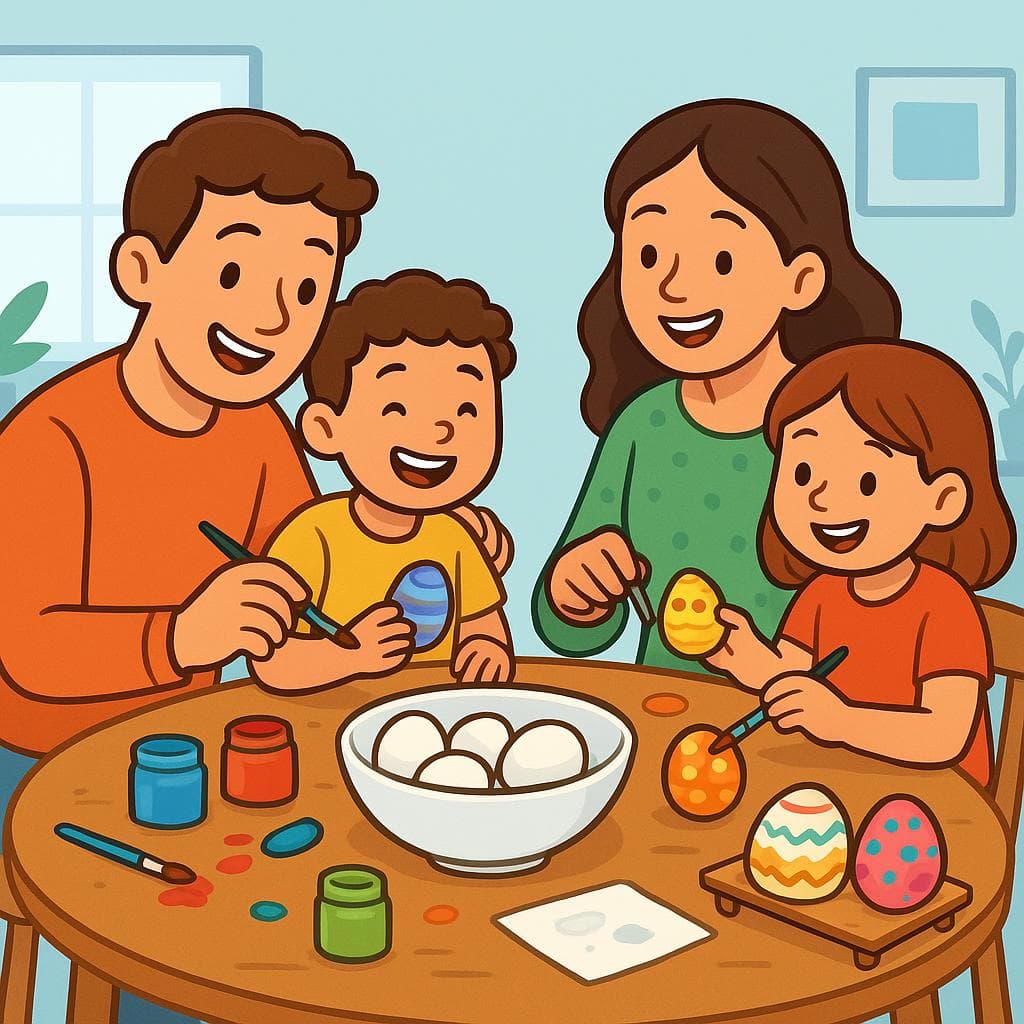
Wishing someone '¡Felices Pascuas!' is a warm way to share in the joy of the Easter season, which often includes family activities like this.
Happy Easter — in Spanish
feh-LEES PAHS-kwah
This is the singular version of the main greeting and is just as common and correct. Think of it as the direct equivalent of 'Happy Easter'.
feh-LEES DEE-ah deh PAHS-kwah
A slightly more specific phrase meaning 'Happy Easter Day'. It puts the focus squarely on Easter Sunday itself.
feh-LEE-sehs PAHS-kwahs deh reh-soo-rrek-SYOHN
A more formal and explicitly religious greeting, meaning 'Happy Easters of Resurrection.' It highlights the Christian meaning of the holiday.
Here’s a quick guide to choosing the best Easter greeting for your situation.
| Phrase | Formality | Best For | Avoid When |
|---|---|---|---|
| ¡Felices Pascuas! | Neutral | Almost any situation; it's the universal, all-purpose greeting. | Never. It's always a safe and friendly choice. |
| ¡Feliz Día de Pascua! | Neutral | Wishing someone well specifically on Easter Sunday. | It might sound a little too specific if used several days before Easter. |
| ¡Felices Pascuas de Resurrección! | Formal / Religious | Church settings or speaking with someone who is devoutly religious. | Casual conversations with people whose beliefs you don't know. |
Fairly easy for English speakers. The main challenge is the 'cua' sound in 'Pascua', which should be a single, quick syllable (like 'qua').
This is a set phrase, so there's no complex grammar to worry about. You just need to memorize it.
Understanding the context of 'Semana Santa' (Holy Week) and its importance adds depth. Knowing that 'Pascua' can mean Christmas in some regions is also a key nuance.
¡Hola, vecina! ¡Felices Pascuas para usted y su familia!
Hello, neighbor! Happy Easter to you and your family!
Te mando un abrazo grande y te deseo un muy Feliz Día de Pascua.
Sending you a big hug and wishing you a very Happy Easter Day.
Que estas Pascuas de Resurrección llenen tu hogar de paz y alegría.
May this Easter of Resurrection fill your home with peace and joy.
¿Qué planes tienen para Pascuas? Nosotros vamos a hacer una comida familiar.
What plans do you have for Easter? We're going to have a family meal.
In most of the Spanish-speaking world, Easter is the culmination of a week-long observance called 'Semana Santa' (Holy Week). This period is marked by elaborate public processions, religious services, and family gatherings. So, when you say '¡Felices Pascuas!', you're often wishing them well for this entire significant period, not just one Sunday.
You'll often hear 'Felices Pascuas' (plural) instead of 'Feliz Pascua' (singular). There's no major difference in meaning, and both are correct. The plural form is very common because 'Pascuas' can historically refer to several different Christian feasts, so it became a way to encompass the entire season of celebration.
While the religious aspect of Easter is very prominent, secular traditions like Easter egg hunts ('búsqueda de huevos de Pascua') and the Easter bunny ('el conejo de Pascua') are becoming more popular, especially for children. This is largely due to cultural influence from the United States.
Here's a tricky one! In some countries, particularly in the Southern Cone like Argentina and Uruguay, 'Pascua' or 'Pascuas' can also be used to refer to Christmas. Context is everything! If it's December, they mean Christmas; if it's spring, they mean Easter.
Mistake: “Saying 'Feliz Easter'.”
Correction: ¡Feliz Pascua! or ¡Felices Pascuas!
Mistake: “Getting stressed about whether to say 'Feliz Pascua' or 'Felices Pascuas'.”
Correction: Use either one! They are interchangeable.
Mistake: “Pronouncing it as 'Pas-coo-ah' with two distinct syllables.”
Correction: Pronounce it as 'PAHS-kwah'.
It's completely normal to start wishing people '¡Felices Pascuas!' in the days leading up to Easter Sunday, especially from Holy Thursday ('Jueves Santo') onwards. It covers the whole holiday weekend.
If someone wishes you a Happy Easter, a simple and warm response is 'Gracias, igualmente' (Thanks, likewise/same to you) or 'Felices Pascuas para ti también' (Happy Easter to you too).
Stick with the standard '¡Felices Pascuas!' or '¡Feliz Pascua!' for general use. Save the more religious '¡Felices Pascuas de Resurrección!' for situations where you know the person is religious or in a church setting.
Easter is defined by 'Semana Santa' processions, which are famous worldwide, especially in Andalusia (like Seville and Málaga). These are very solemn, elaborate parades with religious floats. The holiday is a major public event.
Semana Santa is one of the most important holiday periods in Mexico. Many people get a one or two-week vacation, and beach destinations become extremely popular. Passion plays and local processions are also common.
Crucially, 'Pascua' can also refer to Christmas here. Context is key! For Easter, families often share a 'Rosca de Pascua', a sweet, ring-shaped bread. The week is also a major holiday period.
¡Felices Pascuas!
Happy Easter!
Gracias, igualmente. ¿Tienes algún plan especial?
Thanks, you too. Do you have any special plans?
¡Gracias! Para ti también.
Thanks! For you too.
Vamos a visitar a la familia, ¿y ustedes?
We're going to visit family, and you all?
The biggest difference is the scale. In English-speaking cultures, Easter is typically a long weekend. In the Spanish-speaking world, it's often the culmination of 'Semana Santa' (Holy Week), a major holiday period with public processions and school/work breaks that can last a week or more. The public, religious dimension is often much more visible than in many English-speaking countries.
This is another essential holiday greeting that uses the word 'Feliz'.
Learning the greeting for the other major Christian holiday is a logical next step.
Expands your vocabulary for celebrating happy occasions beyond holidays.
A great way to make conversation after exchanging holiday greetings.
Question 1 of 3
You're speaking with a coworker in Spain on the Thursday before Easter. What is the most appropriate greeting?
Knowing a phrase is one thing — using it at the right moment is another. Read 200+ illustrated and narrated Spanish stories to see phrases in the contexts where they actually belong.
Honestly, for a learner, there is no practical difference. Both are used interchangeably by native speakers to mean 'Happy Easter'. The plural form 'Pascuas' is very common and might feel slightly more traditional or encompass the whole season, but you can't go wrong with either.
Yes, absolutely. Much like 'Merry Christmas' in English, 'Felices Pascuas' has become a standard cultural greeting for the season, regardless of an individual's personal beliefs. It's a friendly, secular-friendly way to acknowledge the holiday.
Easter, as part of 'Semana Santa' (Holy Week), is one of the most significant cultural and religious events of the year, deeply rooted in the Catholic traditions of countries like Spain and many in Latin America. It's a time for major public events, family reunions, and is often a longer public holiday than Christmas.
Yes, and it's a great point to remember. In some South American countries, especially Argentina, 'Pascua' is also a common way to refer to Christmas. However, the context of the time of year will always make the meaning clear. If you hear it in March or April, it's definitely Easter.
While not a native tradition, Easter egg hunts ('búsqueda de huevos de Pascua') and other secular traditions like the Easter Bunny are becoming more common, especially in cities and among families with young children. However, the more traditional focus is on family meals and religious observances.
Strengthen the grammar behind this phrase:
Dive deeper into related topics:
Find similar phrases to expand your Spanish vocabulary:
Browse our complete collection of Spanish phrases organized by situation, from basic greetings to advanced conversations. Perfect for travelers, students, and anyone learning Spanish.
View All Spanish Phrases →