Pronouncing 'Navidad' Incorrectly
Mistake: “Saying 'NA-vi-dad', stressing the first syllable like in many English words.”
Correction: Saying 'nah-vee-DAHD', with the emphasis clearly on the final syllable.
feh-LEES nah-vee-DAHD
This is the direct and most common way to say "Merry Christmas" throughout the entire Spanish-speaking world. It's universally understood and appropriate in any situation.
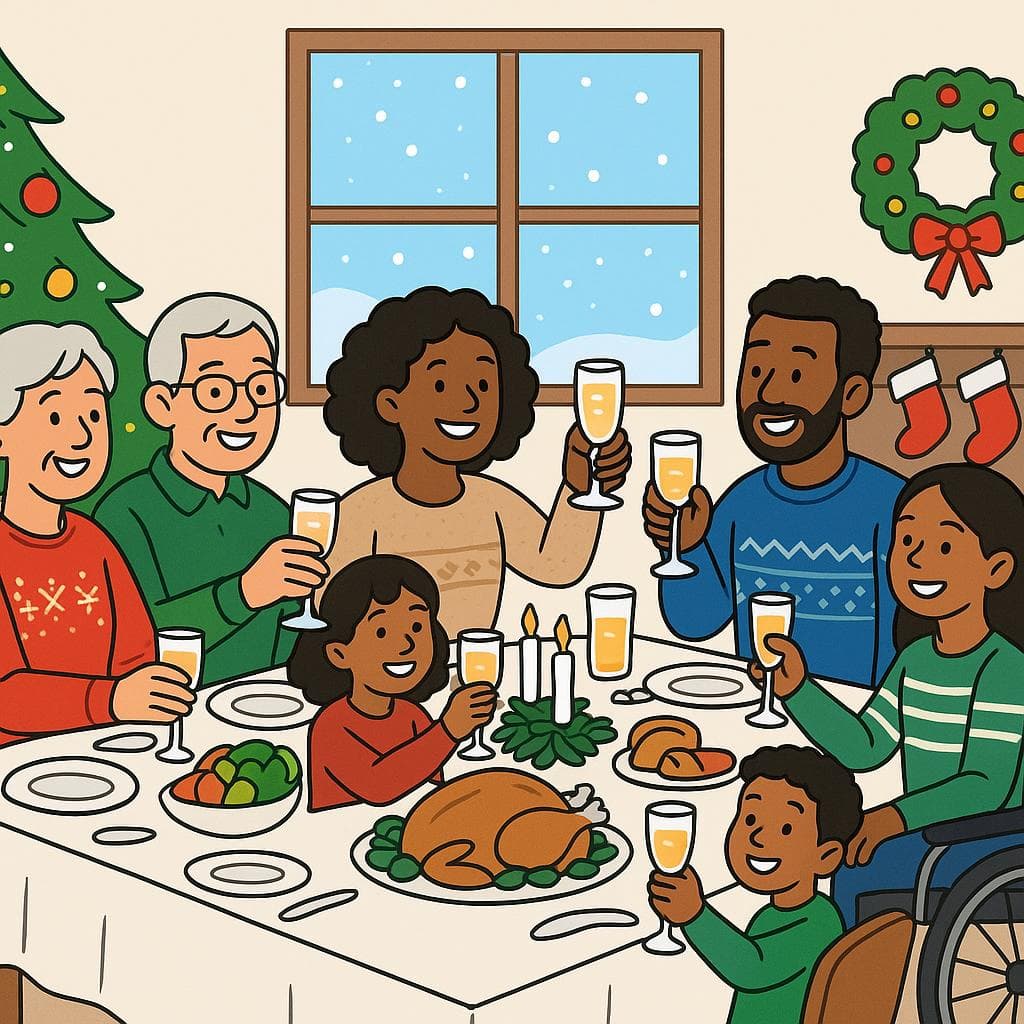
Wishing someone '¡Feliz Navidad!' is all about sharing joy and warmth with loved ones, a scene common across the Spanish-speaking world on Christmas Eve, or 'Nochebuena'.
Merry Christmas — in Spanish
feh-LEE-sehs FYEHS-tahs
Meaning "Happy Holidays," this is a wonderfully inclusive greeting that covers the entire festive season, from Christmas through New Year's and Three Kings' Day.
feh-LEES nah-vee-DAHD ee PROHS-peh-roh AH-nyoh NWEH-voh
This is the classic, full holiday greeting wishing both a "Merry Christmas and a Prosperous New Year." It's very common, especially in writing.
keh PAH-sehs OO-nah feh-LEES nah-vee-DAHD
A more personal and conversational way to wish someone a Merry Christmas, translating to "(I hope) you have a merry Christmas." The use of `pases` makes it informal.
feh-LEES noh-cheh-BWEH-nah
This specifically means "Happy Christmas Eve." It's widely used because in many Spanish-speaking cultures, `Nochebuena` (December 24th) is the main day of celebration.
keh PAH-seh OO-nah feh-LEES nah-vee-DAHD
This is the formal version of the personal greeting, using `pase` (for `usted`). It also means "(I hope) you have a merry Christmas," but with a respectful tone.
feh-lee-see-DAH-dehs
Meaning "Congratulations," this word is also used more broadly during the holiday season to mean "Best wishes" or "Happy Holidays." It's especially common in the Caribbean.
feh-LEE-sehs PAHS-kwahs
This is a tricky one! While it means "Happy Easter" in most of the Spanish-speaking world, in Argentina, Uruguay, and Paraguay it's also a common way to say "Merry Christmas."
Here’s a quick guide to help you choose the best Spanish holiday greeting for any situation.
| Phrase | Formality | Best For | Avoid When |
|---|---|---|---|
| ¡Feliz Navidad! | Neutral | Almost any situation; it's the universal standard for wishing a Merry Christmas. | It's never wrong, but 'Felices Fiestas' can be more inclusive if you're unsure of beliefs. |
| ¡Felices Fiestas! | Neutral | Wishing 'Happy Holidays' in a professional setting or to cover the entire season. | You specifically want to mention Christmas, for example, during a family dinner on Christmas Eve. |
| ¡Feliz Navidad y Próspero Año Nuevo! | Neutral | Holiday cards, emails, and as a final farewell before the long holiday break. | You just need a quick, simple greeting; this one is a bit longer. |
| ¡Que pases una feliz Navidad! | Informal | Adding a personal, warm touch when speaking with friends, family, and peers. | Speaking to a superior, an older person, or anyone you'd address formally. |
Fairly easy. The main challenge is pronouncing the final 'd' in `Navidad` softly, almost like a 'th' sound in English 'the', rather than a hard 'd'.
This is a fixed phrase, so there's no complex grammar to worry about for the main translation. Variations like 'Que pases...' require knowing formal vs. informal, but the basics are simple.
Usage is straightforward, but knowing the importance of Nochebuena, the length of the season, and regionalisms like 'Pascuas' in Argentina will make you sound more knowledgeable.
¡Feliz Navidad a todos! Espero que la pasen muy bien con sus familias.
Merry Christmas to everyone! I hope you have a great time with your families.
De parte de la empresa, le deseamos una Feliz Navidad y un Próspero Año Nuevo.
On behalf of the company, we wish you a Merry Christmas and a Prosperous New Year.
¡Feliz Nochebuena, abuela! ¡Qué rico huele la comida!
Happy Christmas Eve, Grandma! The food smells delicious!
Bueno, me voy. ¡Que pases unas Felices Fiestas!
Alright, I'm leaving. Have a Happy Holidays!
In most of Latin America and Spain, the biggest Christmas celebration happens on the night of December 24th, known as `Nochebuena` (the Good Night). Families gather for a large, late dinner, and often exchange gifts at midnight rather than on Christmas morning.
The Christmas season, often called `las navidades`, is long. It can start in early December and officially ends on January 6th with `el Día de Reyes` (Three Kings' Day), which is when many children traditionally receive the bulk of their presents.
A holiday greeting in Spanish-speaking cultures is rarely just verbal. Expect it to be accompanied by a warm handshake, a hug, or a kiss on the cheek (or two kisses, one on each cheek, if you're in Spain). It's a very warm and physically affectionate time of year.
Don't forget that for countries in the Southern Hemisphere like Argentina, Chile, and Uruguay, Christmas falls in the middle of summer. Holiday celebrations might include a barbecue (`asado`) and outdoor festivities instead of snow and fireplaces.
Mistake: “Saying 'NA-vi-dad', stressing the first syllable like in many English words.”
Correction: Saying 'nah-vee-DAHD', with the emphasis clearly on the final syllable.
Mistake: “Wishing someone '¡Felices Pascuas!' in Mexico or Spain in December.”
Correction: Stick to '¡Feliz Navidad!' or '¡Felices Fiestas!'
Mistake: “Saying '¡Feliz Fiestas!'”
Correction: Saying '¡Felices Fiestas!'
If you're ever unsure what to say, `¡Felices Fiestas!` is your best friend. It's polite, inclusive, covers the entire season, and is appropriate in both formal and informal settings. You can't go wrong with it.
When saying goodbye to someone you won't see until after the new year, it's very common to combine the Christmas and New Year wishes. `¡Feliz Navidad y Próspero Año Nuevo!` is the perfect phrase for this.
When you wish someone '¡Feliz Navidad!', a very common response is `Igualmente`, which means 'Likewise' or 'Same to you.' It's a quick and friendly way to return the good wishes.
The main gift-giving day is often January 6th, `Día de Reyes` (Three Kings' Day), not December 25th. `Nochebuena` (Dec 24th) is the primary family meal. The national Christmas lottery, 'El Gordo,' is a massive cultural event on Dec 22nd.
The season includes `Las Posadas`, nine days of processions and parties re-enacting Mary and Joseph's search for an inn. `Nochebuena` features foods like `tamales`, `pavo` (turkey), and `ponche`. Piñatas are a common feature at Christmas parties.
Using `¡Felices Pascuas!` for Christmas is the most distinct feature of this region. Since it's summer, celebrations are often outdoors and can include an `asado` (barbecue). Fireworks are common at midnight on Nochebuena.
The season is incredibly festive and musical. In Puerto Rico, `parrandas` (or `asaltos navideños`) are a tradition where friends surprise each other late at night with music and song, like a mobile party. The holiday season is the longest, sometimes lasting until the Fiestas de la Calle San Sebastián in late January.
Gracias, igualmente.
Thanks, you too. / Likewise.
¡Que disfrutes!
Enjoy!
¡Nos vemos el año que viene! ¡Felices Fiestas!
See you next year! Happy Holidays!
¡Igualmente! ¡Feliz Navidad y próspero Año Nuevo para ti y tu familia!
You too! Merry Christmas and a prosperous New Year to you and your family!
¡Feliz Nochebuena!
Happy Christmas Eve!
¡Feliz Nochebuena! ¿En qué puedo ayudar?
Happy Christmas Eve! How can I help?
by José Feliciano
The chorus of the song repeats the classic holiday greeting, wishing listeners a Merry Christmas, a prosperous year, and happiness.
Why it matters: This song has made '¡Feliz Navidad!' one of the most recognized Spanish phrases globally, even among non-Spanish speakers. It's a perfect example of the full, warm holiday wish.
📺 Widely available on all music streaming platforms.
This is the next holiday greeting you'll need right after Christmas.
You'll need this to thank people for gifts and good wishes during the holidays.
This is the natural response after someone thanks you for a gift or a kind gesture.
The holidays are a time for expressing affection to family and loved ones.
Question 1 of 3
You are in Buenos Aires, Argentina, in mid-December and someone wishes you '¡Felices Pascuas!'. What is the most likely meaning?
Knowing a phrase is one thing — using it at the right moment is another. Read 200+ illustrated and narrated Spanish stories to see phrases in the contexts where they actually belong.
'¡Feliz Navidad!' specifically means 'Merry Christmas.' '¡Felices Fiestas!' means 'Happy Holidays' and is more general. Use 'Feliz Navidad' if you specifically want to mention Christmas, and 'Felices Fiestas' as a broader, more inclusive greeting for the entire season.
Officially, the Christmas season often extends to January 6th, which is `Día de los Reyes Magos` (Three Kings' Day). This day commemorates the visit of the Magi to the baby Jesus and is traditionally when many children receive their main holiday gifts.
Yes, absolutely! '¡Felicidades!' (which literally means 'Congratulations') is often used as a general term for 'Happy Holidays' or 'Best Wishes' during the Christmas season. It's especially common in Caribbean countries like Puerto Rico and is a very warm and friendly greeting.
The easiest and most common response is 'Gracias, igualmente,' which means 'Thanks, likewise' or 'Thanks, same to you.' You can also simply return the greeting by saying '¡Feliz Navidad!' back to them.
Of course! While the tradition in some countries is to give gifts on January 6th (`Día de Reyes`), the influence of global culture (like Santa Claus, or `Papá Noel`) means that giving gifts on Christmas Eve or Christmas Day is also very common. Both are widely practiced and understood.
It's because the noun `Fiestas` (Holidays) is plural. In Spanish, adjectives must match the noun they describe in both gender and number. Since `Fiestas` is plural, the adjective `Feliz` must also become plural, which is `Felices`.
Strengthen the grammar behind this phrase:
Dive deeper into related topics:
Find similar phrases to expand your Spanish vocabulary:
Browse our complete collection of Spanish phrases organized by situation, from basic greetings to advanced conversations. Perfect for travelers, students, and anyone learning Spanish.
View All Spanish Phrases →