






Forgetting the Masculine Default Rule
Mistake: “Saying 'Tengo un hermano y una hermana, entonces tengo dos hermanas.'”
Correction: Tengo un hermano y una hermana, entonces tengo dos hermanos.
TEN-goh dohs ehr-MAH-nohs
This is the most direct and common way to say 'I have two siblings' in Spanish. It's universally understood and works in any situation, from casual chats to more formal introductions.
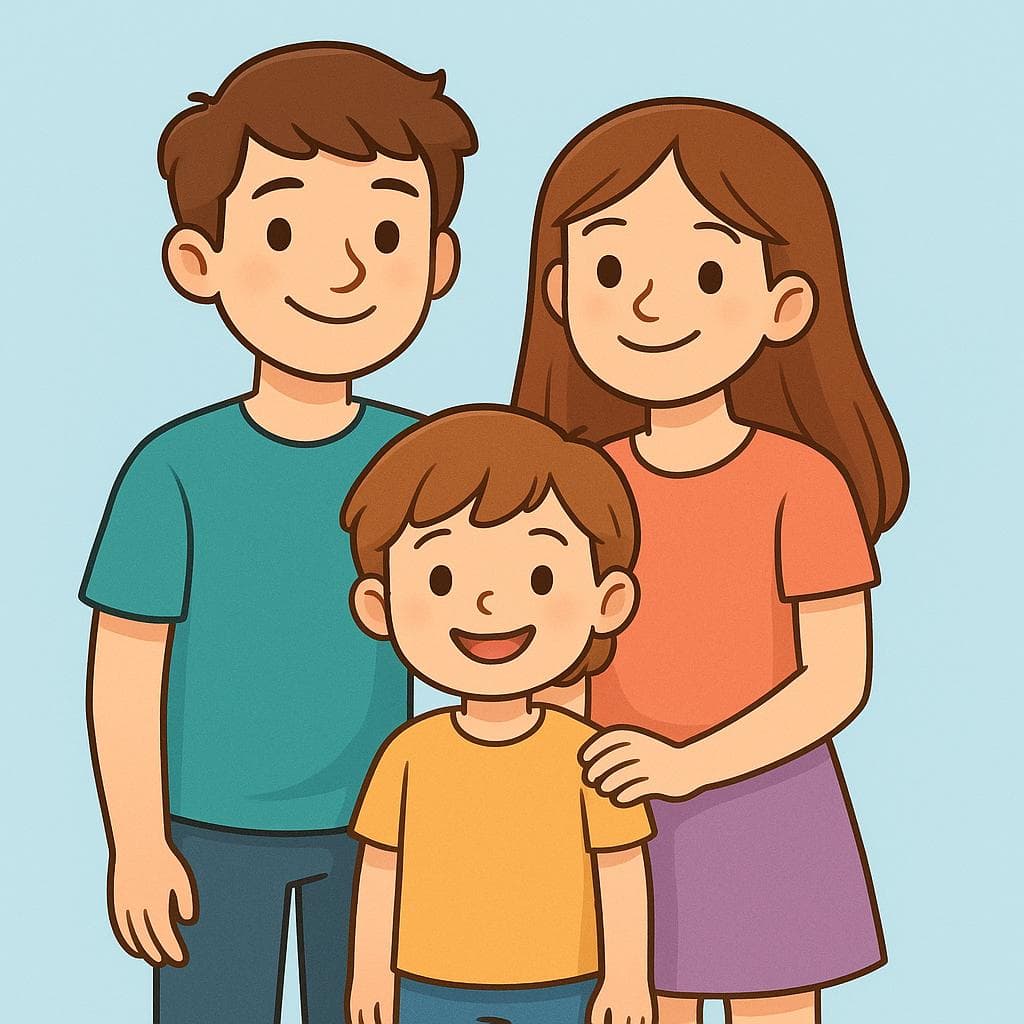
Whether you have brothers, sisters, or both, 'Tengo dos hermanos' is how you'd say 'I have two siblings' in Spanish.
I have two siblings — in Spanish
SOH-mohs trehs ehr-MAH-nohs
This literally means 'We are three siblings.' It's a very common and natural way to express the same idea, focusing on the total number of siblings including yourself.
TEN-goh oon ehr-MAH-noh ee OO-nah ehr-MAH-nah
This translates to 'I have one brother and one sister.' Use this when you want to be specific about the gender of your two siblings.
TEN-goh dohs ehr-MAH-nahs
This means 'I have two sisters.' You use the feminine form 'hermanas' when all of your siblings are female.
en mee fah-MEE-lee-ah, SOH-mohs trehs ehr-MAH-nohs
Meaning 'In my family, we are three siblings.' This version adds a little more context and is a slightly more elaborate way to share the information.
ah-PAR-teh deh MEE, TEN-goh dohs ehr-MAH-nohs
This translates to 'Besides me, I have two siblings.' It's a very clear way to state the number, removing any ambiguity about whether you're including yourself.
Here’s a quick comparison of the most common ways to talk about your two siblings.
| Phrase | Literal Meaning | Best For | When to Avoid |
|---|---|---|---|
| Tengo dos hermanos. | I have two siblings/brothers. | A direct, universal answer for any situation. The safest and most standard option. | It can be slightly ambiguous if you want to specify genders immediately. |
| Somos tres hermanos. | We are three siblings. | Sounding natural and conversational, especially when responding to a question. | If the listener might be confused about whether you're including yourself in the count. |
| Tengo un hermano y una hermana. | I have a brother and a sister. | Being specific and clear to avoid follow-up questions about gender. | When you just need to give a quick number and details aren't important. |
Fairly easy. The 'h' in 'hermanos' is silent, and the rolling 'r' can be tricky for some, but it's generally straightforward.
The grammar is very simple: Verb (Tengo) + Number (dos) + Noun (hermanos). 'Tener' is a fundamental verb to learn early on.
The main cultural point is understanding that 'hermanos' is the default for a mixed-gender group of siblings, which is a key difference from English.
—¿Tienes una familia grande? —No, es pequeña. Solo tengo dos hermanos.
—Do you have a big family? —No, it's small. I only have two siblings.
Me encanta pasar tiempo con mi familia. Como somos tres hermanos, siempre hay alguien con quien hablar.
I love spending time with my family. Since we are three siblings, there's always someone to talk to.
En la foto estamos mis padres, mi hermana mayor, mi hermano menor y yo. En total, tengo dos hermanos.
In the photo it's my parents, my older sister, my younger brother, and me. In total, I have two siblings.
Para la solicitud, necesito listar a mis familiares directos. Tengo dos hermanos, ambos viven en México.
For the application, I need to list my immediate family members. I have two siblings, both live in Mexico.
This is a big one for English speakers! Spanish uses the masculine plural 'hermanos' as the default term for 'siblings.' It can mean 'brothers,' OR 'brothers and sisters.' If a group has 99 sisters and 1 brother, you still refer to them as 'hermanos.' You only use 'hermanas' (sisters) if everyone in the group is female.
In many Spanish-speaking cultures, family is a central part of life and identity. Asking about someone's family, including their siblings, is a very common and friendly way to make small talk and show you're interested in getting to know them. It's generally not considered too personal for initial conversations.
Mistake: “Saying 'Tengo un hermano y una hermana, entonces tengo dos hermanas.'”
Correction: Tengo un hermano y una hermana, entonces tengo dos hermanos.
Mistake: “Yo tengo dos hermanos.”
Correction: Tengo dos hermanos.
Mistake: “Trying to say 'sibilinos' or another literal translation.”
Correction: Use 'hermanos'.
When someone asks '¿Cuántos hermanos tienes?' (How many siblings do you have?), responding with 'Somos tres en total' (There are three of us in total) is a very common and fluid way to answer. It includes you in the count and flows nicely in conversation.
After you say you have siblings, the next questions are almost always: '¿Son mayores o menores que tú?' (Are they older or younger than you?) and '¿Cómo se llaman?' (What are their names?). Have those answers ready to keep the conversation going!
While 'Tengo dos hermanos' is correct for a brother and a sister, it can be ambiguous. It's often clearer and more helpful to just say 'Tengo un hermano y una hermana' from the start. This gives more information and avoids confusion.
This phrase is remarkably standard across the entire Spanish-speaking world. The vocabulary and structure are identical everywhere, making it a very safe and useful phrase to learn. The main variation you'll encounter is purely in the accent and pronunciation.
¿Son mayores o menores que tú?
Are they older or younger than you?
Tengo una hermana mayor y un hermano menor.
I have an older sister and a younger brother.
¿Y a qué se dedican?
And what do they do (for a living)?
Mi hermano es ingeniero y mi hermana todavía estudia.
My brother is an engineer and my sister is still studying.
¿Tienes hermanos?
Do you have siblings?
Sí, tengo dos. ¿Y tú?
Yes, I have two. And you?
The biggest difference is the lack of a direct equivalent for the word 'siblings.' English has one neutral word, while Spanish defaults to the masculine plural 'hermanos' to refer to a group of brothers or a group of brothers and sisters. This concept of a masculine plural being the 'default' for mixed groups extends to many other nouns in Spanish (e.g., 'padres' for parents, 'hijos' for children) and is a fundamental concept for English speakers to grasp.
This is the question that prompts your answer, so you should learn how to ask it too.
This is the logical next step: describing your siblings' ages relative to yours.
It's important to know how to say the opposite, in case you don't have siblings.
This is another very common follow-up question in conversations about family.
Question 1 of 3
If you have one brother and one sister, which sentence is the most accurate and common way to describe your siblings as a group?
Knowing a phrase is one thing — using it at the right moment is another. Read 200+ illustrated and narrated Spanish stories to see phrases in the contexts where they actually belong.
They convey the same information but from a different perspective. 'Tengo dos hermanos' means 'I have two siblings,' focusing on the number of siblings you possess. 'Somos tres hermanos' means 'We are three siblings,' focusing on the total group size, including yourself. Both are correct, but 'Somos...' often sounds a bit more natural in conversation.
You can add the word 'solo' or 'solamente' for emphasis. You would say 'Solo tengo dos hermanos' or 'Tengo solamente dos hermanos.' Both mean 'I only have two siblings'.
Yes, absolutely! If someone asks '¿Tienes hermanos?', they are asking 'Do you have siblings?'. The word 'hermanos' on its own in a plural context is the standard way to refer to siblings in general.
The structure is the same, you just change the number! You would say 'Tengo cuatro hermanos.' If you wanted to specify, you could say something like 'Tengo dos hermanos y dos hermanas' (I have two brothers and two sisters).
Because Spanish doesn't have a single, common noun for 'sibling' like English does. The concept is built into the word 'hermano(s)'. This is a key structural difference between the two languages that you just have to learn and accept.
Yes, it does! For example, 'padres' means 'parents' (not just 'fathers'), 'hijos' means 'children' (not just 'sons'), and 'tíos' means 'aunt(s) and uncle(s)' (not just 'uncles'). It's a very common pattern in Spanish.
Strengthen the grammar behind this phrase:
Dive deeper into related topics:
Find similar phrases to expand your Spanish vocabulary:
Browse our complete collection of Spanish phrases organized by situation, from basic greetings to advanced conversations. Perfect for travelers, students, and anyone learning Spanish.
View All Spanish Phrases →