



Confusing 'Propina' with 'Cubierto'
Mistake: “Thinking the 'cubierto' charge on an Argentine bill is the tip.”
Correction: Treat 'cubierto' as a cover charge and tip 10% extra.
lah pro-PEE-nah ehs-TAH een-kloo-EE-dah
This is the most direct and standard way to ask if the gratuity has already been added to your bill. It works in any Spanish-speaking country.
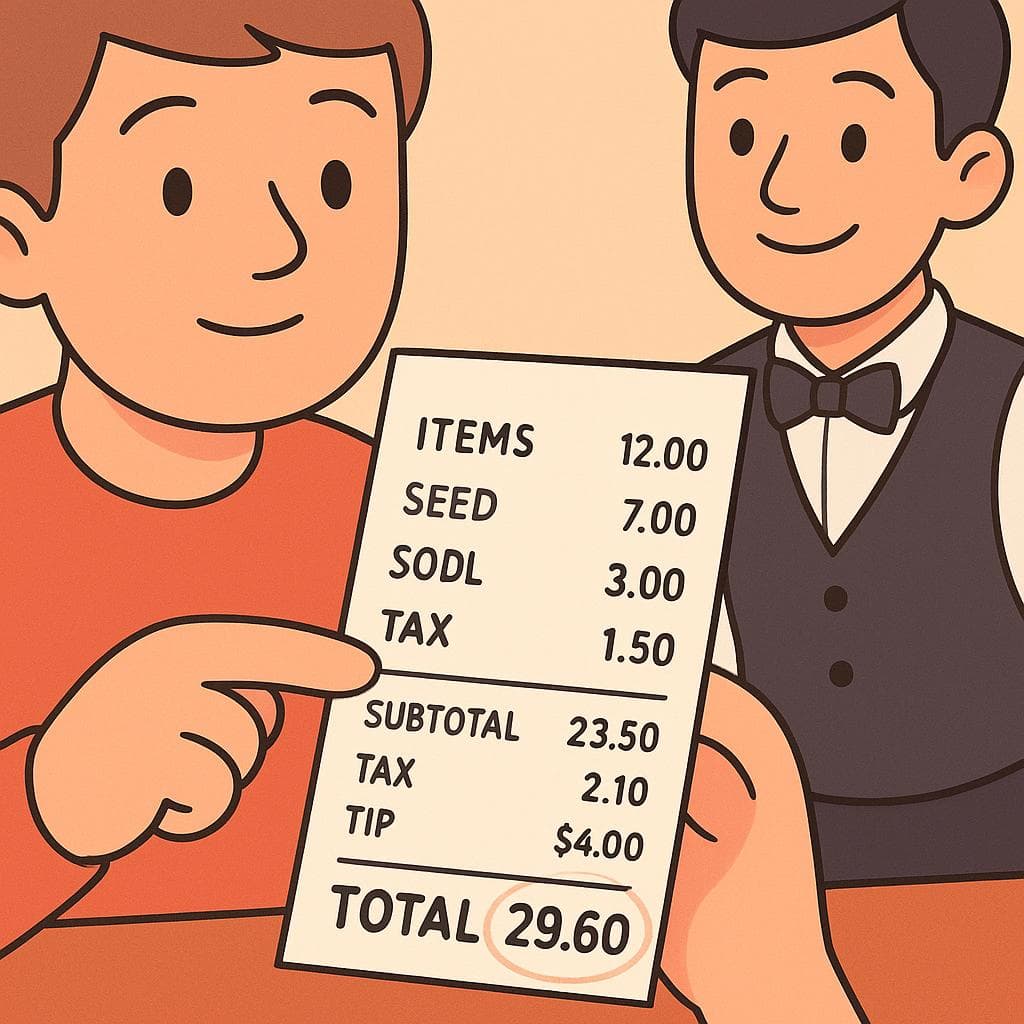
Checking the bill and asking '¿La propina está incluida?' helps avoid confusion when paying.
Is the tip included? — in Spanish
ehl sehr-BEE-see-oh ehs-TAH een-kloo-EE-doh
Very common alternative. In many places, the tip is listed on the bill as 'servicio' (service charge).
een-KLOO-yeh sehr-BEE-see-oh
A shorter, slightly more casual way to ask if the service charge is part of the total price.
yah BIEH-neh kohn lah pro-PEE-nah
Literally 'Does it already come with the tip?'. A more conversational phrasing.
KOH-brahn ehl koo-bee-EHR-toh
Asks if they charge for 'cutlery' (cover charge). Note: In these regions, this is distinct from the tip.
ehl sehr-BEE-see-oh bah ah-PAR-teh
Asking 'Does the service go separately?' (Is the service separate?).
Understanding the difference between the terms you'll see on a bill is crucial for your wallet.
| Term | Literal Meaning | Is it the Tip? | Action Required |
|---|---|---|---|
| Propina | Tip/Gratuity | Yes (Voluntary) | You decide the amount (usually 10-15% in LatAm). |
| Servicio | Service Charge | Yes (Mandatory) | Usually included in total; no extra tip needed unless service was amazing. |
| Cubierto | Cover/Cutlery | NO | You must pay this AND still leave a tip (Argentina/Uruguay). |
Standard Spanish sounds. The hardest part is the diphthong in 'incluida' (wee-dah).
It's a simple passive construction or state-of-being sentence using 'estar'.
The language is easy, but knowing WHEN to ask and HOW MUCH to tip varies heavily by country.
Disculpe, ¿la propina está incluida en la cuenta?
Excuse me, is the tip included in the bill?
No sé si dejar más dinero. ¿El servicio está incluido?
I don't know if I should leave more money. Is the service included?
Aquí dice 'total', pero ¿incluye servicio?
It says 'total' here, but does it include service?
In many Latin American countries, a 10% 'servicio' (service charge) might be automatically added to the bill legally. However, 'propina' usually refers to extra voluntary cash given directly to the waiter. Even if service is included, it's polite to leave a little extra cash if the service was excellent.
Spain has a very different tipping culture than the US. You generally don't calculate a percentage. For a coffee, you leave the small change. For a nice meal, rounding up or leaving a few euros is sufficient. Asking 'Is the tip included?' might confuse waiters in casual bars because tipping isn't mandatory there.
In Argentina and Uruguay, you will often see a charge called 'cubierto' on the bill. This pays for the bread, cutlery, and table setting—it does NOT go to the waiter. You are still expected to leave a tip (usually 10%) on top of the total.
Mistake: “Thinking the 'cubierto' charge on an Argentine bill is the tip.”
Correction: Treat 'cubierto' as a cover charge and tip 10% extra.
Mistake: “Asking '¿Está incluido el tip?'”
Correction: ¿Está incluida la propina?
Mistake: “Leaving 20% in Spain because that's what you do in the US.”
Correction: Round up or leave modest change.
Before asking, look at the bottom of your receipt. Look for words like 'servicio 10%', 'propina sugerida' (suggested tip), or 'servicio incluido'. If you see these, you don't need to ask.
Even if you pay for the meal with a credit card, it is almost always preferred (and sometimes required) to leave the tip in cash to ensure the server actually receives it immediately.
When asking this question, it can sound blunt. Always preface it with 'Disculpe' (Excuse me) to soften the question and sound more polite.
In Mexico, tipping is very similar to the US. 10-15% is standard. It is rarely included automatically unless you are a large group.
Tipping is much more relaxed. It's often just 'el bote' (the jar) or rounding up to the nearest euro. Asking about tips in a cheap tapas bar might seem overly formal.
By law, restaurant bills include a 10% service charge plus tax. You will see this clearly on the bill. Additional tipping is voluntary but appreciated.
No, el servicio es aparte.
No, the service is separate.
Entiendo, ¿puedo agregarla a la tarjeta?
I understand, can I add it to the card?
Aquí tiene su cambio.
Here is your change.
Gracias, quédese con el cambio.
Thanks, keep the change.
In English, 'tip' and 'service charge' are often used somewhat interchangeably in conversation, though they mean different things legally. In Spanish, seeing 'Servicio' on a bill is a formal line item. Also, the culture of asking is different; in the US, you almost never ask if the tip is included (you assume it's not). In Spanish-speaking countries, it is a very common and valid question.
Why it''s different: While 'gratitud' exists in Spanish, it refers to the emotion of gratitude. Don't use it for money.
Use instead: Use 'propina' (tip) or 'servicio' (service).
This is the most common way to leave a tip when paying with cash.
You need to ask for the bill before you can ask about the tip!
Essential payment vocabulary to pair with tipping questions.
Question 1 of 3
You are in Argentina and see 'Cubierto' on the bill. Does this mean the tip is included?
Knowing a phrase is one thing — using it at the right moment is another. Read 200+ illustrated and narrated Spanish stories to see phrases in the contexts where they actually belong.
Not at all! In fact, it is a very practical and common question, especially in tourist areas or countries where policies vary. It shows you want to ensure the staff is compensated correctly.
In Mexico, aim for 10-15%, similar to the US but slightly lower. In Spain, tipping is much smaller—leave the loose change or round up a few euros. 10% in Spain is considered very generous.
In tourist-heavy areas (like Cancun or Barcelona), staff will understand 'tip'. However, using 'propina' is more respectful and guarantees you will be understood everywhere, from rural towns to big cities.
You can ask '¿Puedo incluir la propina en la tarjeta?' (Can I include the tip on the card?). However, in many places, card machines don't have a tip option, so carrying small bills is always safer.
Strengthen the grammar behind this phrase:
Dive deeper into related topics:
Find similar phrases to expand your Spanish vocabulary:
Browse our complete collection of Spanish phrases organized by situation, from basic greetings to advanced conversations. Perfect for travelers, students, and anyone learning Spanish.
View All Spanish Phrases →