



Using 'Mi' instead of 'Me'
Mistake: “Mi cabeza duele.”
Correction: Me duele la cabeza.
meh DWEH-leh lah kah-BEH-sah
This is the most common and direct way to say 'my head hurts' in Spanish. It literally means 'the head hurts me,' a key Spanish structure for talking about pain.
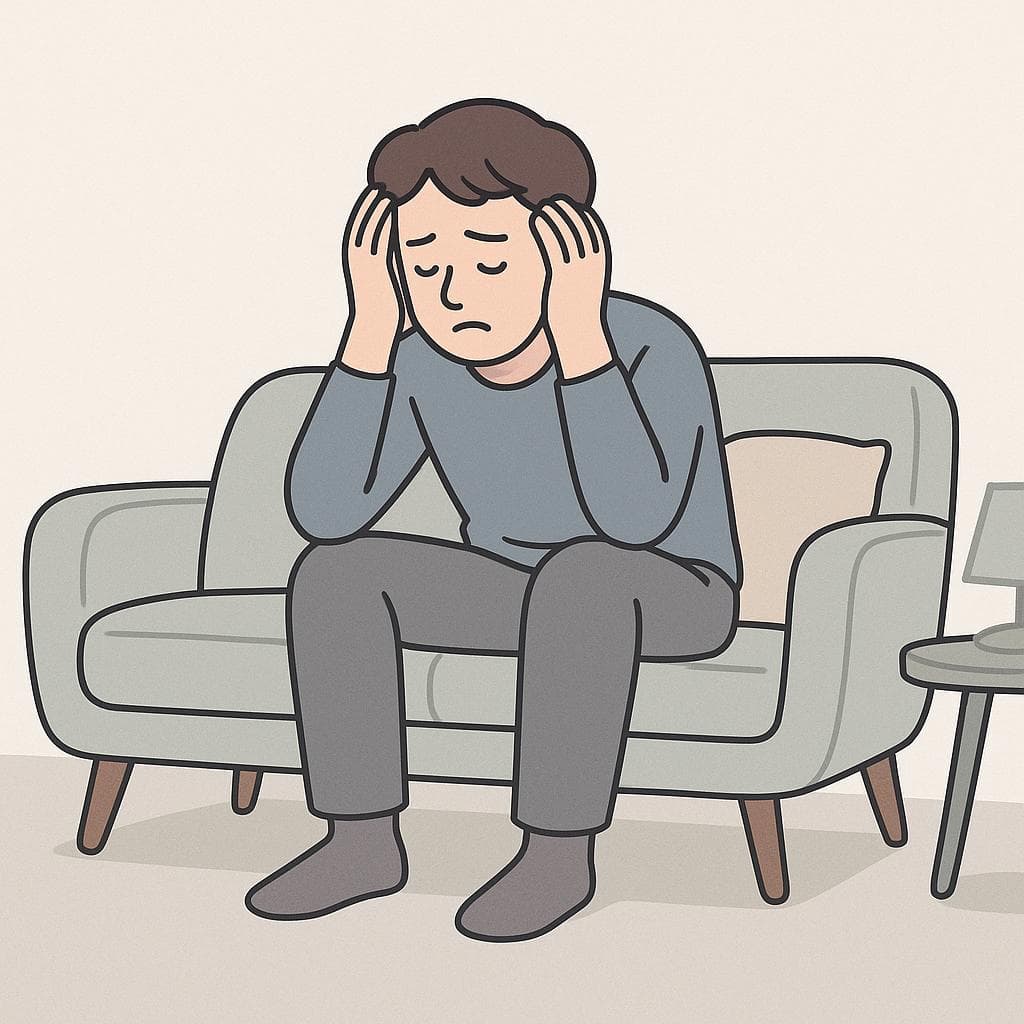
When you need to express that you have a headache, the most common phrase is 'Me duele la cabeza.'
My head hurts — in Spanish
TEN-goh doh-LOR deh kah-BEH-sah
This phrase means 'I have a headache' and is just as common as 'Me duele la cabeza.' They are almost perfectly interchangeable in everyday conversation.
meh ehs-TAH doh-LYEN-doh lah kah-BEH-sah
This version emphasizes that the pain is happening right now. It's the equivalent of saying 'My head is hurting me at this very moment.'
meh bah ah ehs-tah-YAR lah kah-BEH-sah
A dramatic and informal way to say you have a very severe headache, literally 'My head is going to explode.' It's like saying 'my head is splitting' in English.
AHN-doh kohn doh-LOR deh kah-BEH-sah
A more conversational way to say you have a headache, common in much of Latin America. The verb 'andar' (to walk/go around) implies it's something you've been dealing with all day.
TEN-goh hah-KEH-kah
This specifically means 'I have a migraine.' 'Jaqueca' is the medical term for a migraine headache, which is typically more severe and has other symptoms.
meh reh-TOOM-bah lah kah-BEH-sah
A very descriptive phrase for a pounding or throbbing headache. 'Retumbar' means to rumble or echo, painting a vivid picture of the pain.
These common phrases for a headache are mostly interchangeable, but have slight differences in emphasis and formality.
| Phrase | Formality | Best For | Avoid When |
|---|---|---|---|
| Me duele la cabeza. | Neutral | The most standard, all-purpose way to state you have a headache. | Never, this is always a good choice. |
| Tengo dolor de cabeza. | Neutral | Stating the condition you have, like telling a doctor your symptom. | Never, this is also a perfect choice in any context. |
| Ando con dolor de cabeza. | Casual | Casual conversation, implying you've been dealing with it for a while. | In very formal settings or when you want to be very direct, like in an emergency. |
| Me va a estallar la cabeza. | Informal | Expressing severe pain to friends or family in a dramatic way. | Speaking to a doctor for the first time, as it's an exaggeration. |
Fairly easy. The 'z' in 'cabeza' sounds like 's' in Latin America and 'th' in Spain, but both are easy to learn. The main challenge is getting the rhythm right.
The 'me duele' structure is a big hurdle for beginners. It's a type of verb like 'gustar' that works 'backwards' compared to English, which takes some getting used to.
The usage is very straightforward. A headache is a headache everywhere, and these phrases don't carry hidden meanings.
No puedo concentrarme, me duele mucho la cabeza.
I can't concentrate, my head hurts a lot.
Doctora, vengo porque tengo un dolor de cabeza constante desde hace tres días.
Doctor, I've come because I've had a constant headache for three days.
¡Qué fiesta tan ruidosa! Me va a estallar la cabeza si no salimos de aquí.
What a loud party! My head is going to explode if we don't get out of here.
¿Puedes bajar el volumen de la tele, por favor? Ando con dolor de cabeza.
Can you lower the TV volume, please? I've got a headache.
In English, *you* have pain. In Spanish, the pain *happens to you*. That's why you say 'Me duele la cabeza' (The head hurts me) instead of 'Mi cabeza duele.' This structure is used for all body parts and is a fundamental concept to sound natural in Spanish.
In many Spanish-speaking cultures, before reaching for a pill, it's very common to suggest or use a 'remedio casero' (home remedy). For a headache, you'll often hear people recommend a 'té de manzanilla' (chamomile tea) or simply resting in a dark room.
Don't be afraid to be a little expressive. Using phrases like 'Me va a estallar la cabeza' (My head's going to explode) among friends is very common and not seen as overly dramatic. It's a normal way to communicate how bad you're feeling in an informal setting.
Mistake: “Mi cabeza duele.”
Correction: Me duele la cabeza.
Mistake: “Estoy doliendo la cabeza.”
Correction: Me duele la cabeza. / Me está doliendo la cabeza.
Mistake: “Tengo dolor de mi cabeza.”
Correction: Tengo dolor de cabeza.
Make your description more precise by adding words for intensity. You can say 'Me duele un poco la cabeza' (My head hurts a little) or 'Me duele mucho la cabeza' (My head hurts a lot). For a very strong headache, you can say 'Tengo un dolor de cabeza muy fuerte'.
This phrase is a great opener to ask for what you need. Follow it up with a question like, '¿Tienes una pastilla?' (Do you have a pill?) or '¿Podemos descansar un momento?' (Can we rest for a moment?).
Once you understand 'Me duele la cabeza,' you can talk about pain anywhere! Just swap out the body part: 'Me duele el estómago' (My stomach hurts), 'Me duelen los pies' (My feet hurt). Notice it changes to 'duelen' for plural things like feet.
The 'ceceo' or 'th' sound for 'z' and 'c' is the most notable difference. The core phrases are universal, but slang like 'coco' is common in casual speech.
The use of 'andar con...' to mean 'to have' an ailment is very characteristic of Mexican and Central American Spanish. It gives a sense of carrying the problem around with you.
The 'Rioplatense' accent is the main differentiator. Slang like 'bocho' is widespread and instantly marks a speaker from this region. The expression 'estar para atrás' is a common way to say you feel awful.
¿Quieres una aspirina / un analgésico?
Do you want an aspirin / a painkiller?
Sí, por favor. Muchas gracias.
Yes, please. Thank you very much.
¡Qué mal! ¿Por qué no te acuestas un rato?
That's too bad! Why don't you lie down for a bit?
Es una buena idea. Creo que eso haré.
That's a good idea. I think I'll do that.
¿Desde cuándo te sientes así?
How long have you been feeling like this?
Empezó esta mañana, después del café.
It started this morning, after coffee.
This breaks the English habit of starting with 'My head...' and forces you to use the correct Spanish structure with 'Me' at the beginning.
This simple word association connects the Spanish word 'dolor' (pain) to an English word with a similar feeling, making it easier to recall.
The biggest difference is grammatical. English uses a Subject-Verb-Object structure ('I have a headache'), where 'I' is the one doing the action. Spanish uses an Indirect Object structure ('Me duele la cabeza'), where the 'head' is the subject causing pain 'to me'. Mastering this 'backwards' thinking is key to sounding natural when talking about feelings, pains, and preferences in Spanish.
Why it''s different: A word-for-word translation would be 'Mi cabeza duele,' which is grammatically awkward and almost never said by native speakers.
Use instead: Always use 'Me duele la cabeza' or 'Tengo dolor de cabeza.' The pronoun 'me' already indicates that it's your head.
This is the next logical step after describing a specific pain.
Lets you apply the 'me duele' structure to other body parts like your stomach or back.
After you've stated the problem, you'll need to know how to ask for a solution.
Expands your vocabulary for common symptoms to describe your condition more fully.
Question 1 of 3
You wake up with a normal headache. What is the most standard way to tell your roommate?
Knowing a phrase is one thing — using it at the right moment is another. Read 200+ illustrated and narrated Spanish stories to see phrases in the contexts where they actually belong.
Honestly, for a learner, there's almost no difference. They are used interchangeably 99% of the time. If you want to get technical, 'Me duele...' focuses slightly more on the sensation of pain itself, while 'Tengo dolor...' focuses on having the condition of a headache. But you can use either one in any situation.
While it might seem more specific, it's redundant in Spanish. The 'me' in 'me duele' already tells the listener that it's *your* body part that hurts. Adding 'mi' (my) is unnecessary and sounds very unnatural to a native speaker. Just trust the 'me' to do the work!
You have options! You can add an intensifier like 'Me duele muchísimo la cabeza' (My head hurts a whole lot). Or, for a more informal and expressive option, you can use a phrase like 'Me va a estallar la cabeza' (My head is going to explode) or 'Tengo un dolor de cabeza terrible' (I have a terrible headache).
It's easy! Just replace 'la cabeza' with the other body part. For singular parts, use 'duele': 'Me duele el estómago' (My stomach hurts). For plural parts, change it to 'duelen': 'Me duelen los pies' (My feet hurt).
Only with friends and in very casual situations. These words are similar to saying 'my noggin' in English. They are fun and show you have a good command of informal Spanish, but you would not use them with a doctor, your boss, or someone you've just met.
Strengthen the grammar behind this phrase:
Find similar phrases to expand your Spanish vocabulary:
Browse our complete collection of Spanish phrases organized by situation, from basic greetings to advanced conversations. Perfect for travelers, students, and anyone learning Spanish.
View All Spanish Phrases →