






Literal Translation
Mistake: “Trying to translate "sleep tight" word-for-word, resulting in something like "Dormir apretado."”
Correction: Que duermas bien. / Que descanses.
keh DWER-mahs byehn
This is the most common and natural way to say "sleep tight" in Spanish. It literally means "May you sleep well" and is a warm, friendly wish for someone to have a good night's sleep.
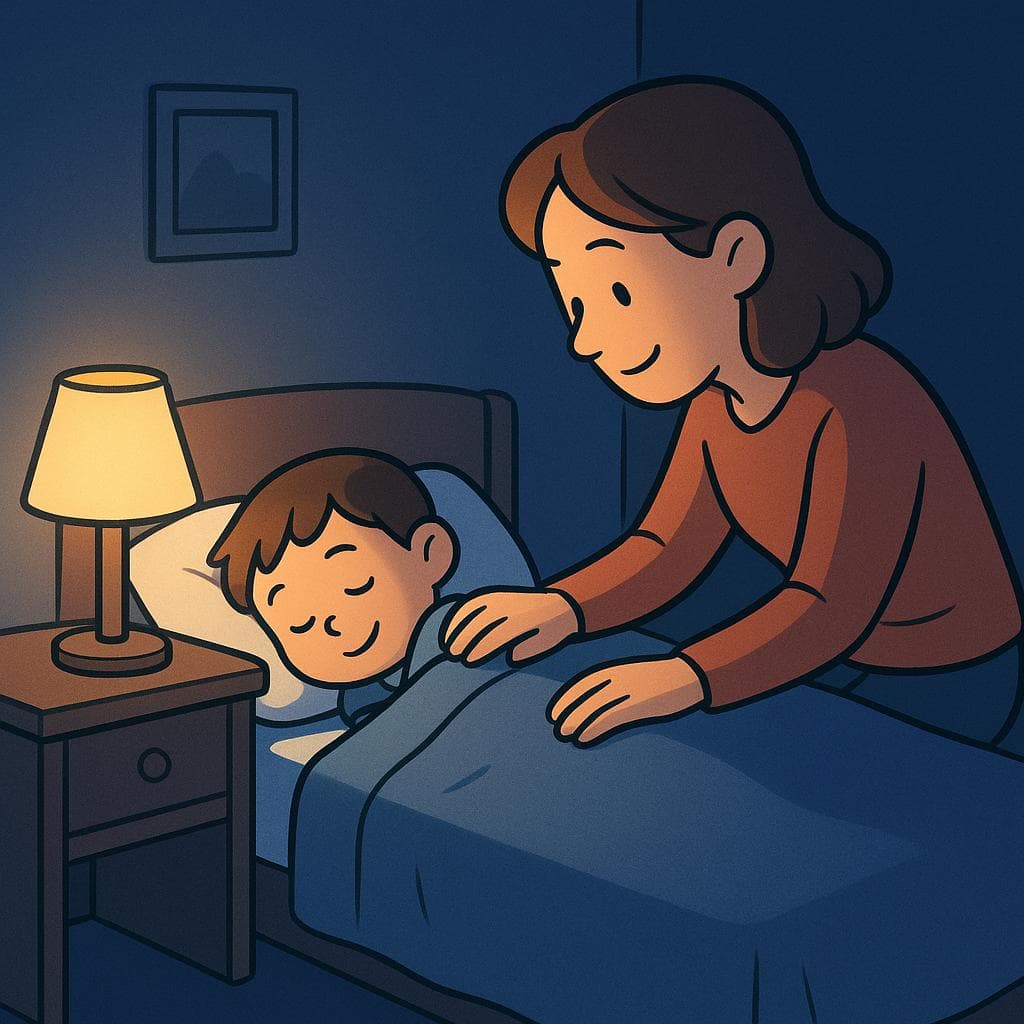
Wishing someone 'Que duermas bien' (sleep well) is a common and caring gesture in Spanish-speaking families.
Sleep tight — in Spanish
keh dehs-KAHN-sehs
Meaning "May you rest," this is an extremely common and slightly more general alternative to "Que duermas bien." It's versatile, warm, and used universally among friends and family.
keh DWER-mah byehn
This is the formal version of the primary translation, used with 'usted'. You're still wishing someone to "sleep well," but with a respectful tone.
keh SWEN-yehs kohn lohs ahn-heh-LEE-tohs
This beautiful phrase means "May you dream with the little angels." It's the Spanish equivalent of telling someone "sweet dreams" and is very tender.
keh TEN-gahs DOOL-sehs SWEN-yohs
Literally "May you have sweet dreams." This is another common, affectionate way to wish someone a good night, similar to "Que sueñes con los angelitos" but slightly less child-focused.
dehs-KAHN-sah
A shorter, more direct version of "Que descanses." It's a simple command meaning "Rest," but used in this context, it's a warm and common way to say goodnight.
keh DWER-mahn byehn
This is the plural form, meaning "(I hope) you all sleep well." It's used when you're saying goodnight to two or more people.
BWEH-nahs NOH-chehs
While it just means "Good night," this phrase is often used on its own to convey the same sentiment as "sleep tight." It's the standard farewell at night.
Here’s a quick comparison to help you choose the best 'sleep tight' variation for your situation.
| Phrase | Formality | Best For | Avoid When |
|---|---|---|---|
| Que duermas bien. | Informal | Friends, family, and partners. The most standard, all-purpose informal wish. | Speaking to someone you'd call 'usted' (e.g., a boss, an elderly stranger). |
| Que descanses. | Informal | A slightly more casual and very common alternative to 'Que duermas bien'. | Formal situations, unless you use the 'usted' form: 'Que descanse'. |
| Que duerma bien. | Formal | Anyone you show respect to: elders, bosses, teachers, hosts you don't know well. | Talking to close friends, kids, or partners, where it would sound too distant. |
| Que sueñes con los angelitos. | Affectionate | Tucking children into bed or being very sweet with a romantic partner. | Almost any other situation, as it can sound childish or overly intimate. |
The 'ue' in 'duermas' and 'sueñes' can be a little tricky for beginners, but otherwise, the sounds are straightforward for English speakers.
These phrases use the present subjunctive ('duermas', 'descanses'). You don't need to know the grammar rule to use the phrase, but understanding that it's a special 'wishing' form is helpful.
The main nuance is knowing when to be formal vs. informal, and which phrases are best for children vs. adults. The basic usage is very straightforward.
Ya es tarde, mi amor. Que duermas bien.
It's late, my love. Sleep tight.
Adiós, niños. ¡Que sueñen con los angelitos!
Goodbye, kids. Dream with the little angels!
Gracias por la cena, señora. Que duerma bien.
Thank you for dinner, ma'am. Sleep well.
Bueno, chicos, me voy a la cama. ¡Que descansen!
Alright, guys, I'm off to bed. Rest well!
The English phrase "sleep tight" is an idiom with historical roots. Spanish doesn't have a direct equivalent. Instead, Spanish speakers express the sentiment as a wish for the other person, using phrases that mean "May you sleep well" or "May you rest." This focus on wishing someone well is very common in Spanish politeness.
The phrase "Que sueñes con los angelitos" is a deeply ingrained part of childhood in many Spanish-speaking countries. It's a very tender and protective thing to say, evoking a sense of innocence and peaceful sleep, watched over by angels. It's a classic example of the affectionate language used within families.
While phrases like "Que descanses" work on their own, it's very common to pair them with "Buenas noches" (Good night). You'll often hear people say, "Buenas noches, que duermas bien." This makes the farewell feel more complete and natural.
Mistake: “Trying to translate "sleep tight" word-for-word, resulting in something like "Dormir apretado."”
Correction: Que duermas bien. / Que descanses.
Mistake: “Saying "Que duermas bien" to an elder or someone you should respect, like a boss.”
Correction: Que duerma bien.
Mistake: “Saying "Que tengas sueño" thinking it means "Have dreams."”
Correction: Que tengas dulces sueños.
"Que descanses" (informal) and its formal version "Que descanse" are incredibly safe and versatile. They cover everything from sleep to just taking a break. If you're unsure which phrase to use, this is a fantastic, all-purpose choice.
Notice how many of these wishes start with 'Que'. This little word is a signal that you're expressing a hope or a wish for someone. It's a key part of the phrase that makes it sound natural.
Remember to match the phrase to your audience. "Que sueñes con los angelitos" is perfect for a 5-year-old but might sound strange said to your 50-year-old friend unless you have a very specific, joking relationship.
"Que descanses" is extremely common in Spain, perhaps even more so than "Que duermas bien." It's a very standard, friendly way to end a conversation for the day.
Both "Que duermas bien" and "Que descanses" are used interchangeably and with high frequency. The choice is purely personal preference. Affectionate phrases for family are also very common.
Argentinians often use 'vos' instead of 'tú'. While 'Que duermas bien' is understood and used, you might also hear the 'vos' command form: '¡Descansá!'. However, 'Que descanses' remains extremely common and is a safe bet.
Que duermas bien
WhatsApp, SMS, social media comments
Hablamos mañana, q duermas bn!
Talk tomorrow, sleep tight!
Que descanses
WhatsApp, SMS, social media comments
Ya me voy a dormir. q descanses :)
I'm going to sleep now. rest well :)
Gracias, igualmente.
Thanks, likewise.
De nada.
You're welcome.
Tú también, que descanses.
You too, rest well.
¡Gracias! Hasta mañana.
Thanks! Until tomorrow.
Associating the sound of the Spanish word with a memorable English image helps lock in the meaning.
This phrase is so visual that simply remembering the literal translation ('dream with the little angels') is the best way to recall it.
The biggest difference is that English uses an idiom ('tight') that describes the quality of sleep in an abstract way, while Spanish uses a direct wish for a positive outcome ('well', 'rest', 'sweet dreams'). The Spanish approach is less idiomatic and more of a straightforward, kind expression of hope for the other person.
Why it''s different: While 'sleep hard' can mean to sleep deeply in English, translating it to 'dormir duro' in Spanish sounds very strange, as 'duro' means hard or difficult. It implies a struggle, not a restful sleep.
Use instead: To say someone slept deeply, you would say 'durmió profundamente'.
It's the natural greeting for the next day.
This is a common question to ask someone in the morning after you've wished them a good night.
This is what you would say right before someone wishes you 'sleep tight'.
This is the essential greeting that often accompanies 'sleep tight'.
Question 1 of 3
You just finished a late dinner at your new boss's house. What is the most appropriate way to say 'sleep tight' to her as you leave?
Knowing a phrase is one thing — using it at the right moment is another. Read 200+ illustrated and narrated Spanish stories to see phrases in the contexts where they actually belong.
No, there isn't. 'Sleep tight' is an English idiom. A literal translation like 'dormir apretado' makes no sense in Spanish. Instead, Spanish speakers express the same sentiment by wishing someone a good quality of sleep with phrases like 'Que duermas bien' (May you sleep well).
They are very similar and often interchangeable. 'Que duermas bien' focuses specifically on sleeping, while 'Que descanses' (May you rest) is slightly broader. Both are extremely common and polite ways to wish someone a good night. You can't go wrong with either in an informal setting.
You use the plural form. The most common way is 'Que duerman bien' (for 'ustedes') or 'Que descansen'. This is what you would say when leaving a party or saying goodnight to a family.
This is a special verb form called the subjunctive. Don't worry about the grammar term! Just know that when you start a sentence with 'Que' to express a hope, wish, or desire for someone, the verb ending changes. It's the 'wishing form' of the verb.
Absolutely. 'Buenas noches' (Good night) works perfectly on its own and conveys the same general sentiment. Adding 'Que duermas bien' or 'Que descanses' is just a warmer, more personal touch, but it's not always necessary.
Yes, it's fairly common, especially in more affectionate contexts. It translates to 'May you have sweet dreams.' It's a lovely thing to say to a partner, a child, or a close family member, but might be a bit too intimate for a casual friend.
Strengthen the grammar behind this phrase:
Dive deeper into related topics:
Find similar phrases to expand your Spanish vocabulary:
Browse our complete collection of Spanish phrases organized by situation, from basic greetings to advanced conversations. Perfect for travelers, students, and anyone learning Spanish.
View All Spanish Phrases →