"Donde hay música no puede haber cosa mala."
DOHN-deh eye MOO-see-kah noh PWEH-deh ah-BEHR KOH-sah MAH-lah
Where there is music, there can be nothing bad.
💡 Understanding the Quote
"Donde hay música no puede haber cosa mala."
🎨 Visual Representation
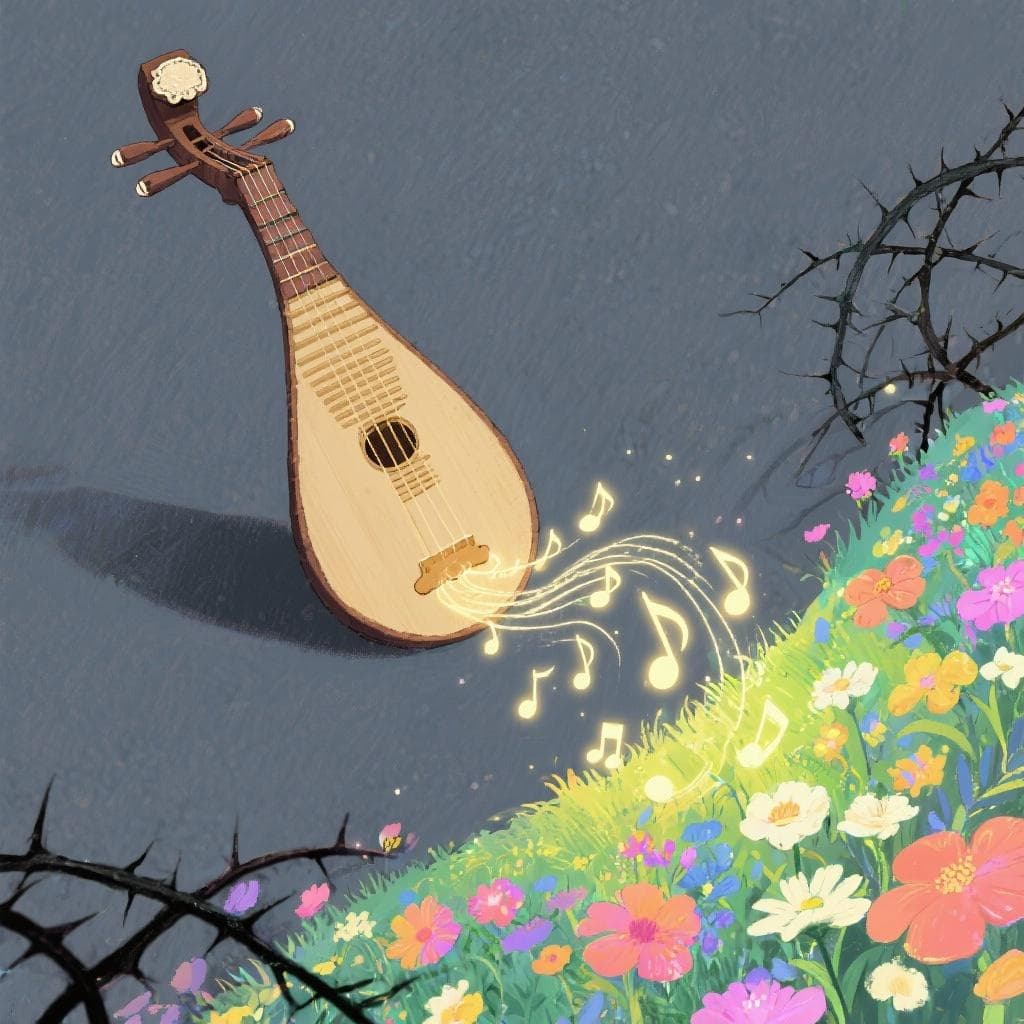
Cervantes' quote captures the power of music to bring goodness and banish negativity.
🔑 Key Words


📖 Context
From the novel 'Don Quijote de la Mancha' (Part II, Chapter 34) by Miguel de Cervantes, published in 1615. The line is spoken by the titular character, Don Quijote.
📝 In Action
Pon un poco de música para alegrar el ambiente. Como decía Cervantes, 'donde hay música no puede haber cosa mala'.
B2Put on some music to liven up the atmosphere. As Cervantes said, 'where there is music, there can be nothing bad'.
Me encanta este festival, todos están felices y bailando. Es la prueba de que 'donde hay música no puede haber cosa mala'.
B2I love this festival, everyone is happy and dancing. It's proof that 'where there is music, there can be nothing bad'.
✍️ About the Author
📜 Historical Context
This quote comes from 'Don Quijote de la Mancha' (Part II, 1615), a cornerstone of Western literature written during Spain's Golden Age. The novel explores themes of idealism versus reality, and this line reflects Don Quijote's optimistic and romantic worldview, seeing pure goodness in art.
🌍 Cultural Significance
The quote is deeply ingrained in Spanish-speaking cultures as a testament to the power of music. It's often used to express the belief that music is a universal good, capable of healing, uniting people, and creating positive environments. It reflects a deep appreciation for music in daily life.
📚 Literary Analysis
The statement is a simple, direct aphorism—a concise observation that contains a general truth. Cervantes uses it to characterize Don Quijote's unwavering belief in ideals. The stark contrast between 'música' (music) and 'cosa mala' (a bad thing) creates a powerful, memorable sentiment about the purity of art.
⭐ Usage Tips
To Express Optimism
Use this quote to lighten the mood, justify putting on music, or express a belief in the positive, unifying power of the arts. It's perfect for casual, feel-good moments.
A Touch of Classic Wisdom
Referencing this quote adds a touch of classic literary wisdom to a conversation about music's importance in culture or personal well-being. Attributing it to Cervantes shows cultural knowledge.
🔗 Related Quotes
✏️ Quick Practice
Quick Quiz: Donde hay música no puede haber cosa mala.
Question 1 of 2
Who is the author of the quote 'Donde hay música no puede haber cosa mala'?
🏷️ Categories
Themes:
Go from quotes to whole stories
A quote can move you. A story can change how you think in Spanish. Read 200+ illustrated and narrated Spanish stories tailored to your level.
Frequently Asked Questions
Is this quote meant literally?
Not entirely. It's a poetic and philosophical statement. Cervantes means that the spirit of music—creativity, harmony, and beauty—is incompatible with the spirit of evil or malice. It's about the essence of music, not that a bad event can't physically occur while a song is playing.
Who says this in the book 'Don Quijote'?
Don Quijote himself says it in Part II, Chapter 34. This is significant because it reflects his idealistic and noble character, always seeking out the good and beautiful in the world, even when others don't see it.