El jinete jineteaba.
el ji-NE-te ji-ne-te-A-ba
The rider was riding.
🔊 Listen & Practice
Start with slow speed to master pronunciation, then gradually increase to challenge yourself.
🎨 Visualization
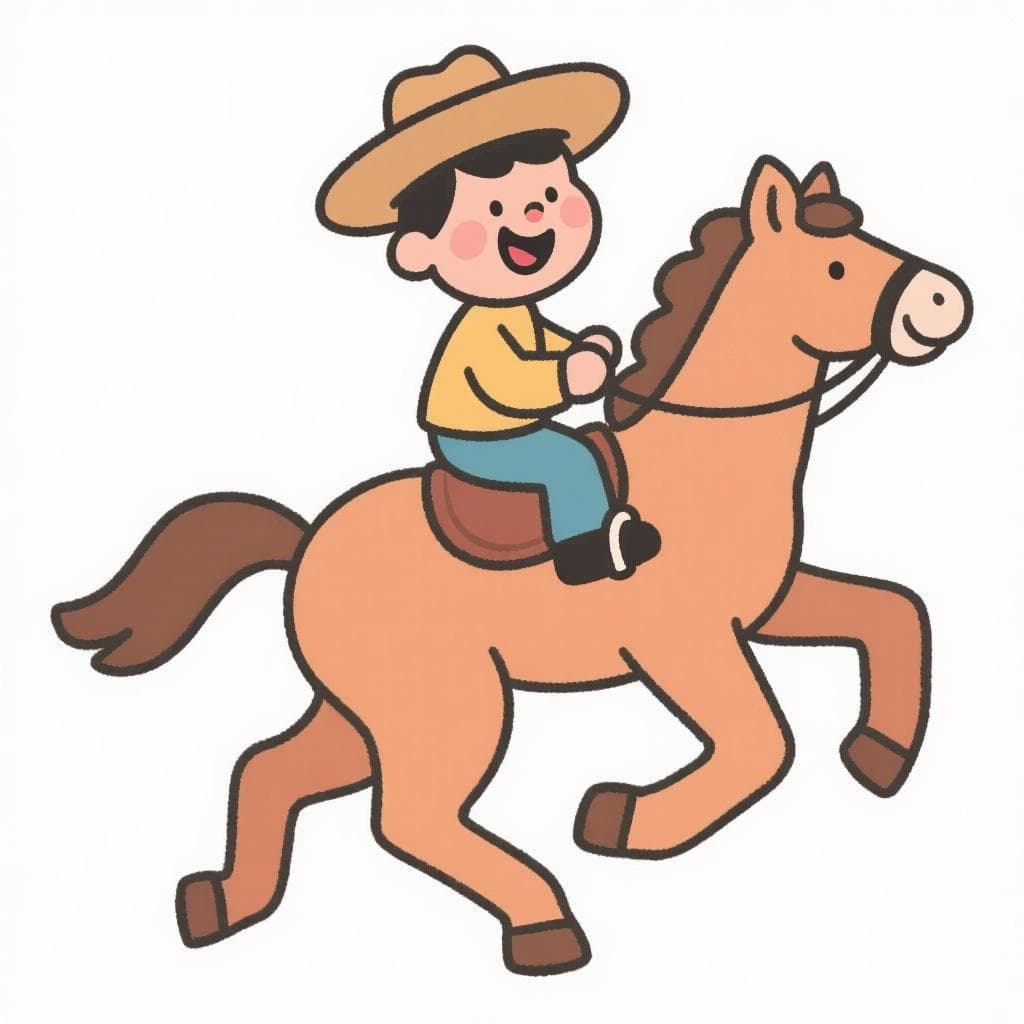
El jinete jineteaba... the rider was riding!
🎯 Pronunciation Focus
The Spanish 'j' Sound (La Jota)
xThis is a sound made in the back of your throat. It's a bit like a strong, raspy 'h' sound in English, as in 'huge,' but with more friction. Imagine you're trying to clear your throat gently to make the sound.
📝 Practice Breakdown
Start with the main noun. Focus on producing that throaty 'j' sound. It should feel like a puff of air from the back of your throat: ji-NE-te.
Now for the verb. It's the same sound, repeated! Try to keep the 'j' sound consistent in both words. The challenge is the rhythm: ji-ne-te-A-ba.
Key Words in This Tongue Twister:
📚 Background
This is a short, classic 'trabalenguas' that perfectly isolates the Spanish 'j' sound. It's a fantastic exercise because it forces you to repeat this tricky sound in quick succession, building muscle memory for one of Spanish's signature sounds.
❌ Common Pitfalls
Using the English 'j' Sound
Mistake: “Saying 'jinete' with the sound from the English word 'jeans' or 'jump'.”
Correction: The Spanish 'j' has no 'd' sound in it. It's a voiceless, airy sound from the back of your throat, similar to a strong English 'h' in 'hello' but with more friction. Think of the sound you make when clearing your throat.
Making the 'j' too soft
Mistake: “Pronouncing the 'j' like a very light, barely-there English 'h'.”
Correction: While it's similar to an 'h', the Spanish 'j' is stronger and has more friction. You should feel a slight rasp or scratchiness in the back of your throat as you make the sound. Don't be afraid to give it a little energy!
🌎 Where It''s Used
General Spanish
The pronunciation of the 'j' sound is consistent across most of the Spanish-speaking world. This tongue twister is universally understood and effective for practice everywhere.
🔗 Related Tongue Twisters
The Jinete Jive
Try saying it five times in a row without losing the throaty 'j' sound. Can you do it in under 7 seconds? Record yourself and see!
🏷️ Tags
Frequently Asked Questions
Is 'jineteaba' a real word?
Yes, it is! It's the imperfect tense of the verb 'jinetear,' which means 'to ride a horse,' often with skill or for show. So, 'El jinete jineteaba' means 'The rider was riding.'
Why is the Spanish 'j' sound so different from the English 'j'?
Languages evolve differently! The Spanish 'j' sound (and the 'g' before 'e' or 'i') comes from a historical sound that shifted over time to the back of the throat. The English 'j' sound is completely different and is made at the front of the mouth. They just happen to share the same letter!