Francisco fríe fabada.
fran-SIS-co FREE-eh fa-BA-da
Francisco fries fava bean stew.
🔊 Listen & Practice
Start with slow speed to master pronunciation, then gradually increase to challenge yourself.
🎨 Visualization
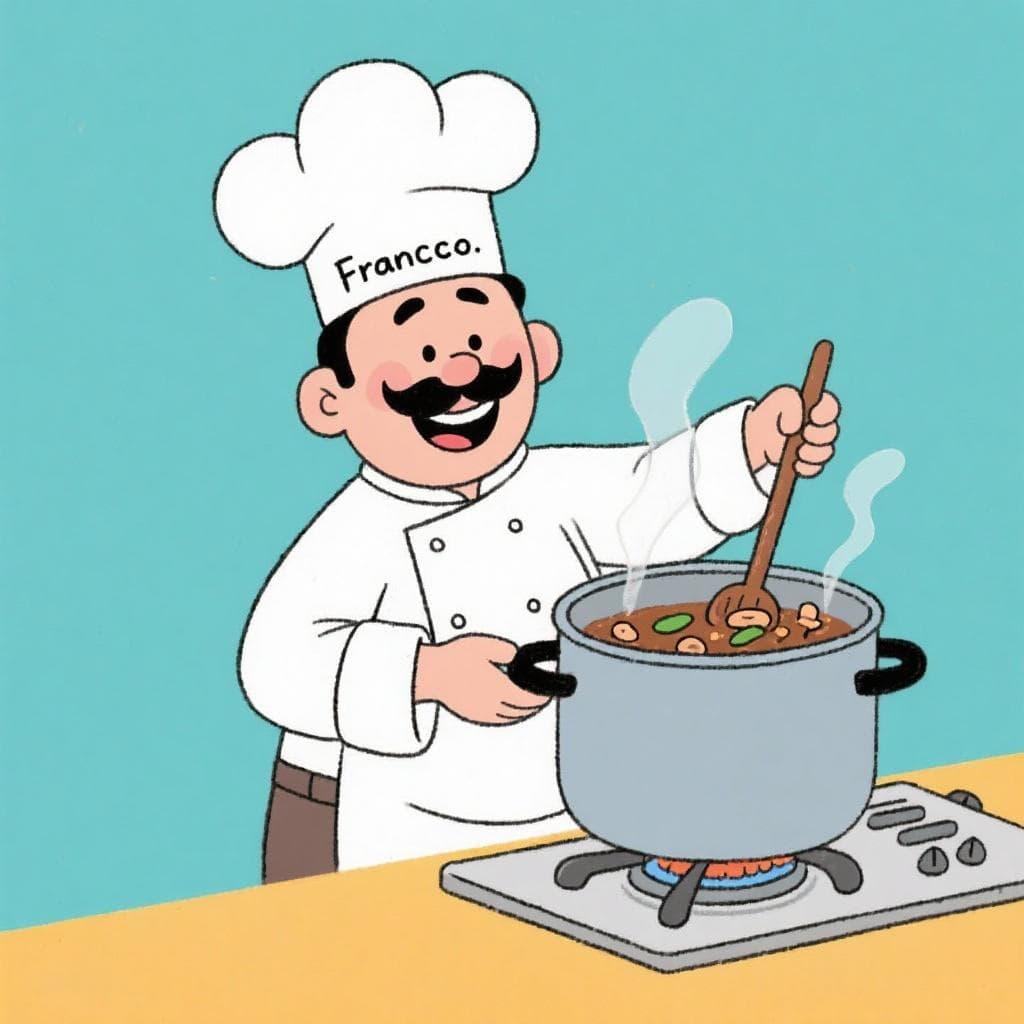
Francisco is frying his famous fabada! Can you say it five times fast?
🎯 Pronunciation Focus
The 'fr' Consonant Cluster
fɾThis is the main event! It combines the airy 'f' sound (top teeth on your bottom lip) with a quick, single tap of the 'r' sound right after. The challenge is making the transition smooth and fast.
The Tap 'r' (vibrante simple)
ɾThe 'r' in 'Francisco' and 'fríe' is a quick, light tap of your tongue against the roof of your mouth, just behind your teeth. Think of the 'tt' sound in the American English pronunciation of 'butter'.
The 'í-e' Vowel Hiatus
i.eIn 'fríe', the accent on the 'í' means you pronounce the two vowels separately, not blended together. It's two distinct sounds: 'free-eh'.
📝 Practice Breakdown
Start with the name. Make sure the 'r' is a light tap, not a roll or the English 'r'. Feel your tongue quickly flick the roof of your mouth: 'Fran-CIS-co'.
Now for the tricky part. For 'fríe', make the 'f' sound and immediately tap your tongue for the 'r'. Then, say the two vowels clearly: 'free-eh'. Finish with a smooth 'fa-BA-da'.
Key Words in This Tongue Twister:
📚 Background
This is a short and classic 'trabalenguas' that's perfect for practicing the 'fr' consonant cluster, a sound that can be tricky for English speakers. It's a fun, quick warm-up for your mouth.
❌ Common Pitfalls
Using an English 'r'
Mistake: “Pronouncing the 'r' in 'Francisco' and 'fríe' like the English 'r' in 'fry', where the tongue doesn't tap anything.”
Correction: The Spanish 'r' here is a physical tap. Your tongue should quickly flick the roof of your mouth right behind your top teeth. It's a very fast and light sound.
Blending the Vowels in 'fríe'
Mistake: “Saying 'fríe' as one syllable, making it sound like the English word 'free'.”
Correction: The accent mark on the 'í' is a signal! It tells you to keep the vowels separate. Pronounce it as two distinct syllables: 'free-EH'. This separation is called a 'hiatus' in Spanish.
🌎 Where It''s Used
General Spanish
This simple tongue twister is known and used throughout the Spanish-speaking world as a basic pronunciation exercise for the 'fr' sound.
🔗 Related Tongue Twisters
The Fabada Fry-Up
Say 'Francisco fríe fabada' five times in a row, as fast as you can without getting your 'fr' sounds tangled up!
🏷️ Tags
Frequently Asked Questions
What exactly is 'fabada'?
Fabada, or 'fabada asturiana', is a rich, hearty bean stew from the Asturias region of Spain. It's a famous and delicious dish, typically made with large white beans, chorizo, and morcilla (blood sausage).
Why is the 'fr' sound so difficult?
For many English speakers, the combination of the 'f' sound (made with your teeth and lip) and the Spanish tap 'r' (made with your tongue) is unfamiliar. It requires quick, precise movements from two different parts of your mouth, which just takes a bit of practice to coordinate.