Koniugacja derribar Czas przyszły
derribar — to knock down
Future tense 'derribaré', 'derribarás' etc., predicts or expresses probability.
Formy derribar Czas przyszły
Kiedy używać Czas przyszły
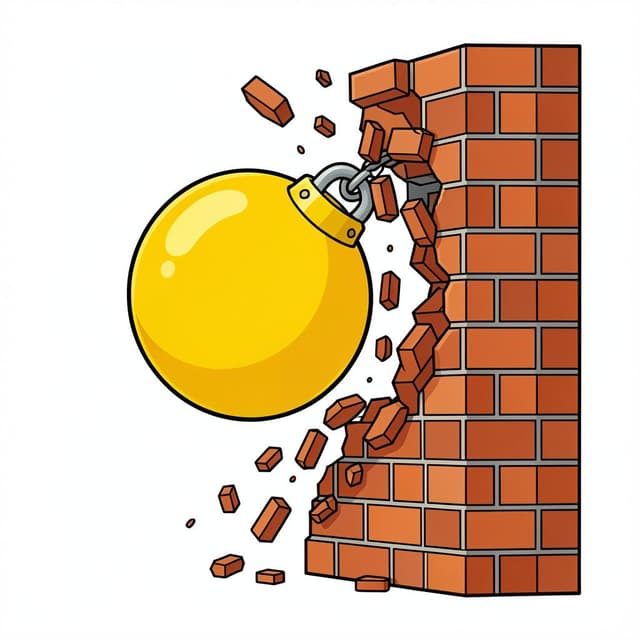
Use the future tense to talk about actions that will definitely happen or to express probability or conjecture about the present. For 'derribar', it's like 'Derribaremos el muro mañana' (We will knock down the wall tomorrow) or 'Seguro que derriba la torre' (He's probably knocking down the tower right now).
Uwagi dotyczące derribar w czasie Czas przyszły
'Derribar' is regular in the future tense. The stem is the full infinitive 'derribar-'.
Przykładowe zdania
Yo derribaré ese récord personal.
I will break that personal record.
yo
¿Tú derribarás la puerta si no te abrimos?
Will you knock down the door if we don't open it for you?
tú
Ellos derribarán el viejo edificio el próximo mes.
They will knock down the old building next month.
ellos/ellas/ustedes
Ustedes derribarán la competencia con este nuevo producto.
You (plural) will crush the competition with this new product.
ellos/ellas/ustedes
Częste błędy
Błąd: Using the present tense for future actions.
Poprawnie: For clear future plans, use the future tense: 'derribaremos' instead of 'derribamos'.
Dlaczego: While the present can sometimes imply future, the future tense is more precise for predictions and definite future events.
Błąd: Adding incorrect endings to the infinitive stem.
Poprawnie: The endings are standard: -é, -ás, -á, -emos, -éis, -án. For 'derribar', it's 'derribaré', 'derribarás', etc.
Dlaczego: These are the consistent endings for all regular verbs in the future indicative.
Opanuj hiszpańskie czasowniki w kontekście
Zapamiętywanie tabel to dopiero początek. Przeczytaj ponad 200 ilustrowanych i udźwiękowionych hiszpańskich historii, aby zobaczyć czasowniki takie jak 'derribar' używane naturalnie — w czasach, których się uczysz.
Powiązane czasy
Czas teraźniejszy
yo: derribo
Present tense 'derribo', 'derribas', etc., describes current or habitual actions.
Czas przeszły prosty
yo: derribé
The preterite of 'derribar' is regular: derribé, derribaste, derribó, derribamos, derribasteis, derribaron.
Czas przeszły niedokonany
yo: derribaba
Imperfect 'derribaba' describes ongoing or habitual past actions.
Tryb warunkowy
yo: derribaría
Conditional 'derribaría' expresses hypotheticals ('would') or polite requests.
Tryb Subj. teraźniejszy
yo: derribe
Present subjunctive (e.g., 'derribe') is used for wishes, doubts, and emotions.
Tryb Subj. przeszły niedokonany
yo: derribara
The imperfect subjunctive (e.g., 'derribara', 'derribase') expresses past hypotheticals or wishes.
Tryb rozkazujący (twierdzący)
yo: derriba
Use imperative forms like 'derriba' (tú) for direct commands with 'derribar'.
Tryb rozkazujący (przeczący)
yo: no derribes
Negative commands use 'no' + present subjunctive forms, like 'no derribes' (tú).