Koniugacja derribar Czas przeszły niedokonany
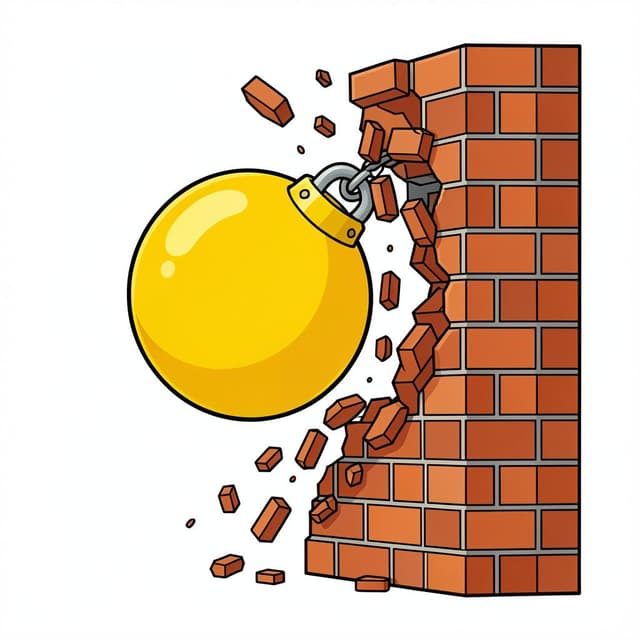
derribar — to knock down
Imperfect 'derribaba' describes ongoing or habitual past actions.
Formy derribar Czas przeszły niedokonany
Kiedy używać Czas przeszły niedokonany
Use the imperfect for descriptions in the past or actions that were happening repeatedly or continuously. For 'derribar', you might describe a scene: 'El viento derribaba los árboles' (The wind was knocking down the trees) or a habit: 'Antes derribaba torres de cartas' (I used to knock down card towers).
Uwagi dotyczące derribar w czasie Czas przeszły niedokonany
'Derribar' is regular in the imperfect indicative tense.
Przykładowe zdania
Cuando era niño, derribaba todas las construcciones de bloques.
When I was a child, I used to knock down all the block constructions.
yo
El camión derribaba postes de luz en la tormenta.
The truck was knocking down utility poles in the storm.
él/ella/usted
Los soldados derribaban las fortificaciones enemigas.
The soldiers were knocking down the enemy fortifications.
ellos/ellas/ustedes
Mientras jugábamos, derribábamos la casa de muñecas sin querer.
While we were playing, we were unintentionally knocking down the dollhouse.
nosotros
Częste błędy
Błąd: Using the preterite 'derribó' for background description.
Poprawnie: For ongoing or descriptive past actions, use the imperfect: 'derribaba' instead of 'derribó'.
Dlaczego: The imperfect sets the scene or describes continuous/habitual past actions, while the preterite marks single, completed events.
Błąd: Confusing the 'yo' and 'él/ella/usted' forms.
Poprawnie: Both 'yo' and 'él/ella/usted' use 'derribaba', but context clarifies who is acting.
Dlaczego: This is a common feature of the imperfect tense for regular -ar verbs.
Opanuj hiszpańskie czasowniki w kontekście
Zapamiętywanie tabel to dopiero początek. Przeczytaj ponad 200 ilustrowanych i udźwiękowionych hiszpańskich historii, aby zobaczyć czasowniki takie jak 'derribar' używane naturalnie — w czasach, których się uczysz.
Powiązane czasy
Czas teraźniejszy
yo: derribo
Present tense 'derribo', 'derribas', etc., describes current or habitual actions.
Czas przeszły prosty
yo: derribé
The preterite of 'derribar' is regular: derribé, derribaste, derribó, derribamos, derribasteis, derribaron.
Czas przyszły
yo: derribaré
Future tense 'derribaré', 'derribarás' etc., predicts or expresses probability.
Tryb warunkowy
yo: derribaría
Conditional 'derribaría' expresses hypotheticals ('would') or polite requests.
Tryb Subj. teraźniejszy
yo: derribe
Present subjunctive (e.g., 'derribe') is used for wishes, doubts, and emotions.
Tryb Subj. przeszły niedokonany
yo: derribara
The imperfect subjunctive (e.g., 'derribara', 'derribase') expresses past hypotheticals or wishes.
Tryb rozkazujący (twierdzący)
yo: derriba
Use imperative forms like 'derriba' (tú) for direct commands with 'derribar'.
Tryb rozkazujący (przeczący)
yo: no derribes
Negative commands use 'no' + present subjunctive forms, like 'no derribes' (tú).