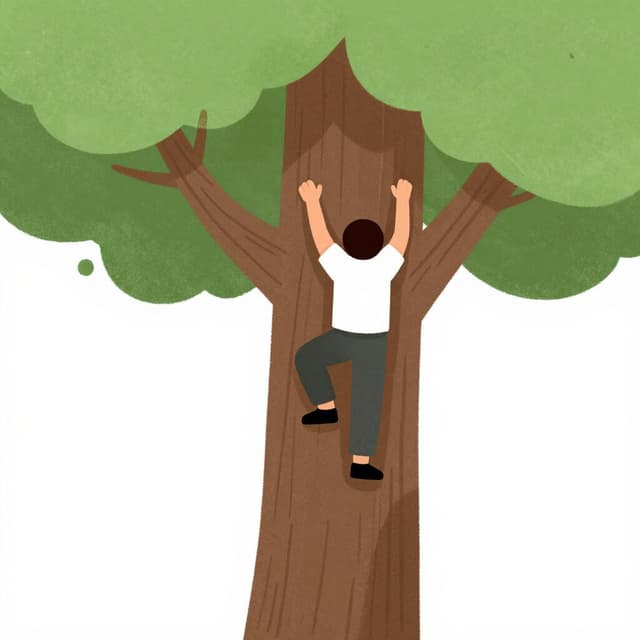
Koniugacja trepar Tryb rozkazujący (przeczący)
trepar — to climb
Use 'no trepes' and 'no trepéis' for negative commands to 'tú' and 'vosotros'.
Formy trepar Tryb rozkazujący (przeczący)
Kiedy używać Tryb rozkazujący (przeczący)
This is for telling someone *not* to do something. For example, 'No trepes tan alto' means 'Don't climb so high!' to one person informally.
Uwagi dotyczące trepar w czasie Tryb rozkazujący (przeczący)
The negative imperative for trepar is regular and uses the present subjunctive forms.
Przykładowe zdania
No trepes por ahí, es peligroso.
Don't climb around there, it's dangerous.
tú
No trepemos sin equipo.
Let's not climb without equipment.
nosotros
Chicos, no trepéis en los muebles.
Kids, don't climb on the furniture.
vosotros
No trepen por la fachada.
Don't climb up the facade.
ustedes
Częste błędy
Błąd: Using the infinitive instead of the subjunctive.
Poprawnie: Say 'No trepar' is incorrect; use 'No trepes' or 'No trepe'.
Dlaczego: Negative commands in Spanish always use the subjunctive mood.
Błąd: Forgetting the 'no'.
Poprawnie: Always include 'no' before the subjunctive verb for negative commands.
Dlaczego: The 'no' is essential to indicate it's a prohibition.
Opanuj hiszpańskie czasowniki w kontekście
Zapamiętywanie tabel to dopiero początek. Przeczytaj ponad 200 ilustrowanych i udźwiękowionych hiszpańskich historii, aby zobaczyć czasowniki takie jak 'trepar' używane naturalnie — w czasach, których się uczysz.
Powiązane czasy
Czas teraźniejszy
yo: trepo
Use 'trepo' and 'trepa' for actions happening now or habitual climbing.
Czas przeszły prosty
yo: trepé
Use 'trepé' and 'trepó' for completed climbing actions in the past.
Czas przeszły niedokonany
yo: trepaba
Use 'trepaba' and 'trepaban' for ongoing or habitual climbing in the past.
Czas przyszły
yo: treparé
Use 'treparé' and 'trepará' for actions that will happen in the future.
Tryb warunkowy
yo: treparía
Use 'treparía' and 'treparían' for hypothetical 'would' scenarios.
Tryb Subj. teraźniejszy
yo: trepe
Use 'trepe' and 'trepen' after expressions of doubt, desire, or emotion.
Tryb Subj. przeszły niedokonany
yo: trepara
Use 'trepara' or 'trepara' for past hypotheticals or wishes, like 'If I climbed...'.
Tryb rozkazujący (twierdzący)
yo: trepa
Use 'trepa' and 'trepad' for direct commands to 'tú' and 'vosotros'.