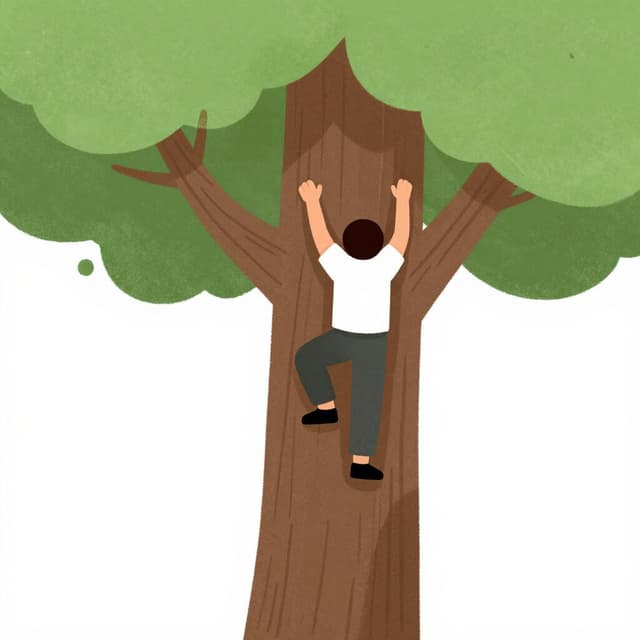
Koniugacja trepar Czas teraźniejszy
trepar — to climb
Use 'trepo' and 'trepa' for actions happening now or habitual climbing.
Formy trepar Czas teraźniejszy
Kiedy używać Czas teraźniejszy
The present tense is for actions happening right now ('Estoy trepando' - I am climbing) or for habitual actions ('Siempre trepo por la mañana' - I always climb in the morning). It's also used for general truths.
Uwagi dotyczące trepar w czasie Czas teraźniejszy
Trepar is regular in the present indicative. The 'yo' form is 'trepo'.
Przykładowe zdania
Yo trepo a los árboles a menudo.
I climb trees often.
yo
¿Tú trepas por la cuerda?
Do you climb the rope?
tú
Mi gato trepa a los tejados.
My cat climbs onto the roofs.
él/ella/usted
Nosotros trepamos por el rocódromo los fines de semana.
We climb the climbing wall on weekends.
nosotros
Częste błędy
Błąd: Using the present tense for an action that just finished.
Poprawnie: If you just finished climbing, use the preterite: 'trepé'.
Dlaczego: The present describes ongoing or habitual actions, not completed ones.
Błąd: Confusing 'trepa' (he/she/you climbs) with 'trepa' (imperative command).
Poprawnie: Context is key. 'Él trepa' is a statement, '¡Trepa!' is a command.
Dlaczego: Both forms are identical, leading to potential confusion without context.
Opanuj hiszpańskie czasowniki w kontekście
Zapamiętywanie tabel to dopiero początek. Przeczytaj ponad 200 ilustrowanych i udźwiękowionych hiszpańskich historii, aby zobaczyć czasowniki takie jak 'trepar' używane naturalnie — w czasach, których się uczysz.
Powiązane czasy
Czas przeszły prosty
yo: trepé
Use 'trepé' and 'trepó' for completed climbing actions in the past.
Czas przeszły niedokonany
yo: trepaba
Use 'trepaba' and 'trepaban' for ongoing or habitual climbing in the past.
Czas przyszły
yo: treparé
Use 'treparé' and 'trepará' for actions that will happen in the future.
Tryb warunkowy
yo: treparía
Use 'treparía' and 'treparían' for hypothetical 'would' scenarios.
Tryb Subj. teraźniejszy
yo: trepe
Use 'trepe' and 'trepen' after expressions of doubt, desire, or emotion.
Tryb Subj. przeszły niedokonany
yo: trepara
Use 'trepara' or 'trepara' for past hypotheticals or wishes, like 'If I climbed...'.
Tryb rozkazujący (twierdzący)
yo: trepa
Use 'trepa' and 'trepad' for direct commands to 'tú' and 'vosotros'.
Tryb rozkazujący (przeczący)
yo: no trepes
Use 'no trepes' and 'no trepéis' for negative commands to 'tú' and 'vosotros'.