
Aquello vs Aquel
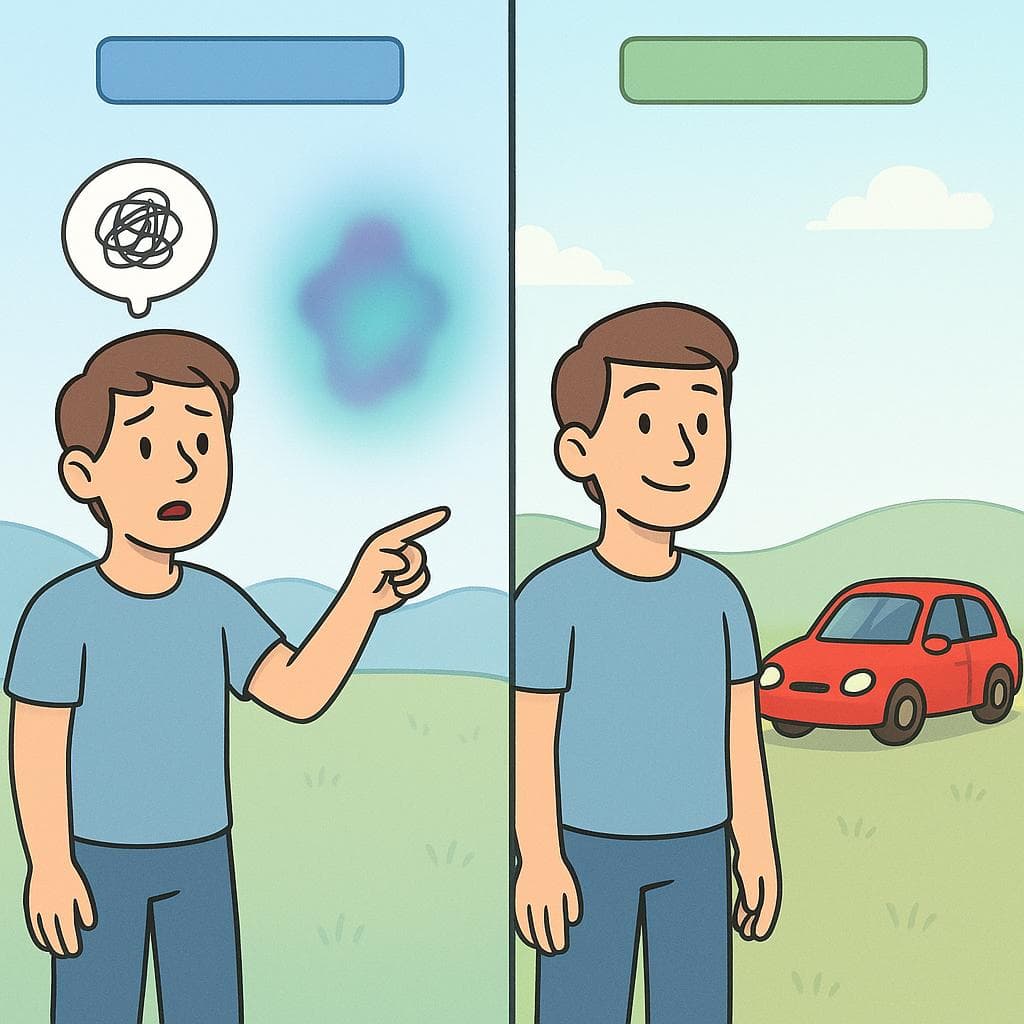
Aquel describes a noun. Aquello replaces a noun or refers to an idea.
aquello
That thing over there / That idea. A pronoun used for abstract concepts, unknown objects, or things without a specific name.
ah-KEH-yohaquel
That (over there). An adjective used to describe a specific masculine noun that is far away in distance or time.
ah-KEHLQuick Rule
Aquel describes a noun. Aquello replaces a noun or refers to an idea.
AqueL has an 'L' like a Label for a noun. AqueLLO stands alOne.
- Aquel changes for gender and number (aquella, aquellos, aquellas), but aquello never changes.
- Aquel can also be a pronoun if the noun is understood from context (e.g., '¿Cuál coche? Aquel.'). But aquello is used for things without a clear gender or name.
Comparison Table
| Context | aquello | aquel | Why? |
|---|---|---|---|
| Pointing at something | ¿Qué es aquello? | ¿Qué es aquel edificio? | Use 'aquello' for an unknown 'thing'. Use 'aquel' when you can name the 'thing' (edificio). |
| Talking about the past | Aquello fue un verano increíble. | Aquel verano fue increíble. | 'Aquello' refers to the whole experience. 'Aquel' specifies the noun 'verano'. |
| Expressing an opinion | Aquello no me parece justo. | Aquel comentario no fue justo. | 'Aquello' refers to the general situation. 'Aquel' refers to a specific noun ('comentario'). |
When to Use "aquello / aquel"
aquello
That thing over there / That idea. A pronoun used for abstract concepts, unknown objects, or things without a specific name.
ah-KEH-yoh
Referring to an abstract idea or situation
Aquello que pasó fue muy extraño.
That thing that happened was very strange.
Pointing out an unknown or unnamed object
¿Qué es aquello que brilla en la montaña?
What is that thing shining on the mountain?
Referring to a previous statement
No debiste decir eso. Aquello fue hiriente.
You shouldn't have said that. That was hurtful.
Always stands alone (never followed by a noun)
Aquello no tiene sentido.
That doesn't make sense.
aquel
That (over there). An adjective used to describe a specific masculine noun that is far away in distance or time.
ah-KEHL
Describing a specific masculine noun
Aquel edificio es el más alto de la ciudad.
That building over there is the tallest in the city.
Always comes before the noun it describes
Recuerdo a aquel profesor con mucho cariño.
I remember that teacher with much affection.
Has feminine and plural forms
Aquella casa, aquellos años, aquellas nubes.
That house, those years, those clouds.
Referring to a distant time in the past
En aquel entonces, todo era diferente.
Back in those days, everything was different.
Contrast Examples
With "aquello":
Mira, ¿qué es aquello en el cielo?
Look, what is that (thing) in the sky?
With "aquel":
Mira aquel pájaro en el cielo.
Look at that bird in the sky.
The Difference: Use 'aquello' when you don't know what the object is. Once you identify it as a 'pájaro' (bird), you switch to 'aquel' to describe it.
With "aquello":
Recuerdo aquello con cariño.
I remember that (whole experience) with affection.
With "aquel":
Recuerdo aquel día con cariño.
I remember that day with affection.
The Difference: 'Aquello' refers to the entire situation in a vague, abstract way. 'Aquel' modifies the specific noun 'día', pinpointing exactly what is being remembered.
With "aquello":
Lo que dijiste... aquello fue muy inteligente.
What you said... that was very intelligent.
With "aquel":
Aquel argumento que usaste fue muy inteligente.
That argument you used was very intelligent.
The Difference: 'Aquello' refers back to the entire previous statement or idea. 'Aquel' modifies a specific part of it, the 'argumento'.
Common Mistakes
Aquello libro es muy viejo.
Aquel libro es muy viejo.
'Aquello' can never be followed by a noun. Since 'libro' is a noun, you must use the adjective 'aquel'.
No entiendo aquel de la física cuántica.
No entiendo aquello de la física cuántica.
When referring to a concept, an idea, or 'the whole thing about...' something, use the abstract pronoun 'aquello'.
Quick Practice
Quick Quiz: Aquello vs Aquel
Question 1 of 3
Which is correct? '___ coche de allí es de mi padre.'
Related Grammar
Want to understand the grammar behind this pair? Explore these lessons for a deep dive:
Key Words





Tags
Build the instinct, not just the rule
Rules help you get it right; context makes it automatic. Read 200+ illustrated and narrated Spanish stories to see confusing pairs chosen correctly — over and over — until you stop thinking about it.
Frequently Asked Questions
So 'aquello' is just the masculine form of 'aquella'?
No, that's a common confusion! 'Aquel' is the masculine form that goes with 'aquella' (feminine). 'Aquello' is different; it's 'neuter', meaning it has no gender. You use it for concepts, ideas, or unknown things that don't have a grammatical gender.
Are there other pairs like this in Spanish?
Yes! This pattern exists for all three distances. For 'this/these': 'este' (masc), 'esta' (fem), and 'esto' (neuter/abstract). For 'that/those': 'ese' (masc), 'esa' (fem), and 'eso' (neuter/abstract). 'Aquel/aquella/aquello' is just the set for things that are furthest away.