
Caber vs Entrar
Caber is about 'if' it fits (space/capacity). Entrar is about the 'act' of going in.
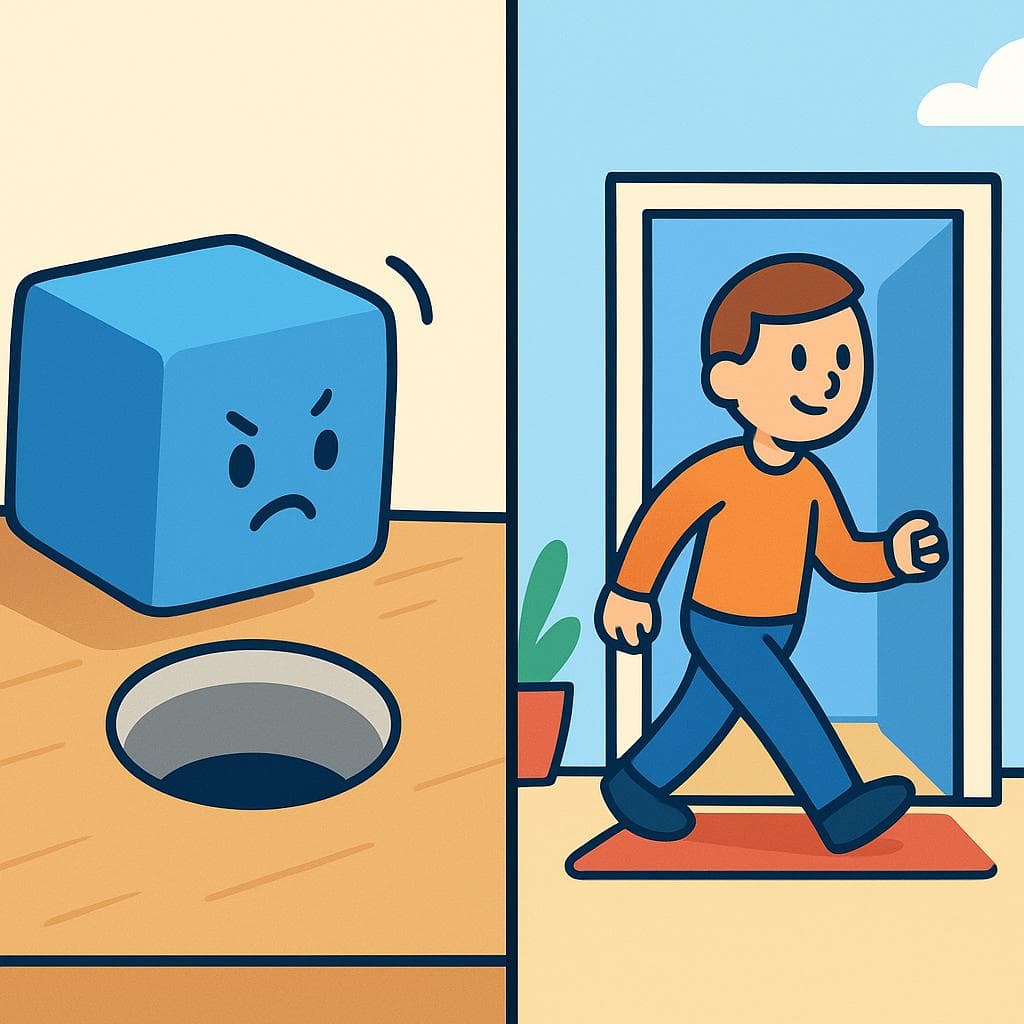
caber
To fit (in terms of space, size, or capacity)
kah-BEHRentrar
To enter, to go in, to come in
ehn-TRARQuick Rule
Caber is about 'if' it fits (space/capacity). Entrar is about the 'act' of going in.
Think: Caber = Capacity. Entrar = Entrance.
- For clothes, you often use 'entrar' to say something fits, e.g., 'Los vaqueros no me entran' (The jeans don't fit me).
Comparison Table
| Context | caber | entrar | Why? |
|---|---|---|---|
| Furniture & Rooms | La mesa no cabe en la cocina. | Vamos a entrar la mesa a la cocina. | Caber is about the size problem (it won't fit). Entrar is about the action of moving it inside. |
| People & Vehicles | ¿Cabemos todos en el ascensor? | No entres todavía, está lleno. | Caber asks about the capacity (is there enough space for us?). Entrar is the action of getting in. |
| Figurative Ideas | No me cabe en la cabeza que hiciera eso. | De repente, me entró el pánico. | Caber uses the 'space' metaphor for understanding. Entrar describes the onset or 'entering' of a feeling. |
When to Use "caber / entrar"
caber
To fit (in terms of space, size, or capacity)
kah-BEHR
Physical space/capacity
El sofá no cabe por la puerta.
The sofa doesn't fit through the door.
Number of items that can fit
En el coche caben cinco personas.
Five people fit in the car.
Figurative possibility or room
No cabe duda de que es la mejor opción.
There's no room for doubt that it's the best option.
entrar
To enter, to go in, to come in
ehn-TRAR
Entering a physical space
Por favor, entra en la casa.
Please, come into the house.
Starting something (a season, a job)
El otoño entra en septiembre.
Autumn begins in September.
Fitting into clothes (common use)
Estos pantalones ya no me entran.
These pants don't fit me anymore.
Contrast Examples
With "caber":
Mi coche no cabe en esa plaza.
My car doesn't fit in that spot. (It's too big.)
With "entrar":
No puedo entrar en esa plaza.
I can't enter that spot. (Maybe another car is blocking me.)
The Difference: Caber focuses on the static problem of size and capacity. Entrar focuses on the action of moving into the space, which could be blocked for reasons other than size.
With "caber":
Este libro no cabe en la mochila.
This book doesn't fit in the backpack. (There's no more room.)
With "entrar":
¡No entres el libro todavía!
Don't put the book in yet!
The Difference: Caber describes the backpack's capacity. Entrar (or more commonly 'meter') refers to the physical action of putting the book inside.
Common Mistakes
La llave no entra en la cerradura.
La llave no cabe en la cerradura.
While 'entrar' might be understood, 'caber' is more precise because the problem is size/shape, not the action of entering. The key is the wrong size to fit.
¿Puedes caber en la tienda?
¿Puedes entrar en la tienda?
You ask someone to perform the action of going in ('entrar'). Asking if they 'cabe' sounds strange, as if you're questioning if their body is small enough to physically fit inside the building.
Quick Practice
Quick Quiz: Caber vs Entrar
Question 1 of 2
Which is correct? 'Toda mi ropa no ___ en esta maleta pequeña.'
Related Grammar
Want to understand the grammar behind this pair? Explore these lessons for a deep dive:
Key Words

Tags
Build the instinct, not just the rule
Rules help you get it right; context makes it automatic. Read 200+ illustrated and narrated Spanish stories to see confusing pairs chosen correctly — over and over — until you stop thinking about it.
Frequently Asked Questions
Wait, so for clothes, I should use 'entrar' instead of 'caber'?
Yes, most of the time. While 'caber' isn't technically wrong, it's much more common and natural for native speakers to say 'Estos zapatos no me entran' (These shoes don't fit me) than 'no me caben'. Think of it as a common exception.
What is the 'yo' form of 'caber'? It seems weird.
It is! 'Caber' is a highly irregular verb. In the present tense, the 'yo' form is 'quepo'. For example, 'No quepo en ese asiento' (I don't fit in that seat). It's one you just have to memorize.