
Emocionar vs Emocionarse
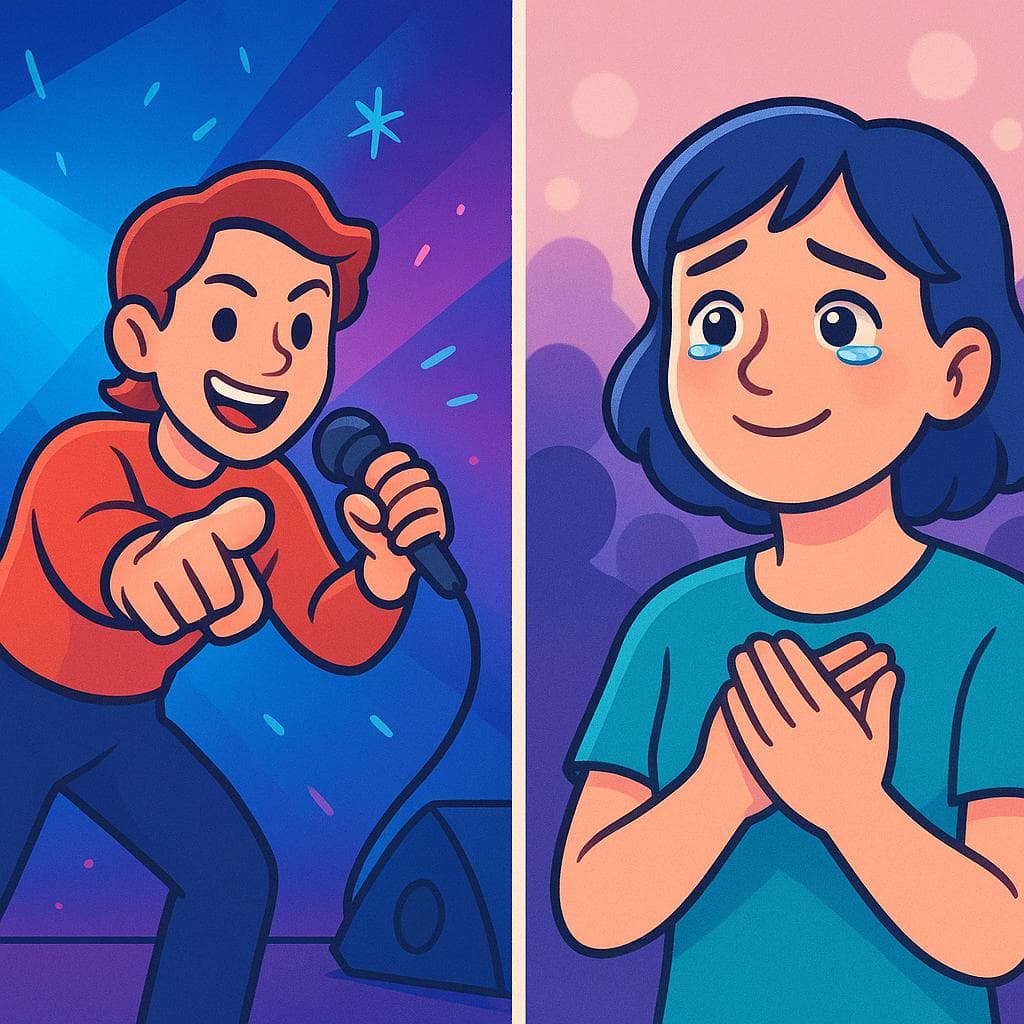
Emocionar = to excite someone else. Emocionarse = to get excited yourself.
emocionar
To excite, thrill, or move someone else. An action one thing does to another.
eh-moh-syoh-NARemocionarse
To get excited, to get emotional, to be moved. An emotion you feel inside yourself.
eh-moh-syoh-NAR-sehQuick Rule
Emocionar = to excite someone else. Emocionarse = to get excited yourself.
The '-se' is for 'self'. Emocionarse is the emotion you feel your'self'.
Comparison Table
| Context | emocionar | emocionarse | Why? |
|---|---|---|---|
| Cause vs. Feeling | La canción emociona. | Me emociono con la canción. | Emocionar is what the song DOES (it causes excitement). Emocionarse is what YOU FEEL. |
| Talking about News | La noticia emocionó a mi padre. | Mi padre se emocionó con la noticia. | Both are correct. The first focuses on the news as the 'actor'. The second focuses on the father's reaction. |
| Describing a Person | Es una persona que emociona. | Es una persona que se emociona. | The first means he is an exciting/moving person (he affects others). The second means he is an emotional person (he feels things easily). |
When to Use "emocionar / emocionarse"
emocionar
To excite, thrill, or move someone else. An action one thing does to another.
eh-moh-syoh-NAR
Something causes an emotion in you
La película me emocionó mucho.
The movie moved me a lot.
A person causes an emotion in others
Su discurso emocionó al público.
His speech moved the audience.
Asking what causes excitement
¿Qué tipo de música te emociona?
What kind of music excites you?
emocionarse
To get excited, to get emotional, to be moved. An emotion you feel inside yourself.
eh-moh-syoh-NAR-seh
You feel an emotion
Me emocioné cuando recibí la noticia.
I got excited when I received the news.
Describing someone else's emotional reaction
Ella se emociona con las sorpresas.
She gets emotional about surprises.
A group feels an emotion together
Nos emocionamos al final del partido.
We got excited at the end of the game.
Contrast Examples
With "emocionar":
Él sabe cómo emocionar al público.
He knows how to move the audience.
With "emocionarse":
Él se emociona con facilidad.
He gets emotional easily.
The Difference: With 'emocionar', he has a skill to affect others. With 'emocionarse', we're describing his own tendency to feel emotions.
With "emocionar":
Tu regalo me emocionó.
Your gift moved me.
With "emocionarse":
Me emocioné con tu regalo.
I got emotional over your gift.
The Difference: These are very similar and often interchangeable. 'Emocionar' puts the focus on the gift as the cause. 'Emocionarse' puts the focus on your personal feeling and reaction.
Common Mistakes
Yo emociono cuando veo fútbol.
Yo me emociono cuando veo fútbol.
You are the one feeling the emotion, so you need the reflexive form 'me emociono'. 'Yo emociono' would mean 'I am a person who excites others'.
La película se emocionó mucho.
La película me emocionó mucho.
A movie can't feel emotions. It causes emotions in a person (me, you, them). The movie 'emociona a alguien' (excites someone).
Quick Practice
Quick Quiz: Emocionar vs Emocionarse
Question 1 of 2
Choose the correct verb: 'La ceremonia ___ a todos los presentes.'
Related Grammar
Want to understand the grammar behind this pair? Explore these lessons for a deep dive:
Key Words

Tags
Build the instinct, not just the rule
Rules help you get it right; context makes it automatic. Read 200+ illustrated and narrated Spanish stories to see confusing pairs chosen correctly — over and over — until you stop thinking about it.
Frequently Asked Questions
Does this pattern apply to other emotion verbs?
Yes, absolutely! This is a very common pattern in Spanish. For example, 'aburrir' means 'to bore someone,' while 'aburrirse' means 'to get bored.' 'Preocupar' means 'to worry someone,' and 'preocuparse' means 'to worry (yourself).'
Can I say 'La noticia se emocionó'?
No, because inanimate objects like 'news' or 'a movie' cannot feel emotions. The reflexive '-se' implies the subject is feeling the emotion itself. Only living beings can 'emocionarse'.