
Me vs Mí
Use 'me' with a verb. Use 'mí' after a preposition (like 'a', 'para', 'de').
me
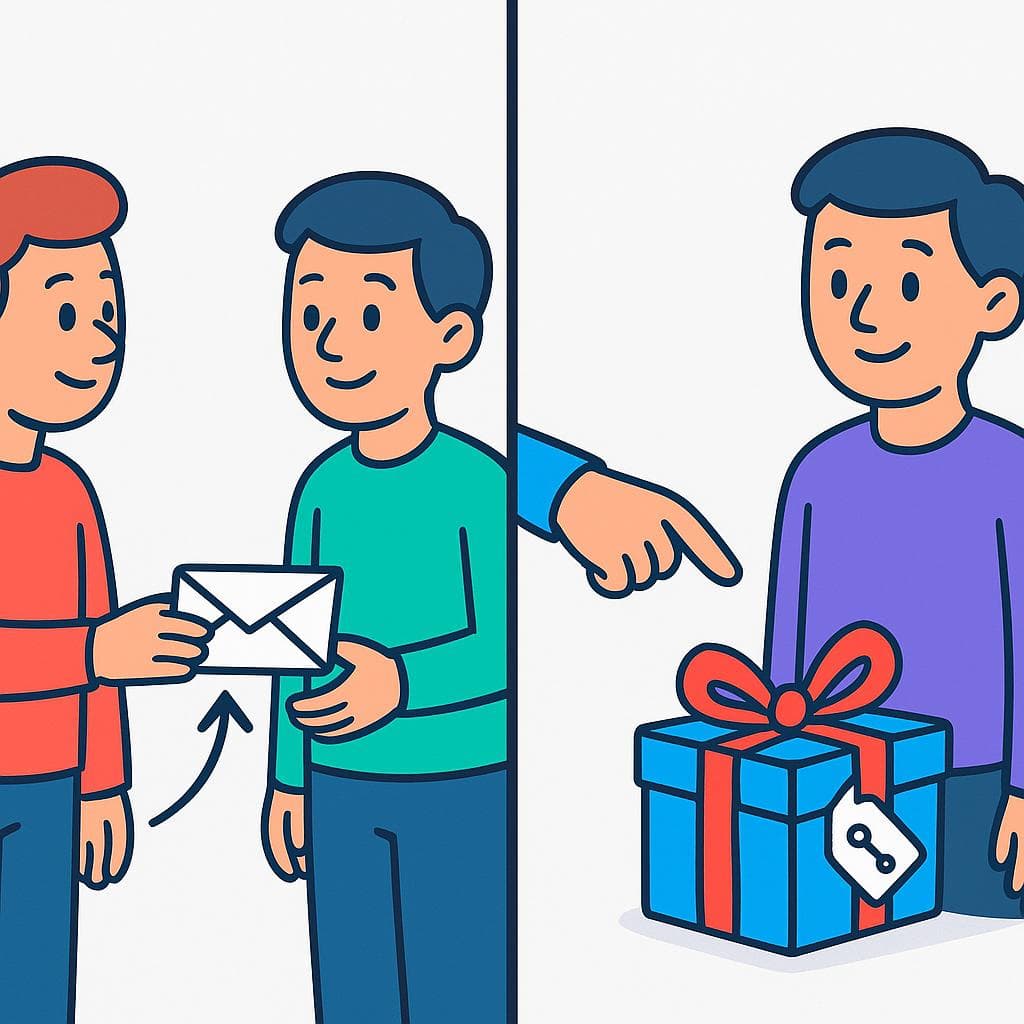
'Me' as the person receiving the action of a verb.
MEHmí
'Me' after a preposition, like 'for me', 'to me', 'about me'.
MEEQuick Rule
Use 'me' with a verb. Use 'mí' after a preposition (like 'a', 'para', 'de').
Prepositions point to Mí. (Think: a mí, para mí, de mí)
- The preposition 'con' (with) combines with 'mí' to become 'conmigo'.
- The preposition 'entre' (between) uses 'yo', not 'mí'. Example: 'entre tú y yo'.
Comparison Table
| Context | me | mí | Why? |
|---|---|---|---|
| Receiving something | Mi amigo me dio un libro. | El libro es para mí. | 'me' shows who received the action of giving. 'mí' is used after the preposition 'para'. |
| Being the topic | ¿Me entiendes? | La pregunta es sobre mí. | 'me' is the object of the verb 'entiendes'. 'mí' follows the preposition 'sobre' (about). |
| Expressing likes | Me gusta la música. | A mí también. | 'me' is required with 'gusta'. 'A mí' is used after the preposition 'a' for emphasis or to respond. |
When to Use "me / mí"
me
'Me' as the person receiving the action of a verb.
MEH
Receiving a direct action (Direct Object)
Ella me ve.
She sees me.
Receiving something indirectly (Indirect Object)
Él me da el libro.
He gives the book to me.
With reflexive verbs (doing something to yourself)
Me levanto a las siete.
I get (myself) up at seven.
mí
'Me' after a preposition, like 'for me', 'to me', 'about me'.
MEE
After 'para' (for)
Este regalo es para mí.
This gift is for me.
After 'a' (to)
A mí me gusta el café.
To me, coffee is pleasing. (I like coffee.)
After 'de' (of/from/about)
Hablan de mí.
They are talking about me.
Contrast Examples
With "me":
Mi hermano me compró un suéter.
My brother bought me a sweater.
With "mí":
El suéter es de mi hermano para mí.
The sweater is from my brother for me.
The Difference: 'Me' shows *who* received the action of buying. 'Mí' comes after the preposition 'para' to clarify who the gift is for.
With "me":
Esa película me aburre.
That movie bores me.
With "mí":
Para mí, esa película es aburrida.
For me, that movie is boring.
The Difference: 'Me' is the object of the verb 'aburrir' (to bore). 'Para mí' is a phrase used to introduce your personal opinion.
With "me":
Ella me llama todos los días.
She calls me every day.
With "mí":
La llamada es para mí.
The call is for me.
The Difference: 'Me' directly receives the action of the verb 'llamar' (to call). 'Mí' follows the preposition 'para' to state the intended recipient.
Common Mistakes
El café es para me.
El café es para mí.
After prepositions like 'para', 'a', 'de', or 'sin', you must always use 'mí', not 'me'.
A me me gusta viajar.
A mí me gusta viajar.
The preposition 'a' (to) must be followed by 'mí'. The accent is important to distinguish it from 'mi' (my).
Puedes hablar con mí.
Puedes hablar conmigo.
'Con' (with) is a special case. It combines with 'mí' to form a single word: 'conmigo'.
Quick Practice
Quick Quiz: Me vs Mí
Question 1 of 3
Which sentence is correct?
Related Grammar
Want to understand the grammar behind this pair? Explore these lessons for a deep dive:
Key Words


Tags
Build the instinct, not just the rule
Rules help you get it right; context makes it automatic. Read 200+ illustrated and narrated Spanish stories to see confusing pairs chosen correctly — over and over — until you stop thinking about it.
Frequently Asked Questions
Why does 'a mí me gusta' use both 'mí' and 'me'?
Great question! This is a feature of Spanish that feels redundant to English speakers. The 'me' is the required part of the verb 'gustar'. The 'a mí' is added for emphasis or clarity, like saying 'As for me, I like it.' So while 'Me gusta' is a complete sentence, 'A mí me gusta' is also very common for emphasis.
Is 'mí' with an accent mark different from 'mi' without one?
Yes, completely! 'Mí' (with an accent) is the pronoun we're talking about here, used after prepositions. 'Mi' (no accent) is a possessive adjective meaning 'my', as in 'mi casa' (my house). The accent mark changes the entire meaning.