
Mirar vs Ver
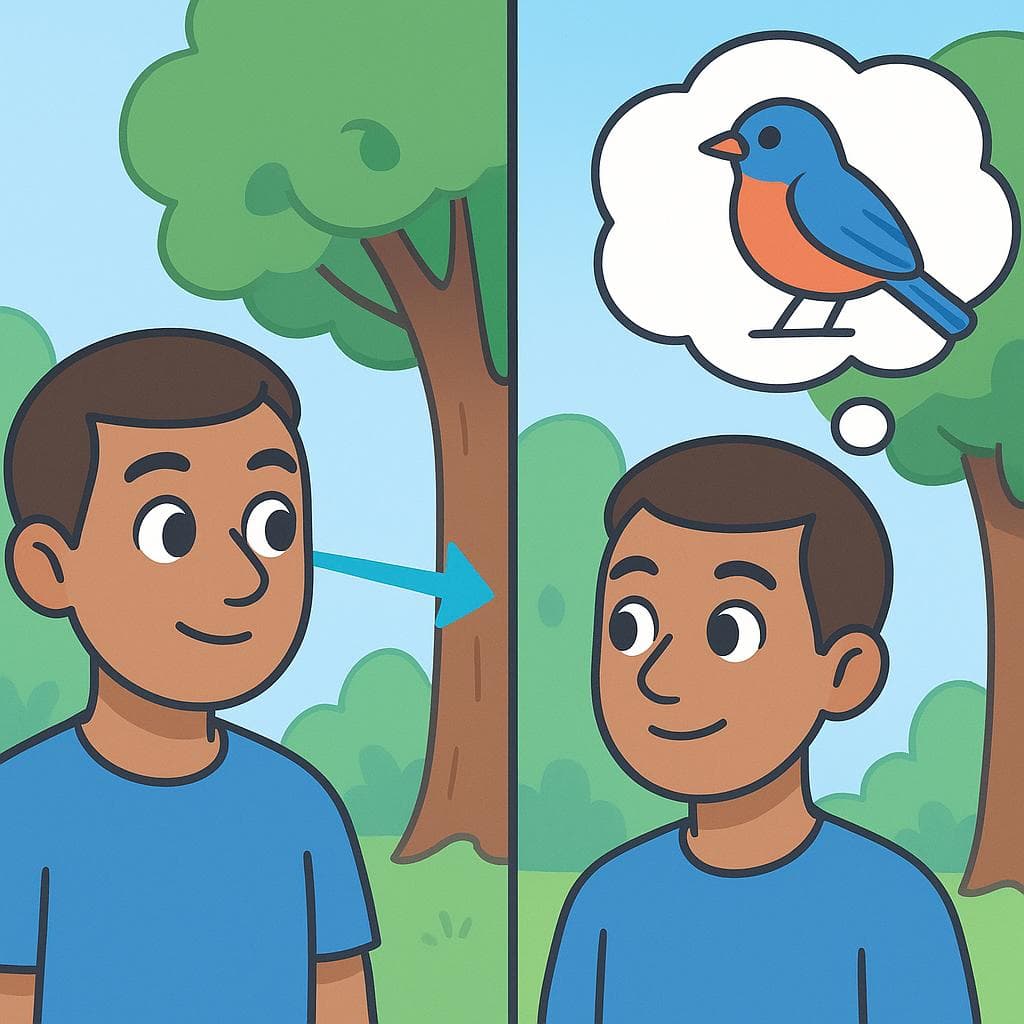
Mirar is to look (the action). Ver is to see (the result).
mirar
To look at, to watch (focusing on the action of directing your eyes)
mee-RAHRver
To see, to perceive with the eyes, to watch (a show/movie)
VEHRQuick Rule
Mirar is to look (the action). Ver is to see (the result).
Think: You have to M-ove your eyes to Mirar. You use your V-ision to Ver.
- For watching shows/movies, 'ver' is almost always the right choice, even though it feels like an intentional action.
Comparison Table
| Context | mirar | ver | Why? |
|---|---|---|---|
| Watching TV/Movies | Mira la pantalla, está sucia. | Vemos las noticias por la noche. | Mirar = looking at the physical screen. Ver = watching the content. |
| Spotting something | ¡Mira! Allá va el autobús. | ¿Ves el autobús? ¡Corre! | Mirar is the command to direct your eyes. Ver is the question about perception. |
| General Ability | Me gusta mirar el mar. | No veo bien de lejos. | Mirar is an intentional activity. Ver describes your physical ability to see. |
| Figurative Use | Mira, tenemos que hablar. | ¿Ves? Te lo dije. | Mirar is used to get someone's attention. Ver is used to confirm understanding. |
When to Use "mirar / ver"
mirar
To look at, to watch (focusing on the action of directing your eyes)
mee-RAHR
Directing your gaze
¡Mira ese pájaro!
Look at that bird!
Paying attention to something
El profesor me miró fijamente.
The teacher looked at me intently.
Checking or examining
Mira debajo de la cama.
Look under the bed.
To face a certain direction
Mi ventana mira al parque.
My window looks out onto the park.
ver
To see, to perceive with the eyes, to watch (a show/movie)
VEHR
Perceiving something with your eyes
No veo nada sin mis gafas.
I can't see anything without my glasses.
Watching movies, TV shows, or events
Anoche vimos una película de terror.
Last night we watched a horror movie.
To understand or realize
Ah, ya veo lo que quieres decir.
Ah, now I see what you mean.
To meet or visit someone
Voy a ver a mis amigos.
I'm going to see my friends.
Contrast Examples
With "mirar":
Estoy mirando el cuadro de Picasso.
I am looking at the Picasso painting. (My eyes are directed at it.)
With "ver":
Veo una guitarra en el cuadro de Picasso.
I see a guitar in the Picasso painting. (I am perceiving this detail.)
The Difference: You have to 'mirar' (look) first in order to 'ver' (see). Mirar is the action; ver is the result of that action.
With "mirar":
Mira la tele, pero no la enciendas.
Look at the TV (the physical object), but don't turn it on.
With "ver":
¿Vemos la tele un rato?
Shall we watch TV for a bit? (Watch the shows on it.)
The Difference: This is a key difference. 'Mirar la tele' is about the object itself, while 'ver la tele' is about watching the programming.
With "mirar":
¡Mira eso!
Look at that!
With "ver":
¿Ves eso?
Do you see that?
The Difference: Mirar is a command to direct someone's attention. Ver is a question to confirm if they are successfully perceiving what you're pointing at.
Common Mistakes
¿Quieres mirar una película conmigo?
¿Quieres ver una película conmigo?
For watching content like movies, series, or plays, 'ver' is the correct verb. 'Mirar una película' would imply just staring at the screen, not following the story.
No miro bien sin mis gafas.
No veo bien sin mis gafas.
When talking about your eyesight or the physical ability to perceive things, always use 'ver'. 'Mirar' is the intentional act of looking.
Quick Practice
Quick Quiz: Mirar vs Ver
Question 1 of 3
Which verb do you use to talk about your ability to see? 'No ___ bien sin gafas.'
Related Grammar
Want to understand the grammar behind this pair? Explore these lessons for a deep dive:
Key Words


Tags
Build the instinct, not just the rule
Rules help you get it right; context makes it automatic. Read 200+ illustrated and narrated Spanish stories to see confusing pairs chosen correctly — over and over — until you stop thinking about it.
Frequently Asked Questions
Is 'mirar la tele' ever correct?
Yes, but it's rare. You would use it if you're talking about the physical object, for example: 'El niño mira la tele todo el día, aunque esté apagada.' (The child looks at the TV all day, even when it's off). For watching shows, always use 'ver la tele'.
Is this distinction similar to 'oír' vs 'escuchar'?
Exactly! It's the same concept but for a different sense. 'Ver' is like 'oír' (to hear) – it's the passive sense of perception. 'Mirar' is like 'escuchar' (to listen) – it's the active, intentional action. You look (mirar) in order to see (ver), just like you listen (escuchar) in order to hear (oír).