
Negar vs Negarse
Negar = Deny a fact. Negarse = Refuse an action.
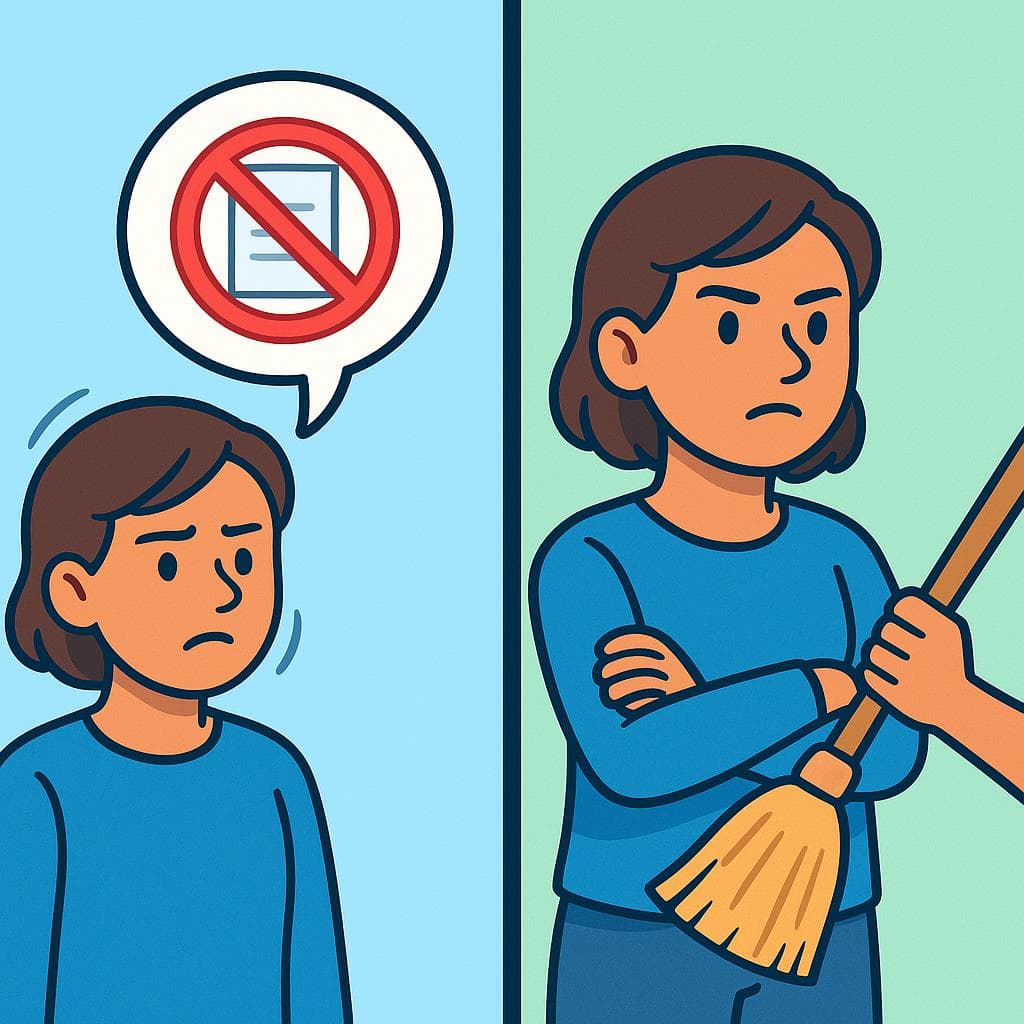
negar
To deny; to say that something is not true or did not happen.
neh-GARnegarse
To refuse; to say that you will not do something.
neh-GAR-sehQuick Rule
Negar = Deny a fact. Negarse = Refuse an action.
Think: 'Negar' is for your mouth (denying words). 'Negarse' is for your body (refusing to act).
- The main confusion comes from English, where 'deny' can mean both. For example, 'they were denied entry' is 'les negaron la entrada', not reflexive.
Comparison Table
| Context | negar | negarse | Why? |
|---|---|---|---|
| Responding to a request | Niego que sea mi responsabilidad. | Me niego a aceptar la responsabilidad. | Negar denies the fact of responsibility. Negarse refuses the action of accepting it. |
| At work | La empresa negó la existencia del problema. | La empresa se negó a solucionar el problema. | One is about denying information (the problem exists). The other is about refusing to act (to solve it). |
| In court | El testigo negó haber visto algo. | El testigo se negó a testificar. | Negar is about the content of testimony (denying you saw something). Negarse is about the act of testifying itself. |
When to Use "negar / negarse"
negar
To deny; to say that something is not true or did not happen.
neh-GAR
Denying a fact or accusation
El político negó los rumores.
The politician denied the rumors.
Denying knowledge of something
Niego saber dónde están las llaves.
I deny knowing where the keys are.
Denying something to someone (to withhold)
Le negaron el visado.
They denied him the visa.
negarse
To refuse; to say that you will not do something.
neh-GAR-seh
Refusing to do an action
Me niego a trabajar este fin de semana.
I refuse to work this weekend.
Refusing to obey an order
El niño se negó a irse a la cama.
The child refused to go to bed.
Refusing to accept or believe something
Se niega a creer que su equipo perdió.
He refuses to believe that his team lost.
Contrast Examples
With "negar":
El empleado negó el error.
The employee denied the mistake. (Said it didn't happen.)
With "negarse":
El empleado se negó a corregir el error.
The employee refused to correct the mistake. (Wouldn't do the action.)
The Difference: Negar is about saying the mistake doesn't exist. Negarse is about being unwilling to do the work to fix it.
With "negar":
El acusado negó todo.
The defendant denied everything. (Claimed all accusations were false.)
With "negarse":
El acusado se negó a declarar.
The defendant refused to testify. (Wouldn't perform the act of speaking.)
The Difference: Use 'negar' to challenge the truth of a statement. Use 'negarse' to communicate unwillingness to perform an action.
With "negar":
Negó que fuera un problema para él.
He denied that it was a problem for him.
With "negarse":
Se negó a ayudarme.
He refused to help me.
The Difference: One is about information (saying 'it's not a problem'). The other is about the action (not helping).
Common Mistakes
Yo niego a ir a la fiesta.
Yo me niego a ir a la fiesta.
When you refuse to perform an action (like 'to go'), you must use the reflexive form 'negarse'.
Él se negó que robó el dinero.
Él negó haber robado el dinero.
When you are denying a fact or a piece of information (that he stole money), use the non-reflexive 'negar'.
Quick Practice
Quick Quiz: Negar vs Negarse
Question 1 of 2
Choose the correct verb: 'El niño ___ a comer las verduras.'
Related Grammar
Want to understand the grammar behind this pair? Explore these lessons for a deep dive:
Key Words

Tags
Build the instinct, not just the rule
Rules help you get it right; context makes it automatic. Read 200+ illustrated and narrated Spanish stories to see confusing pairs chosen correctly — over and over — until you stop thinking about it.
Frequently Asked Questions
Why does 'negarse' need the 'se' part?
The 'se' is a reflexive pronoun. In Spanish, many verbs change their meaning when you add a reflexive pronoun. For this pair, the pronoun turns the meaning from 'to deny a fact' (negar) to 'to refuse an action' (negarse a + infinitive).
Can I say 'negar a hacer algo'?
No, that's incorrect. When you're talking about refusing to do an action, you must use the reflexive form: 'negarse a hacer algo'. For example, 'Me niego a salir' (I refuse to go out).