
Notar vs Darse Cuenta
Notar = notice with your senses. Darse cuenta = realize in your mind.
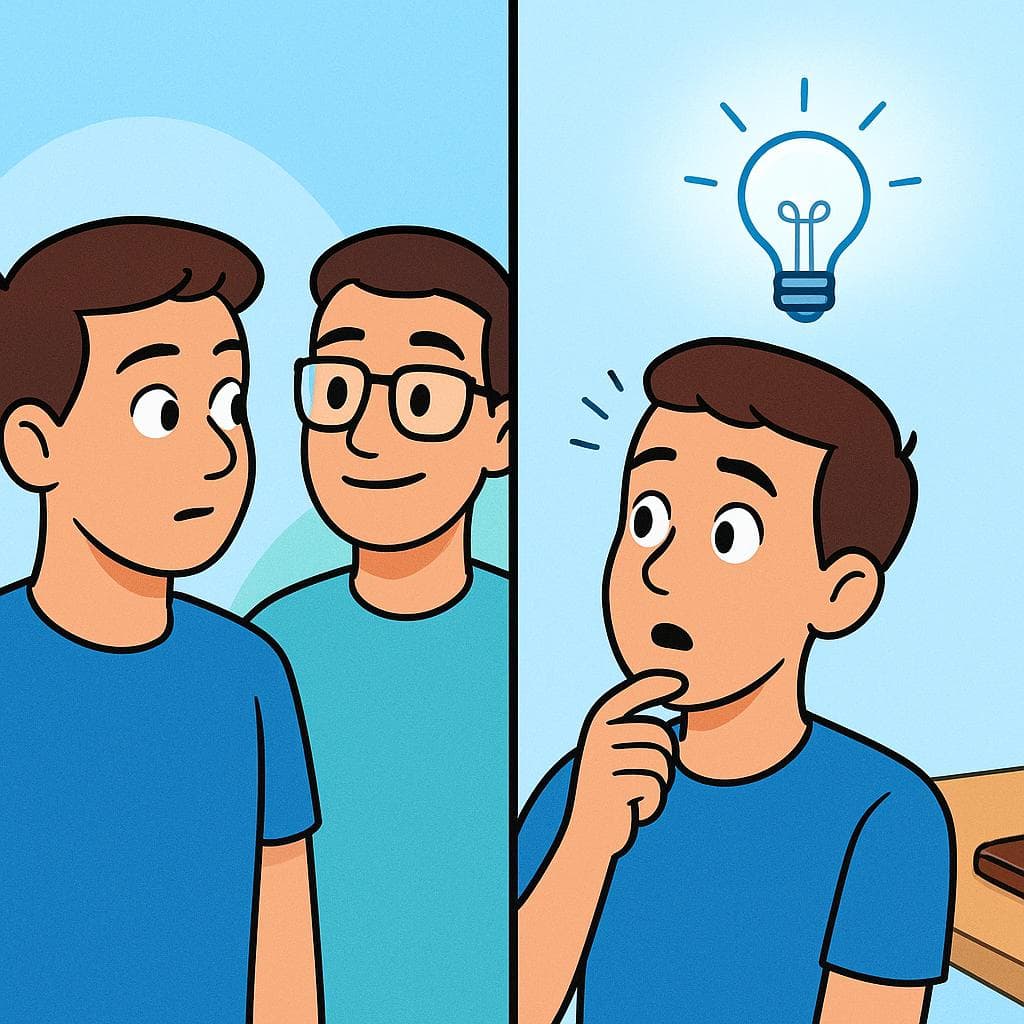
notar
To notice, observe, or perceive something directly with your senses (sight, hearing, feeling).
noh-TARdarse cuenta
To realize, become aware of, or figure something out. It's a mental process, not a sensory one.
DAR-seh KWEN-tahQuick Rule
Notar = notice with your senses. Darse cuenta = realize in your mind.
Think: 'Notar' is for your Notes (what you observe). 'Darse Cuenta' is for your Cranium (the 'aha!' moment).
- The grammar is different: you 'notar algo' (notice something) but you 'darse cuenta DE algo' (realize something).
Comparison Table
| Context | notar | darse cuenta | Why? |
|---|---|---|---|
| A person's state | Noté que temblaba. | Me di cuenta de que tenía frío. | 'Notar' for the physical observation (trembling). 'Darse cuenta' for the mental conclusion (he's cold). |
| Finding a mistake | Noté un error de ortografía. | Me di cuenta de que el cálculo estaba mal. | You 'notar' a typo you can see. You 'darse cuenta' that the logic or result is wrong. |
| Forgetting something | Noté el espacio vacío en la mesa. | Me di cuenta de que había olvidado mi móvil. | 'Notar' is observing the empty space. 'Darse cuenta' is the internal 'aha!' moment of knowing what's missing. |
When to Use "notar / darse cuenta"
notar
To notice, observe, or perceive something directly with your senses (sight, hearing, feeling).
noh-TAR
Perceiving a physical change
Noté que te cortaste el pelo.
I noticed you cut your hair.
Sensing a mood or atmosphere
Noté que todos estaban muy serios.
I noticed everyone was very serious.
Detecting with senses (smell, sound)
Noté un olor a quemado.
I noticed a burning smell.
darse cuenta
To realize, become aware of, or figure something out. It's a mental process, not a sensory one.
DAR-seh KWEN-tah
Having a realization (the 'aha!' moment)
De repente, me di cuenta de que había dejado las llaves en casa.
Suddenly, I realized I had left my keys at home.
Understanding a situation
Cuando vi su cara, me di cuenta del problema.
When I saw his face, I realized the problem.
Figuring out the truth
Se dio cuenta de que le estaban mintiendo.
He realized they were lying to him.
Contrast Examples
With "notar":
Noté que tenías mala cara.
I noticed you looked unwell.
With "darse cuenta":
Me di cuenta de que estabas enfermo.
I realized that you were sick.
The Difference: 'Notar' is the direct, visual observation (you see their face). 'Darse cuenta' is the conclusion you draw from that observation (oh, you must be sick).
With "notar":
Noté que el suelo estaba mojado.
I noticed the floor was wet.
With "darse cuenta":
Me di cuenta de que el frigorífico perdía agua.
I realized the fridge was leaking water.
The Difference: You use your senses to 'notar' the wet floor. You use your brain to connect the dots and 'darse cuenta' of the source of the problem.
With "notar":
Noté que Juan no estaba en la reunión.
I noticed Juan wasn't at the meeting.
With "darse cuenta":
Entonces me di cuenta de que la reunión era mañana.
Then I realized the meeting was tomorrow.
The Difference: 'Notar' is a simple observation of someone's absence. 'Darse cuenta' is the bigger mental leap to understand the reason why.
Common Mistakes
Me di cuenta de tu nuevo vestido.
Noté tu nuevo vestido.
You see a dress with your eyes. It's a direct observation, so 'notar' is the natural choice. 'Realizing' someone has a new dress sounds a bit strange.
Noté que la tienda ya estaba cerrada.
Me di cuenta de que la tienda ya estaba cerrada.
While you see the closed door ('notar la puerta cerrada'), the understanding that you can't go in is a mental realization. 'Darse cuenta' captures this 'oh, I get it now' feeling.
Me di cuenta que no tenía dinero.
Me di cuenta DE que no tenía dinero.
This is a grammar mistake. 'Darse cuenta' almost always needs the preposition 'de' before the thing you realize. Remember: darse cuenta DE algo.
Quick Practice
Quick Quiz: Notar vs Darse Cuenta
Question 1 of 3
A friend gets a new tattoo. What's the most natural way to say you saw it?
Related Grammar
Want to understand the grammar behind this pair? Explore these lessons for a deep dive:
Key Words



Tags
Build the instinct, not just the rule
Rules help you get it right; context makes it automatic. Read 200+ illustrated and narrated Spanish stories to see confusing pairs chosen correctly — over and over — until you stop thinking about it.
Frequently Asked Questions
Can 'realizar' be used to mean 'to realize'?
This is a very common mistake for English speakers! In Spanish, 'realizar' means 'to carry out', 'to accomplish', or 'to make real'. It does not mean 'to realize'. To say 'I realize', you must use 'me doy cuenta'.
Can 'notar' and 'darse cuenta' ever be interchangeable?
Sometimes, but rarely. For example, if you see a friend is sad, you could say 'Noté que estabas triste' (I noticed you were sad) or 'Me di cuenta de que estabas triste' (I realized you were sad). The first focuses on your observation, the second on your conclusion. But the core difference (senses vs. mind) is the best guide to follow 99% of the time.