
Olvidar vs Olvidarse de
Olvidar = to forget (you take the blame). Olvidarse de = it was forgotten (it was an accident).
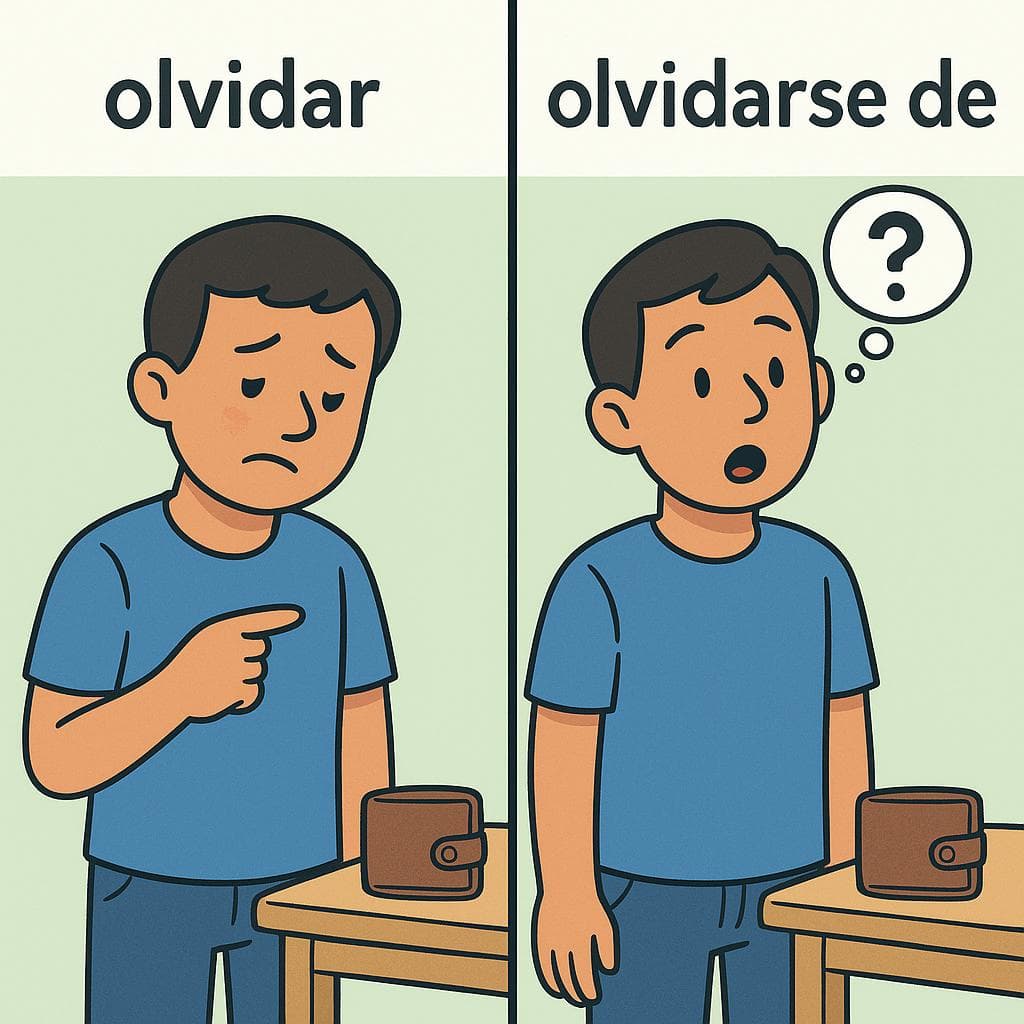
olvidar
To forget (direct, often implying responsibility or a simple failure to remember)
ol-bee-DARolvidarse de
To forget (indirect, emphasizing that it slipped one's mind accidentally)
ol-bee-DAR-seh dehQuick Rule
Olvidar = to forget (you take the blame). Olvidarse de = it was forgotten (it was an accident).
Think: Olvidar = I forgot (my fault). Olvidar-SE = It Slipped my mind (accidental).
- In casual speech, they are often used interchangeably, but 'se me olvidó' is the classic way to express accidental forgetting.
Comparison Table
| Context | olvidar | olvidarse de | Why? |
|---|---|---|---|
| Leaving something | Olvidé el libro. | Se me olvidó el libro. | A is a direct statement: 'I forgot the book.' B is accidental: 'The book was forgotten by me,' implying it wasn't my fault. |
| Forgetting an event | Olvidé la reunión. | Me olvidé de la reunión. | Both are correct. A is a straightforward fact. B emphasizes the mental lapse, that it slipped your mind. |
| Grammar Structure | Olvidé llamarte. | Me olvidé de llamarte. | Notice the structure: 'olvidar + verb' vs. 'olvidarse + de + verb'. You must include 'de' with the 'se' form. |
When to Use "olvidar / olvidarse de"
olvidar
To forget (direct, often implying responsibility or a simple failure to remember)
ol-bee-DAR
Forgetting information directly
Olvidé la respuesta del examen.
I forgot the answer to the test.
Forgetting to do something (an action)
Olvidé comprar leche.
I forgot to buy milk.
Leaving something behind (taking responsibility)
Olvidé mi paraguas en la oficina.
I forgot my umbrella at the office.
olvidarse de
To forget (indirect, emphasizing that it slipped one's mind accidentally)
ol-bee-DAR-seh deh
Something slipping your mind
Me olvidé de que hoy era tu cumpleaños.
I forgot that today was your birthday.
The 'accidental se' construction
Se me olvidaron las llaves.
I forgot the keys. (Literally: The keys were forgotten by me.)
Forgetting about a person or topic
Nunca me olvidaré de este viaje.
I will never forget about this trip.
Contrast Examples
With "olvidar":
Olvidé las llaves en casa.
I forgot the keys at home. (It's my fault.)
With "olvidarse de":
Se me olvidaron las llaves en casa.
I forgot the keys at home. (It happened to me, it was an accident.)
The Difference: Using 'olvidé' sounds like you are taking direct responsibility. The 'se me olvidaron' construction is extremely common and shifts the blame away from you, making it sound like an unfortunate accident.
With "olvidar":
Olvidé nuestro aniversario.
I forgot our anniversary. (A direct, almost blunt admission.)
With "olvidarse de":
Me olvidé de nuestro aniversario.
I forgot about our anniversary. (Softer, implies it slipped my mind.)
The Difference: Both are bad, but 'olvidé' can sound more serious, like a conscious failure. 'Me olvidé de' frames it as a mental error, which can sometimes soften the blow.
Common Mistakes
Me olvidé las llaves.
Me olvidé de las llaves. (or) Se me olvidaron las llaves.
If you use the reflexive form 'me olvidé', you must include the preposition 'de' before the thing you forgot.
Olvidé de apagar la luz.
Olvidé apagar la luz.
The simple verb 'olvidar' connects directly to another verb. You don't need 'de' in this case.
Quick Practice
Quick Quiz: Olvidar vs Olvidarse de
Question 1 of 2
To say 'I accidentally left my keys,' which is the most natural choice?
Related Grammar
Want to understand the grammar behind this pair? Explore these lessons for a deep dive:
Key Words

Tags
Build the instinct, not just the rule
Rules help you get it right; context makes it automatic. Read 200+ illustrated and narrated Spanish stories to see confusing pairs chosen correctly — over and over — until you stop thinking about it.
Frequently Asked Questions
So, is 'olvidar' always my fault and 'olvidarse de' always an accident?
That's the best way to think about it! 'Olvidar' puts you as the subject who forgot. 'Se me olvidó' makes the thing you forgot the subject of the sentence, which is a clever way Spanish expresses accidents. 'Me olvidé de' is a middle ground but still feels less direct than just 'olvidé'.
What is that 'se me olvidaron' structure? It looks weird.
It's called the 'accidental se' or 'involuntary se'. You'll see it with other verbs like 'caer' (to fall) -> 'se me cayó el vaso' (I dropped the glass) or 'romper' (to break) -> 'se me rompió el plato' (I broke the plate). It's a very common way to describe accidents without taking direct blame.