
Pelear vs Luchar
Pelear = a direct fight (physical or verbal). Luchar = a struggle for a cause or goal.
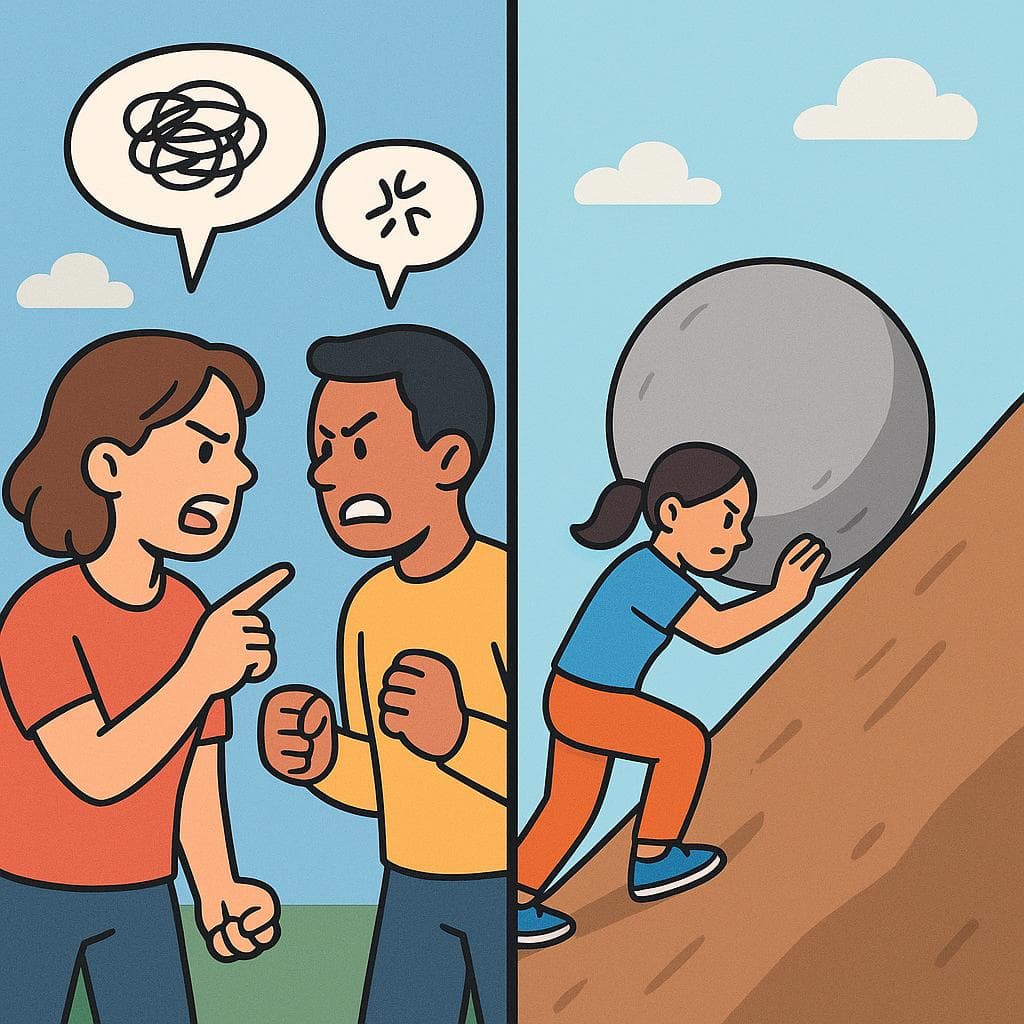
pelear
To fight, argue, or quarrel. It usually involves a direct, often personal, conflict.
peh-leh-ARluchar
To struggle, strive, or fight for a larger goal, ideal, or against a significant obstacle.
loo-CHARQuick Rule
Pelear = a direct fight (physical or verbal). Luchar = a struggle for a cause or goal.
You 'pelear' WITH a person, but 'luchar' FOR a purpose.
- Luchar can sometimes mean physical fighting (like wrestling or boxing), but this is less common in everyday speech than pelear.
- Pelear can sometimes be used for striving for something in a competitive way, like in sports.
Comparison Table
| Context | pelear | luchar | Why? |
|---|---|---|---|
| Personal Conflict | Dejaron de hablarse porque pelearon. | Luchó contra su adicción por años. | Pelear is for a specific argument between people. Luchar is for a long-term struggle against a personal demon or condition. |
| Achieving Goals | Los dos equipos pelean por el campeonato. | Ella lucha por un futuro mejor para sus hijos. | Pelear implies direct, head-to-head competition. Luchar implies a broader, more noble, and sustained effort towards a goal. |
| Physical Confrontation | Vi a dos personas peleando en la calle. | El bombero luchó contra el fuego. | Pelear is used for fights between individuals. Luchar is used for struggling against a powerful, impersonal force (like fire, a storm, or a disease). |
When to Use "pelear / luchar"
pelear
To fight, argue, or quarrel. It usually involves a direct, often personal, conflict.
peh-leh-AR
Physical fights
Los dos boxeadores van a pelear mañana.
The two boxers are going to fight tomorrow.
Verbal arguments
Mis hermanos siempre pelean por el control remoto.
My brothers always argue over the remote control.
Inner conflict (less common)
Peleo contra el impulso de comerme todo el pastel.
I'm fighting the impulse to eat the whole cake.
luchar
To struggle, strive, or fight for a larger goal, ideal, or against a significant obstacle.
loo-CHAR
Fighting for a cause or rights
Lucharon por la igualdad.
They fought for equality.
Struggling against an obstacle
Está luchando contra una enfermedad grave.
He is fighting against a serious illness.
Striving for a personal goal
Lucho todos los días para ser mejor persona.
I strive every day to be a better person.
Contrast Examples
With "pelear":
Peleé con mi jefe por el horario.
I argued with my boss about the schedule.
With "luchar":
Luché contra mi jefe por mejores condiciones laborales.
I fought against my boss for better working conditions.
The Difference: 'Pelear' suggests a specific, personal disagreement. 'Luchar' elevates the conflict to a principled stand for a greater good.
With "pelear":
Me peleo con la tecnología todos los días.
I fight with technology every day. (A daily annoyance.)
With "luchar":
Lucho por sobrevivir en una ciudad difícil.
I struggle to survive in a difficult city. (A serious, ongoing effort.)
The Difference: 'Pelear con algo' often expresses frustration with an inanimate object or concept. 'Luchar por algo' describes a significant, sustained effort to overcome a major challenge.
Common Mistakes
La gente pelea por la justicia social.
La gente lucha por la justicia social.
For abstract ideals like 'justice', 'freedom', or 'equality', the correct verb is 'luchar'. 'Pelear' would imply people are physically brawling in the streets.
Estoy luchando con mi hermana por el coche.
Estoy peleando con mi hermana por el coche.
For a simple, everyday argument or disagreement with someone, 'pelear' is the natural choice. 'Luchar' sounds overly dramatic, as if it were a life-or-death struggle.
Quick Practice
Quick Quiz: Pelear vs Luchar
Question 1 of 2
Activists often ___ for human rights.
Related Grammar
Want to understand the grammar behind this pair? Explore these lessons for a deep dive:
Present Tense Regular -AR Verbs
Both 'pelear' and 'luchar' are regular -ar verbs, so knowing this conjugation pattern is essential.
Preterite vs Imperfect
When talking about past fights or struggles, choosing between the preterite (a specific fight) and imperfect (an ongoing struggle) is a key skill.
Key Words




Tags
Build the instinct, not just the rule
Rules help you get it right; context makes it automatic. Read 200+ illustrated and narrated Spanish stories to see confusing pairs chosen correctly — over and over — until you stop thinking about it.
Frequently Asked Questions
Can I ever use 'luchar' for a physical fight?
Yes, especially in specific contexts like professional wrestling ('lucha libre') or historical battles ('los soldados lucharon valientemente'). However, for a common street fight or a boxing match, 'pelear' is much more common.
What are the noun forms?
They follow the same logic! 'Una pelea' is a single fight or argument ('Tuvieron una pelea' - They had a fight). 'Una lucha' is a struggle or a campaign ('Es una lucha constante' - It's a constant struggle).