
Seguir vs Perseguir
Seguir = to follow a path. Perseguir = to chase a target.
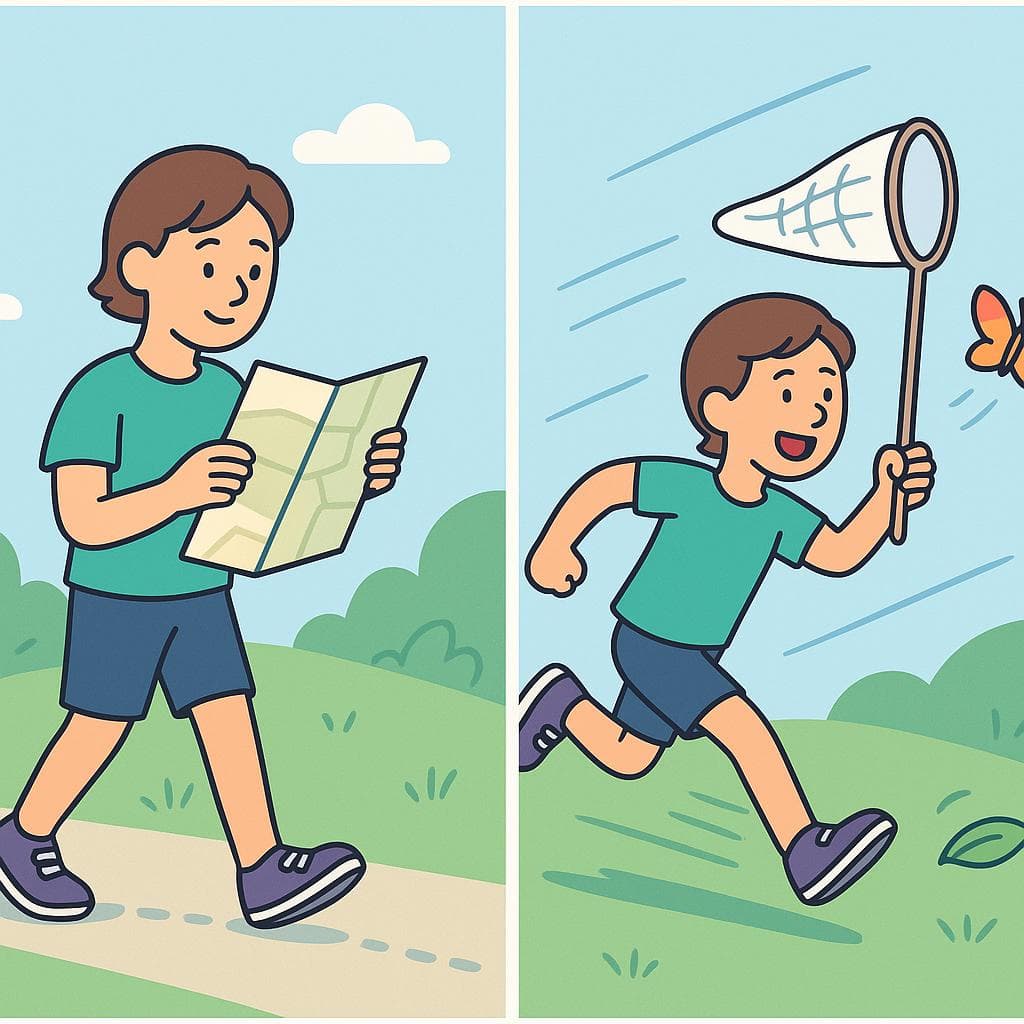
seguir
To follow (a path, a person, instructions); to continue or keep doing something.
seh-GEERperseguir
To chase, pursue, or run after a person, animal, or goal.
pehr-seh-GEERQuick Rule
Seguir = to follow a path. Perseguir = to chase a target.
Think: Perseguir has a P for Pursue. You pursue a person or a passion.
- Seguir + gerund means 'to keep doing' something (e.g., Sigo trabajando = I'm still working).
- Perseguir can also mean 'to persecute' or 'to haunt'.
Comparison Table
| Context | seguir | perseguir | Why? |
|---|---|---|---|
| On the street | Sigue recto por esta calle. | El perro persigue la bicicleta. | Seguir for following a route. Perseguir for chasing a moving target. |
| Interacting with people | Sigo a mi artista favorito en redes. | El paparazzi persigue al actor. | Seguir is a neutral 'follow' (like on social media). Perseguir implies an intense, often unwanted, chase. |
| Goals and Ambitions | Sigue con tu plan, vas bien. | Persigue tus sueños sin descanso. | Seguir con means to continue something already started. Perseguir means to actively go after a goal. |
When to Use "seguir / perseguir"
seguir
To follow (a path, a person, instructions); to continue or keep doing something.
seh-GEER
Following a path or directions
Sigue esta calle hasta el final.
Follow this street to the end.
Following someone (not chasing)
Te sigo en Instagram.
I follow you on Instagram.
Following instructions or advice
Debes seguir las reglas.
You must follow the rules.
To continue or keep doing something
Él sigue esperando la respuesta.
He is still waiting for the answer.
perseguir
To chase, pursue, or run after a person, animal, or goal.
pehr-seh-GEER
Physically chasing someone or something
El gato persigue al ratón.
The cat chases the mouse.
Pursuing a goal or dream
Ella persigue su sueño de ser cantante.
She is pursuing her dream of being a singer.
When police pursue a suspect
La policía persigue al ladrón por toda la ciudad.
The police are chasing the thief all over the city.
To persecute or harass
El recuerdo de ese día me persigue.
The memory of that day haunts me.
Contrast Examples
With "seguir":
Sigue a ese coche discretamente.
Follow that car discreetly.
With "perseguir":
¡Persigue a ese coche! ¡Que no escape!
Chase that car! Don't let it get away!
The Difference: Seguir is about maintaining a distance and observing. Perseguir is an urgent chase with the goal of catching up.
With "seguir":
Sigo estudiando para ser médico.
I'm still studying to be a doctor.
With "perseguir":
Persigo mi sueño de ser médico.
I'm pursuing my dream of being a doctor.
The Difference: Seguir describes the continuation of the action (studying). Perseguir describes the active pursuit of the overall ambition (the dream).
With "seguir":
Sigue tu corazón.
Follow your heart. (Listen to your feelings.)
With "perseguir":
Persigue lo que tu corazón desea.
Chase what your heart desires. (Actively go after your passions.)
The Difference: Seguir here is more passive, like listening to an inner guide. Perseguir is active, about taking action to achieve your passions.
Common Mistakes
Persigo las instrucciones del mapa.
Sigo las instrucciones del mapa.
You 'follow' instructions, you don't 'chase' them. Chasing implies they are running away from you!
El detective persigue al coche para ver a dónde va.
El detective sigue al coche para ver a dónde va.
If the goal is to observe without being noticed, 'seguir' (to follow) is correct. 'Perseguir' implies a high-speed chase where the other car knows it's being followed.
Quick Practice
Quick Quiz: Seguir vs Perseguir
Question 1 of 3
If you are trying to catch a bus that is leaving, you would...
Related Grammar
Want to understand the grammar behind this pair? Explore these lessons for a deep dive:
Key Words


Tags
Build the instinct, not just the rule
Rules help you get it right; context makes it automatic. Read 200+ illustrated and narrated Spanish stories to see confusing pairs chosen correctly — over and over — until you stop thinking about it.
Frequently Asked Questions
Can 'seguir' ever mean to chase?
Not really. It means 'to follow'. While you might follow someone closely, 'seguir' lacks the intensity and intent to catch that 'perseguir' has. If there's a chase, it's always 'perseguir'.
They both come from the Latin word for 'to follow', right?
Yes, that's why they're so similar! Both come from the Latin 'sequi'. The 'per-' in 'perseguir' is an intensifier, meaning 'thoroughly' or 'to the end'. So you can think of it as 'to follow thoroughly' or 'to follow to the very end', which evolved into our modern meaning of 'to chase' or 'pursue'.