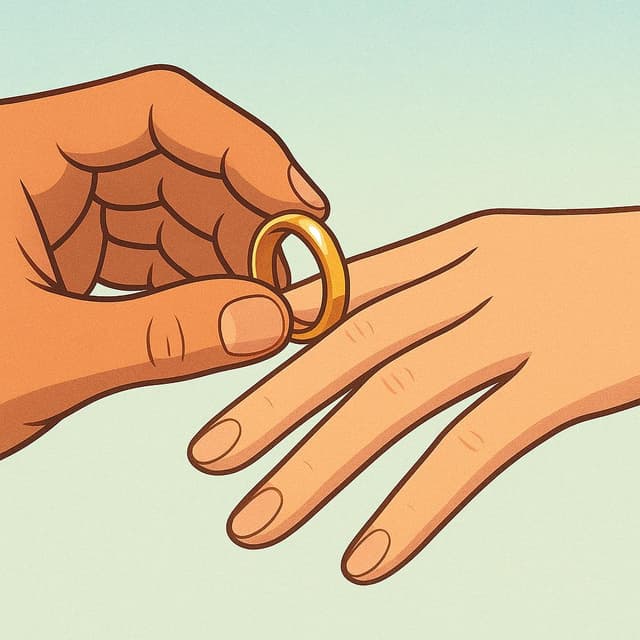
casarse Affirmative Imperative Conjugation
casarse — to get married
The affirmative imperative of casarse attaches pronouns to the end: cásate, cásese, casémonos, casaos, cásense.
casarse Affirmative Imperative Forms
When to Use the Affirmative Imperative
Use this for direct advice or commands to get married.
Notes on casarse in the Affirmative Imperative
Note the accent marks added to maintain the stress when the pronoun is attached. For 'nosotros', the 's' is dropped: casémonos (not casémosnos). For 'vosotros', the 'd' is dropped: casaos (not casados).
Example Sentences
¡Cásate conmigo!
Marry me!
tú
Casémonos en Las Vegas.
Let's get married in Las Vegas.
nosotros
Casaos si realmente os queréis.
Get married (plural) if you really love each other.
vosotros
Common Mistakes
Mistake: Writing 'casate' without the accent.
Correct: cásate
Why: Adding the pronoun 'te' shifts the word length, requiring an accent to keep the stress on the 'ca' syllable.
Mistake: Using 'casarnos' for 'let's get married'.
Correct: casémonos
Why: The command form for 'we' is the subjunctive form minus the final 's' plus 'nos'.
Master Spanish verbs in context
Memorizing tables only gets you so far. Read 200+ illustrated and narrated Spanish stories to see verbs like 'casarse' used naturally — in the tenses you're learning.
Related Tenses
Present
yo: me caso
The present tense of casarse is regular: me caso, te casas, se casa, nos casamos, os casáis, se casan.
Preterite
yo: me casé
The preterite of casarse is regular: me casé, te casaste, se casó, nos casamos, os casasteis, se casaron.
Imperfect
yo: me casaba
The imperfect of casarse is regular and follows the -ar pattern: me casaba, te casabas, se casaba, nos casábamos, os casabais, se casaban.
Future
yo: me casaré
The future of casarse uses the infinitive as the stem: me casaré, te casarás, se casará, nos casaremos, os casaréis, se casarán.
Conditional
yo: me casaría
The conditional of casarse is regular: me casaría, te casarías, se casaría, nos casaríamos, os casaríais, se casarían.
Present Subjunctive
yo: me case
The present subjunctive of casarse is regular: me case, te cases, se case, nos casemos, os caséis, se casen.
Imperfect Subjunctive
yo: me casara
The imperfect subjunctive of casarse uses the -ra endings: me casara, te casaras, se casara, nos casáramos, os casarais, se casaran.
Negative Imperative
yo: no te cases
The negative imperative of casarse uses the present subjunctive: no te cases, no se case, no nos casemos, no os caséis, no se casen.