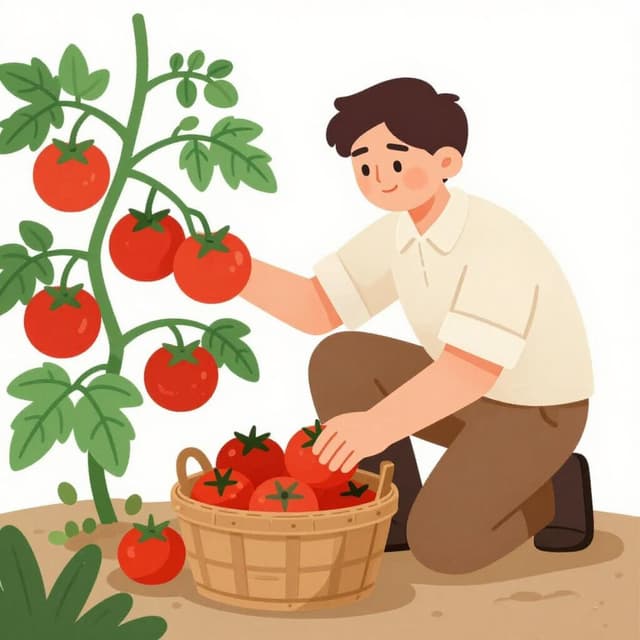
cosechar Conditional Conjugation
cosechar — to harvest
Use conditional for hypothetical harvests ('I would harvest') or polite requests, like 'cosecharía' or 'cosecharían'.
cosechar Conditional Forms
When to Use the Conditional
The conditional is for hypothetical situations ('I would harvest if I had time'), polite requests ('Would you harvest this for me?'), or to express future actions from a past perspective ('He said he would harvest it'). For example, 'Yo cosecharía más si tuviera ayuda' (I would harvest more if I had help).
Notes on cosechar in the Conditional
Cosechar is regular in the conditional tense. The stem is the infinitive 'cosechar-', and the standard conditional endings are added: -ía, -ías, -ía, -íamos, -íais, -ían.
Example Sentences
Yo cosecharía las manzanas si no estuviera lloviendo.
I would harvest the apples if it weren't raining.
yo
¿Tú cosecharías más si te pagaran mejor?
Would you harvest more if they paid you better?
tú
Él dijo que cosecharía las uvas mañana.
He said he would harvest the grapes tomorrow.
él/ella/usted
Nosotros cosecharíamos todo si tuviéramos más tiempo.
We would harvest everything if we had more time.
nosotros
Ellos cosecharían el trigo si la tierra estuviera seca.
They would harvest the wheat if the ground were dry.
ellos/ellas/ustedes
Common Mistakes
Mistake: Confusing conditional with future tense.
Correct: Use 'cosecharía' for hypothetical 'would', and 'cosecharé' for definite 'will'.
Why: The conditional expresses possibility or politeness, while the future expresses certainty.
Mistake: Using the wrong stem.
Correct: The stem is the full infinitive 'cosechar-'. So it's 'cosecharía', not 'cosecharía'.
Why: Conditional stems are based on the infinitive form, just like the future tense.
Master Spanish verbs in context
Memorizing tables only gets you so far. Read 200+ illustrated and narrated Spanish stories to see verbs like 'cosechar' used naturally — in the tenses you're learning.
Related Tenses
Present
yo: cosecho
Use the present tense for habitual harvests or things happening now, like 'cosecho' (I harvest) or 'cosechan' (they harvest).
Preterite
yo: coseché
Use preterite for completed harvests, like 'coseché' (I harvested) or 'cosecharon' (they harvested).
Imperfect
yo: cosechaba
Use imperfect for ongoing or habitual past harvests, like 'yo cosechaba' (I used to harvest) or 'ellos cosechaban' (they used to harvest).
Future
yo: cosecharé
Use the future tense for harvests that will happen, like 'cosecharé' (I will harvest) or 'cosecharán' (they will harvest).
Present Subjunctive
yo: coseche
Use present subjunctive after expressions of doubt, desire, or emotion, like 'Espero que coseches bien' (I hope you harvest well).
Imperfect Subjunctive
yo: cosechara
Use imperfect subjunctive for past hypotheticals or wishes, like 'si cosechara' (if I were to harvest).
Affirmative Imperative
yo: cosecha
Use the imperative to give direct commands like 'cosecha' (harvest!) or 'cosechad' (harvest!).
Negative Imperative
yo: no coseches
Use negative commands like 'no coseches' (don't harvest) based on the present subjunctive.