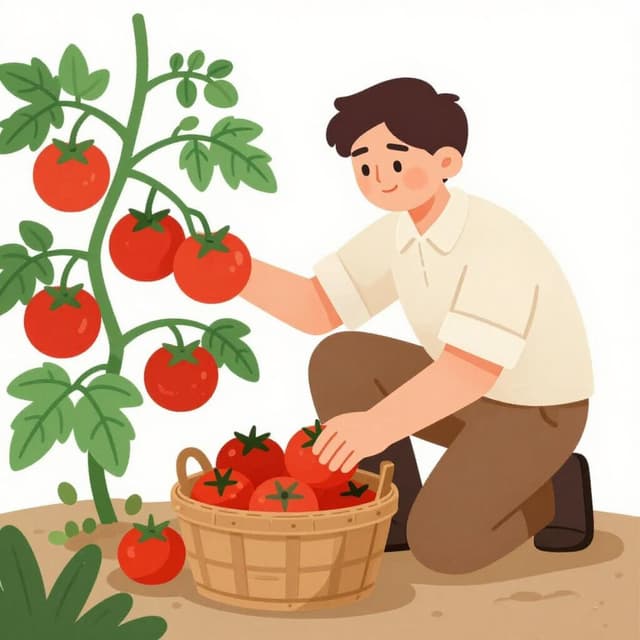
cosechar Present Conjugation
cosechar — to harvest
Use the present tense for habitual harvests or things happening now, like 'cosecho' (I harvest) or 'cosechan' (they harvest).
cosechar Present Forms
When to Use the Present
This tense is for actions happening right now, habitual actions, or general truths. For example, 'Cada verano, cosechamos tomates' (Every summer, we harvest tomatoes) or 'El agricultor cosecha ahora mismo' (The farmer is harvesting right now).
Notes on cosechar in the Present
Cosechar is regular in the present indicative. The endings are standard for -ar verbs: -o, -as, -a, -amos, -áis, -an.
Example Sentences
Yo cosecho muchas verduras en mi huerto.
I harvest many vegetables in my garden.
yo
¿Tú cosechas café?
Do you harvest coffee?
tú
Ella cosecha flores para vender.
She harvests flowers to sell.
él/ella/usted
Nosotros cosechamos trigo todos los años.
We harvest wheat every year.
nosotros
Ellos cosechan la fruta en septiembre.
They harvest the fruit in September.
ellos/ellas/ustedes
Common Mistakes
Mistake: Using the present tense for a specific completed past action.
Correct: Use the preterite 'coseché' for a completed past harvest, not 'cosecho'.
Why: The present tense describes current or habitual actions, not finished ones.
Mistake: Confusing 'nosotros' and 'vosotros' forms.
Correct: Use 'cosechamos' for 'nosotros' and 'cosecháis' for 'vosotros'.
Why: These are distinct plural forms used in different regions or contexts.
Master Spanish verbs in context
Memorizing tables only gets you so far. Read 200+ illustrated and narrated Spanish stories to see verbs like 'cosechar' used naturally — in the tenses you're learning.
Related Tenses
Preterite
yo: coseché
Use preterite for completed harvests, like 'coseché' (I harvested) or 'cosecharon' (they harvested).
Imperfect
yo: cosechaba
Use imperfect for ongoing or habitual past harvests, like 'yo cosechaba' (I used to harvest) or 'ellos cosechaban' (they used to harvest).
Future
yo: cosecharé
Use the future tense for harvests that will happen, like 'cosecharé' (I will harvest) or 'cosecharán' (they will harvest).
Conditional
yo: cosecharía
Use conditional for hypothetical harvests ('I would harvest') or polite requests, like 'cosecharía' or 'cosecharían'.
Present Subjunctive
yo: coseche
Use present subjunctive after expressions of doubt, desire, or emotion, like 'Espero que coseches bien' (I hope you harvest well).
Imperfect Subjunctive
yo: cosechara
Use imperfect subjunctive for past hypotheticals or wishes, like 'si cosechara' (if I were to harvest).
Affirmative Imperative
yo: cosecha
Use the imperative to give direct commands like 'cosecha' (harvest!) or 'cosechad' (harvest!).
Negative Imperative
yo: no coseches
Use negative commands like 'no coseches' (don't harvest) based on the present subjunctive.