coma
“coma” means “comma” in Spanish. It has 3 different meanings depending on context:
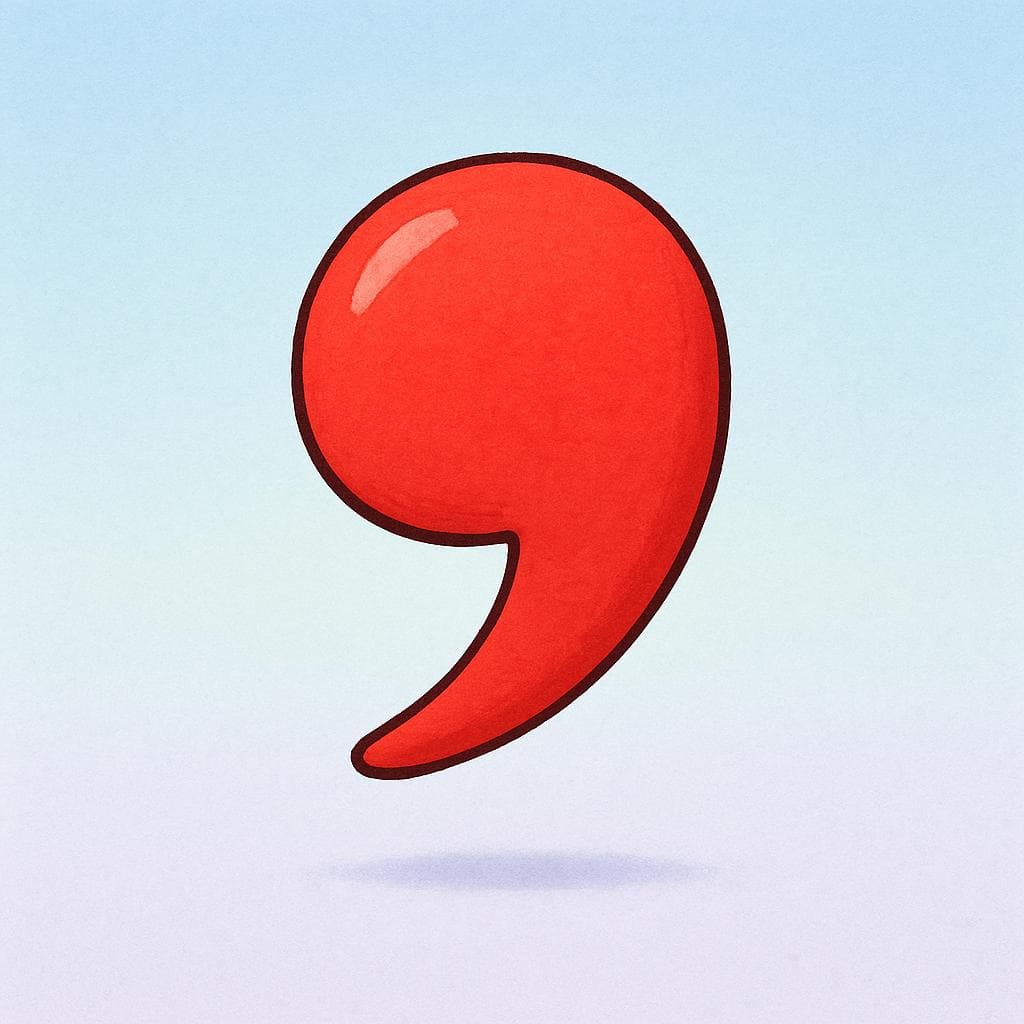


comma
📝 In Action
Necesitas poner una coma entre el sujeto y el verbo en esa frase.
A2You need to put a comma between the subject and the verb in that sentence.
Para hacer una lista, usamos comas para separar los elementos.
A1To make a list, we use commas to separate the items.
Word Connections
coma

📝 In Action
El paciente fue inducido a un coma después de la cirugía.
C1The patient was induced into a coma after the surgery.
Permaneció en coma durante tres días antes de despertar.
B2He remained in a coma for three days before waking up.
Word Connections
he/she/it eats (subjunctive), eat! (formal command)

📝 In Action
Espero que mi hijo coma más verduras hoy.
B1I hope my son eats more vegetables today.
Señor García, coma esto. Lo preparé especialmente para usted.
A2Mr. García, eat this. I prepared it specially for you.
Si ella no come bien, es importante que coma un suplemento.
B1If she doesn't eat well, it is important that she eats a supplement.
Word Connections
Indicative
Present
Imperfect
Preterite
Subjunctive
Present Subjunctive
Imperfect Subjunctive
✏️ Quick Practice
Quick Quiz: coma
Question 1 of 2
Which sentence uses the feminine noun 'la coma' correctly?
📚 More Resources
👥 Word Family
🎵 Rhymes
📚 Etymology
The word 'coma' has three separate origins, which is why it has three distinct meanings: 1. **Punctuation (la coma):** Comes from the Greek word *kómma*, meaning 'a piece cut off' or 'a short clause.' 2. **Medical State (el coma):** Comes from the Greek word *kôma*, meaning 'deep sleep.' 3. **Verb Form (de comer):** Comes from the Latin verb *comedere*, meaning 'to eat up' or 'to consume.'
First recorded: 15th century (as a medical term)
Cognates (Related words)
💡 Master Spanish
Take your Spanish to the next level. Read 200+ illustrated and narrated Spanish stories tailored to your level with the Inklingo app!
Frequently Asked Questions
How can I tell the difference between the two noun meanings of 'coma'?
The easiest way is by the article (the little word before it): 'La coma' is the punctuation mark (feminine), and 'El coma' is the medical state (masculine). Context will always make it clear.
Why does the verb 'comer' use 'coma' in the subjunctive?
In Spanish, the present subjunctive forms of '-er' and '-ir' verbs often borrow the characteristic vowel of the '-ar' verbs, which is 'a'. This vowel swap helps signal that the verb is in the special subjunctive mood.