Inklingo

enfermos

/en-FER-mos/

sick

Two young boys lying in separate beds under colorful blankets, both looking pale and unwell, illustrating the state of being sick.

When describing multiple male subjects who are unwell, we use the adjective enfermos (sick).

enfermos(Adjective)

mA1

sick

?

plural masculine

,

ill

?

plural masculine

Also:

unwell

?

plural masculine

📝 In Action

Los turistas estaban enfermos después de la cena.

A1

The tourists were sick after dinner.

Necesitamos más camas para los pacientes enfermos.

A2

We need more beds for the ill patients.

Asegúrate de que tus hijos no estén enfermos antes de viajar.

A1

Make sure your children aren't sick before traveling.

Word Connections

Synonyms

  • indispuestos (unwell)
  • malos (bad/not feeling well)

Antonyms

Common Collocations

  • están enfermosthey are sick

💡 Grammar Points

Adjective Agreement

Since 'enfermos' describes multiple masculine people (or a mixed group), it must end in '-os' to match. For multiple women, you would use 'enfermas'.

❌ Common Pitfalls

Confusing Gender

Mistake: "Las mujeres estaban enfermos."

Correction: Las mujeres estaban enfermas. (Adjectives must match the gender of the people they describe.)

⭐ Usage Tips

Using 'Estar'

To talk about temporary conditions like being sick, Spanish almost always uses the verb 'estar' (to be temporarily) rather than 'ser' (to be permanently).

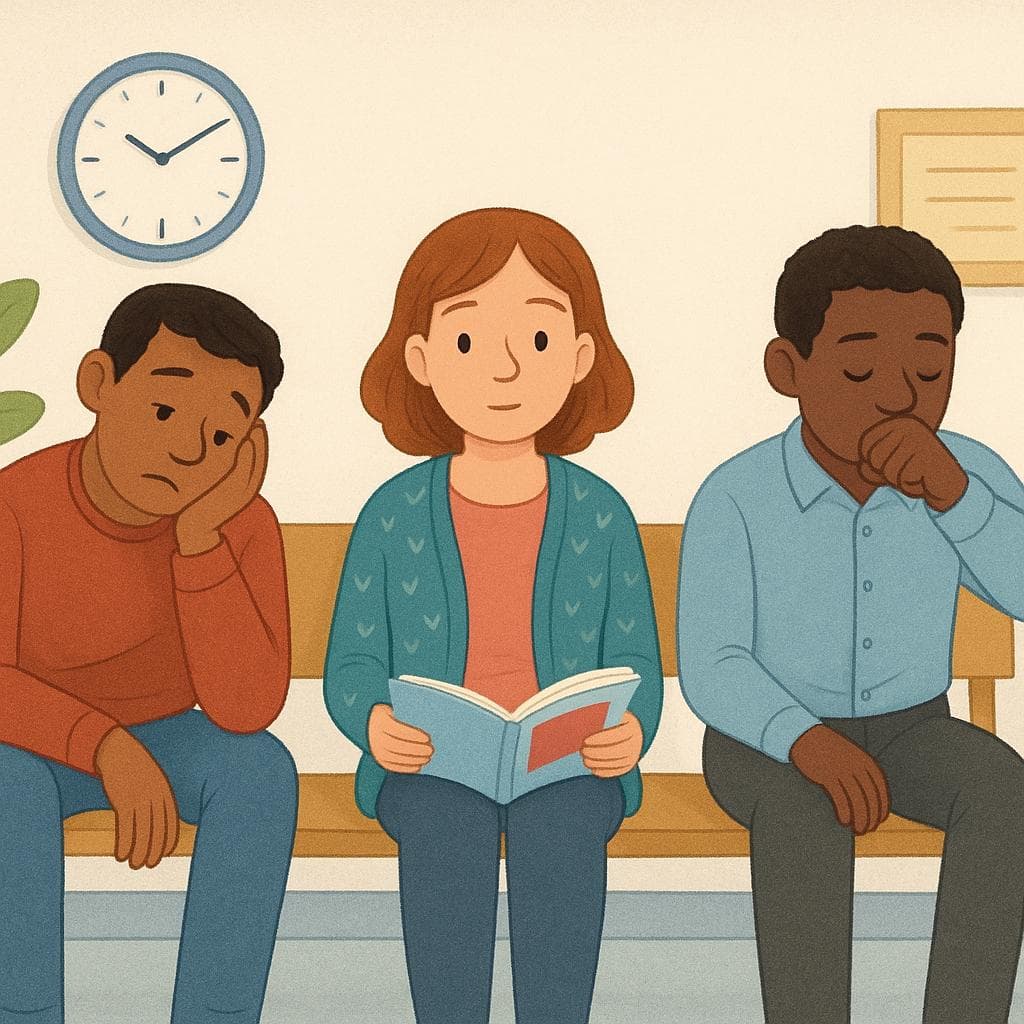
A group of three people, including men and women, sitting quietly on a wooden bench in a simple, brightly colored room. One person is resting their head on their hand, looking fatigued, representing a group of sick people.

As a noun, enfermos refers to a group of sick people or the ill.

enfermos(Noun)

mA2

sick people

?

the ill

,

patients

?

hospital setting (masculine/mixed group)

Also:

the ill

?

referring to a group

📝 In Action

La sala de espera estaba llena de enfermos.

A2

The waiting room was full of sick people (or patients).

Los enfermos necesitan cuidados especiales.

B1

The patients need special care.

Word Connections

Synonyms

  • pacientes (patients)

Antonyms

  • sanadores (healers)

Common Collocations

  • cuidar a los enfermosto care for the sick

💡 Grammar Points

Adjectives Become Nouns

In Spanish, you can place the article 'los' or 'las' in front of an adjective to turn it into a noun that refers to the group of people with that quality. 'Los enfermos' means 'the sick people' collectively.

❌ Common Pitfalls

Mixing Singular/Plural

Mistake: "El hospital tiene muchos enfermo."

Correction: El hospital tiene muchos enfermos. (When referring to many people, you need the plural form.)

⭐ Usage Tips

Formal vs. Common Usage

While 'pacientes' is more formal in a medical context, 'enfermos' is a very common and direct way to refer to people suffering from illness.

✏️ Quick Practice

💡 Quick Quiz: enfermos

Question 1 of 1

Which sentence uses 'enfermos' correctly as a noun?

📚 More Resources

Frequently Asked Questions

Does 'enfermos' come from a verb conjugation?

No. Although many Spanish words ending in *-mos* are verb forms (like *comemos*), 'enfermos' is exclusively the plural form of the noun/adjective 'enfermo' (sick person/sick). The 'nosotros' form of the verb 'enfermar' (to get sick) is actually *enfermamos*.

How do I say 'sick' for a group of women?

You must change the ending to match the feminine plural: 'enfermas'.