Inklingo

entra

/EN-trah/

he/she enters

A young person is stepping across the threshold of a brightly lit wooden doorway, clearly moving from outside to inside a room.

In its most common use, entra means he/she/you (formal) enters or comes in.

entra(Verb)

A1regular ar

he/she enters

?

going into a place

,

you enter

?

formal 'usted'

Also:

he/she comes in

?

entering the place where the speaker is

📝 In Action

El profesor entra en la clase.

A1

The teacher enters the classroom.

Mi perro nunca entra sin permiso.

A1

My dog never comes in without permission.

Disculpe, ¿usted no entra?

A2

Excuse me, are you (formal) not coming in?

Word Connections

Synonyms

  • ingresar (to enter (more formal))
  • acceder (to access, to gain entry)

Antonyms

  • salir (to leave, to exit)

Common Collocations

  • entrar en casato enter the house
  • entrar por la puertato enter through the door

💡 Grammar Points

Who is 'entra' for?

'Entra' is the form of 'entrar' you use for 'él' (he), 'ella' (she), and 'usted' (the formal 'you'). For example: 'Él entra' means 'He enters'.

'Entra' can also be a command

When you're telling a friend ('tú') to do something, you also use 'entra'. For example, '¡Entra, por favor!' means 'Come in, please!'. You can tell it's a command because there's usually no person mentioned before it.

❌ Common Pitfalls

Mixing up 'entra' and 'entro'

Mistake: "Using 'entra' when you're talking about yourself. For instance, saying 'Yo entra a la tienda.'"

Correction: The correct form for 'I' is 'entro'. So you should say, 'Yo entro a la tienda' (I enter the store). Remember: if it's about 'yo', it ends in '-o'.

⭐ Usage Tips

Use 'en' or 'a' after 'entrar'

When you say you're entering a place, you can use either 'en' or 'a' right after the verb. Both 'entra en la casa' and 'entra a la casa' are correct and mean 'he/she enters the house'.

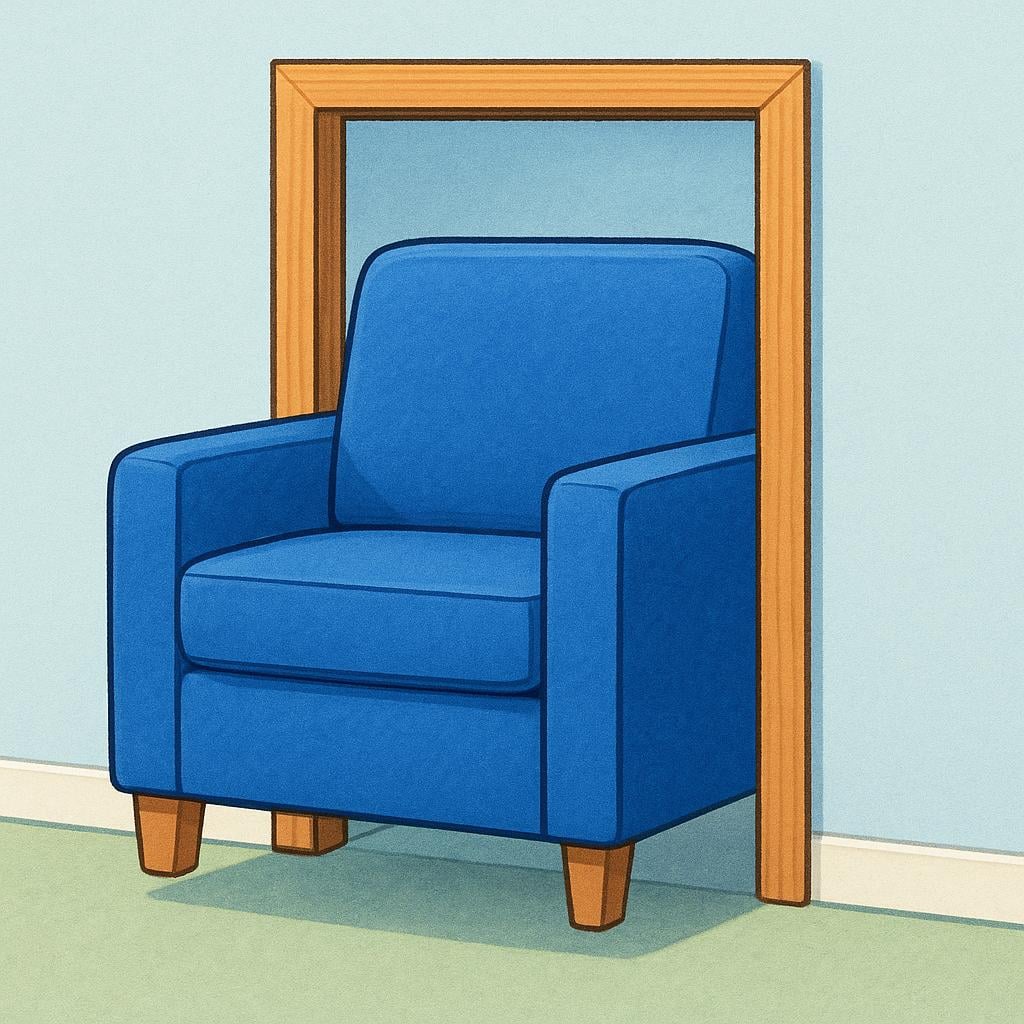
A large, square, blue armchair is being pushed through a narrow wooden door frame, fitting perfectly with no space to spare.

When referring to objects, entra can mean that 'it fits' into a specific space.

entra(Verb)

A2regular ar

it fits

?

clothes, furniture in a space

📝 In Action

El sofá no entra por la puerta.

A2

The sofa doesn't fit through the door.

No sé si el coche entra en esa plaza de garaje.

B1

I don't know if the car fits in that parking spot.

¡Qué bien! El vestido todavía me entra.

B1

Great! The dress still fits me.

Word Connections

Synonyms

  • caber (to fit (in terms of capacity))

Common Collocations

  • entrar en los pantalonesto fit into the pants
  • entrar por la puertato fit through the door

⭐ Usage Tips

A Visual Way to Talk About Fitting

Think of this meaning literally. If something 'fits', it's because it can 'enter' the space. This is a very natural and common way to talk about clothes, furniture, and objects.

A visual boundary on the ground clearly separates a snowy, cold winter landscape on the left from a sunny, blooming spring landscape on the right, illustrating the start of a season.

Entra can also be used to mean 'it begins' when referring to seasons or new phases of life.

entra(Verb)

B1regular ar

it begins

?

seasons, a new year

,

it starts

?

a phase, a process

Also:

one gets/feels

?

used with feelings like hunger or sleepiness

📝 In Action

El verano entra oficialmente la próxima semana.

B1

Summer officially begins next week.

Cuando ve las noticias, le entra una gran tristeza.

B2

When he watches the news, a great sadness comes over him. (Literally: ...a great sadness enters him.)

Después de comer, siempre me entra sueño.

B1

After eating, I always get sleepy. (Literally: ...sleepiness enters me.)

Word Connections

Synonyms

Antonyms

Common Collocations

  • entrar en vigorto come into effect (for a law)
  • entrar en juegoto come into play
  • entrar en razónto see reason

⭐ Usage Tips

Feelings That 'Enter' You

Spanish often talks about feelings like hunger, thirst, or sleepiness as things that 'enter' you. For example, 'me entra hambre' means 'I'm getting hungry'. It's a very common and natural-sounding structure.

🔄 Conjugations

indicative

present

él/ella/ustedentra
yoentro
entras
ellos/ellas/ustedesentran
nosotrosentramos
vosotrosentráis

imperfect

él/ella/ustedentraba
yoentraba
entrabas
ellos/ellas/ustedesentraban
nosotrosentrábamos
vosotrosentrabais

preterite

él/ella/ustedentró
yoentré
entraste
ellos/ellas/ustedesentraron
nosotrosentramos
vosotrosentrasteis

subjunctive

present

él/ella/ustedentre
yoentre
entres
ellos/ellas/ustedesentren
nosotrosentremos
vosotrosentréis

imperfect

él/ella/ustedentrara
yoentrara
entraras
ellos/ellas/ustedesentraran
nosotrosentráramos
vosotrosentrarais

✏️ Quick Practice

💡 Quick Quiz: entra

Question 1 of 1

Which sentence uses 'entra' to mean 'it fits'?

📚 More Resources

Word Family

entrar(to enter) - verb
entrada(entrance, ticket, entry) - noun

Frequently Asked Questions

Is 'entra' a command or just a statement?

It can be both! It depends on how you use it. If you say 'Él entra', it's a statement meaning 'He enters'. If you say '¡Entra!' to a friend, it's a command meaning 'Come in!'. The context and the absence of a person's name or pronoun before the verb usually signal that it's a command.

Do I always need to use 'en' or 'a' after 'entra'?

When you're saying what place someone is entering, yes. You would say 'entra en la casa' or 'entra a la casa'. But if you're just saying 'Come in!', you can just say '¡Entra!' by itself.