Inklingo

miró

/mee-ROH/

he looked

A high quality storybook illustration of a young boy standing outdoors in a sunny field, intently gazing at a bright red butterfly fluttering past him.

"Miró" means 'he looked'. This boy is performing the completed action of looking at the butterfly.

miró(Verb)

A1regular ar

he looked

?

completed action in the past

,

she looked

?

completed action in the past

,

you looked (formal)

?

completed action in the past (Usted form)

Also:

he watched

?

e.g., watching a TV show

,

he glanced

?

a quick look

📝 In Action

Él miró la foto y sonrió.

A1

He looked at the photo and smiled.

La niña miró a su madre buscando permiso.

A2

The girl looked at her mother, seeking permission.

Usted miró el menú por diez minutos antes de ordenar.

A2

You (formal) looked at the menu for ten minutes before ordering.

Word Connections

Synonyms

Common Collocations

  • miró de reojohe/she glanced sideways
  • miró fijamentehe/she stared intently

💡 Grammar Points

The Preterite Tense

Miró is the preterite form, which means the action of looking started and finished quickly at a specific time in the past (e.g., 'He looked at the map').

Who Did the Looking?

This form (miró) is used for 'él' (he), 'ella' (she), or 'usted' (the formal 'you'). Always check the context to know who performed the action.

❌ Common Pitfalls

Preterite vs. Imperfect

Mistake: "Using 'miraba' when you mean a single, completed action."

Correction: Use 'miró' (preterite) for one-time, finished events ('She looked at him once'). Use 'miraba' (imperfect) for ongoing or habitual actions ('She used to look at him').

⭐ Usage Tips

Using 'a'

When you look at a person, Spanish often requires the personal 'a': 'Él miró a la mujer' (He looked at the woman).

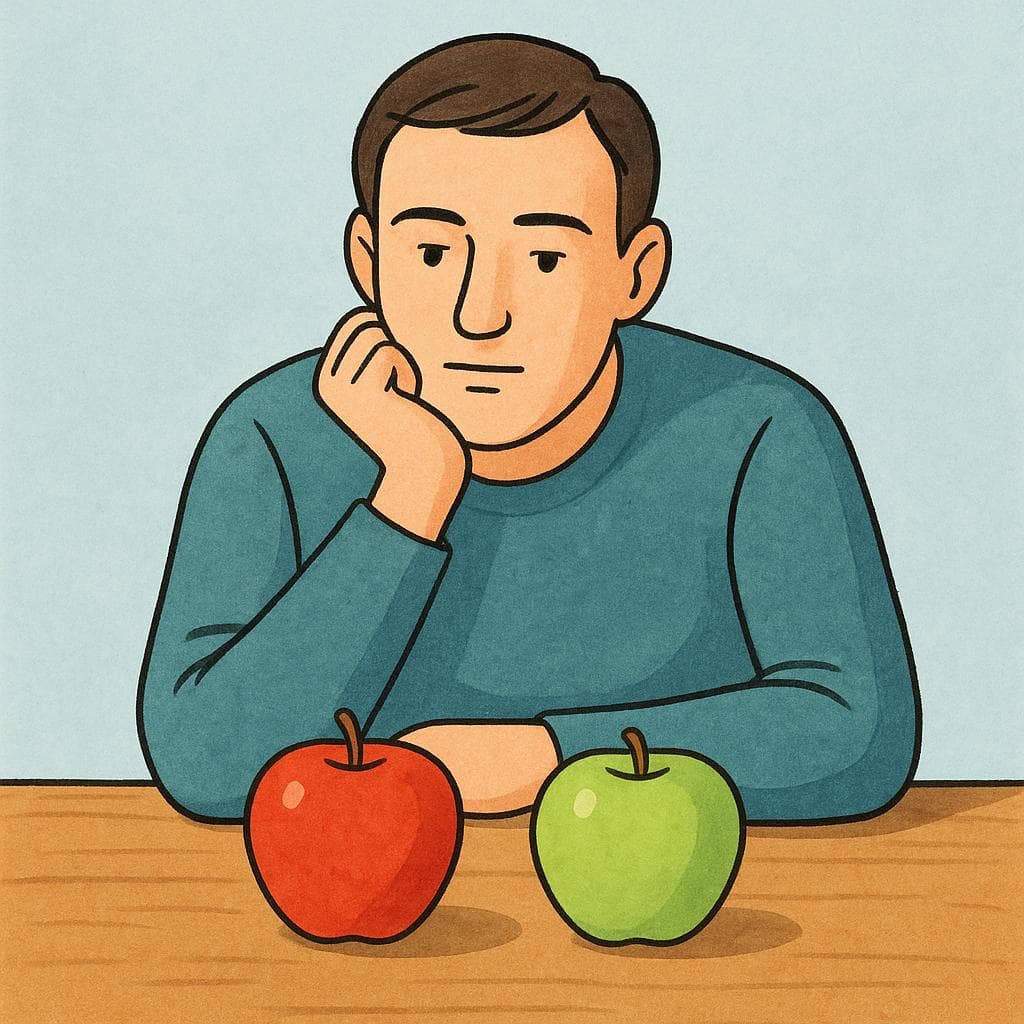
A high quality storybook illustration of a man sitting at a simple wooden table, resting his chin on his hand, deep in thought while considering two different colored apples placed on the table.

"Miró" can also mean 'he considered' or 'took into account'. The man is considering which apple to choose.

miró(Verb)

B1regular ar

he considered

?

took into account

,

she took care of

?

looked after

Also:

he paid attention to

?

focused on a detail

📝 In Action

El comité miró todos los detalles antes de votar.

B1

The committee considered all the details before voting.

Ella miró por el bienestar de sus empleados.

B2

She looked out for (took care of) the well-being of her employees.

Word Connections

Synonyms

Common Collocations

  • miró por la seguridadhe/she ensured safety
  • miró los pros y contrashe/she weighed the pros and cons

💡 Grammar Points

Figurative Use with 'por'

When 'mirar' means 'to take care of' or 'to look out for,' it is often followed by the preposition 'por' (e.g., 'mirar por el futuro').

⭐ Usage Tips

Beyond the Eyes

Remember that 'miró' doesn't always involve eyes; it can mean 'he/she thought deeply about' or 'he/she was concerned with' a situation.

🔄 Conjugations

indicative

present

él/ella/ustedmira
yomiro
miras
ellos/ellas/ustedesmiran
nosotrosmiramos
vosotrosmiráis

imperfect

él/ella/ustedmiraba
yomiraba
mirabas
ellos/ellas/ustedesmiraban
nosotrosmirábamos
vosotrosmirabais

preterite

él/ella/ustedmiró
yomiré
miraste
ellos/ellas/ustedesmiraron
nosotrosmiramos
vosotrosmirasteis

subjunctive

present

él/ella/ustedmire
yomire
mires
ellos/ellas/ustedesmiren
nosotrosmiremos
vosotrosmiréis

imperfect

él/ella/ustedmirara/mirase
yomirara/mirase
miraras/mirases
ellos/ellas/ustedesmiraran/mirasen
nosotrosmiráramos/mirásemos
vosotrosmirarais/miraseis

✏️ Quick Practice

💡 Quick Quiz: miró

Question 1 of 2

Which sentence correctly uses 'miró' to mean 'he/she considered'?

📚 More Resources

Word Family

mirar(to look, to watch) - verb

Frequently Asked Questions

Is 'miró' the same as 'vio'?

No, they are similar but different! 'Miró' (from 'mirar') means 'he/she looked' or 'paid attention to.' It implies intent. 'Vio' (from 'ver') means 'he/she saw,' which is simply the act of perceiving something without necessarily trying to.

How do I know if 'miró' refers to 'él,' 'ella,' or 'usted'?

You need context! Spanish often omits the subject pronoun. If the sentence is 'Miró el coche,' you must look at the surrounding conversation to know if 'He,' 'She,' or 'You (formal)' performed the action. If the subject is clearly stated, like 'Mi padre miró el coche,' then the subject is 'He' (mi padre).