


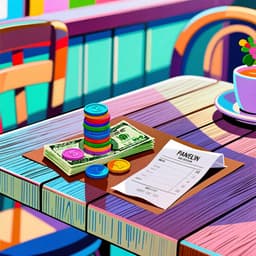
Asking for a 'Receta'
Mistake: “Saying '¿Me da una receta?'”
Correction: Say '¿Me da un recibo?'
meh PWEH-deh dahr oon reh-SEE-boh, por fah-VOR
This is the standard, polite way to ask for a proof of purchase anywhere in the Spanish-speaking world. It uses the formal 'usted' form, which is safe for interactions with shopkeepers or cashiers.

Asking '¿Me da un recibo?' ensures you get proof of your purchase.
Can I have a receipt please? — in Spanish
meh dah el TEE-keht, por fah-VOR
In Spain and parts of Latin America, the English loanword 'ticket' is the most common word for a small store receipt.
meh reh-GAH-lah oon reh-SEE-boh
Uses the verb 'regalar' (to gift), which is a very common and polite way to request things in Colombia and parts of Central America.
neh-seh-SEE-toh fahk-TOO-rah
A 'factura' is a formal tax invoice, not just a simple receipt. You need this if you are expensing the purchase for a company.
meh dah OO-nah boh-LEH-tah
In the Andean regions and Chile, 'boleta' is the specific term for a standard sales receipt.
meh dahs el com-pro-BAHN-teh
'Comprobante' means 'proof' (voucher). It's a generic term often used for credit card slips or bank transaction records.
meh AH-sehs OO-nah NOH-tah
A 'nota' is often a handwritten receipt in smaller markets or independent shops.
Choosing the right word depends on whether you need a simple slip of paper or an official tax document.
| Phrase | Formality | Best For | Avoid When |
|---|---|---|---|
| Un recibo | Neutral | General use anywhere | You specifically need a tax invoice |
| El ticket | Casual | Supermarkets, cafes, Spain | In very formal business settings |
| Una factura | Formal | Business expenses/Tax deductions | Buying small items for personal use |
| Una boleta | Neutral | Shopping in Chile/Peru | You are in Mexico or Spain |
The rolled 'r' in 'recibo' is the main challenge, but 'ticket' is very easy for English speakers.
Simple request structure: 'Verb + Noun'. No complex conjugation needed.
Knowing when to ask for a 'factura' vs a 'recibo' can be confusing in business contexts.
Disculpe, ¿me puede dar un recibo para el reembolso?
Excuse me, can you give me a receipt for the reimbursement?
No necesito bolsa, pero sí el ticket, por favor.
I don't need a bag, but yes (I need) the receipt, please.
¿Me podría hacer una factura a nombre de la empresa?
Could you make out an invoice in the company's name?
Vecina, ¿me regala el recibito?
Neighbor (friendly term), can I have the little receipt?
In many Latin American countries (especially Mexico and Argentina), there is a huge legal difference between a simple receipt (*ticket* or *nota*) and a *factura*. A *factura* is an electronic tax invoice linked to the government. If you just want proof you paid, ask for a *ticket*. If you need to deduct it for taxes, you must ask for a *factura* and provide your tax ID.
In Colombia, it is extremely common to use the verb *regalar* (to give as a gift) for small requests. Asking *'¿Me regala un recibo?'* doesn't mean you want it for free or as a present; it's simply the polite, standard way to say 'Can I have...' It makes the interaction sound warmer and less transactional.
In restaurants, the receipt usually comes inside a small booklet or on a tray. In many places, the tip (*propina*) is not included in the total. If you pay by card, you might need to tell the waiter to add the tip *before* they print the final receipt (*voucher*), as you can't always write it on the slip afterwards like in the US.
Mistake: “Saying '¿Me da una receta?'”
Correction: Say '¿Me da un recibo?'
Mistake: “Asking for the 'recibo' when you want to pay the bill.”
Correction: Ask for 'la cuenta' (the check/bill).
Mistake: “Asking for a 'factura' for a pack of gum.”
Correction: Ask for a 'ticket' or 'recibo'.
If you are a tourist in Spain or parts of Latin America, keeping your receipts (*tickets*) is essential if you want to claim a VAT (tax) refund at the airport. Look for signs that say 'Tax Free' in shop windows.
If you forget the word *recibo*, just say 'ticket' (pronounced TEE-keht). It is understood almost universally in the Spanish-speaking world due to English influence and is the standard term in Spain.
Spaniards almost exclusively use the English word 'ticket' for store receipts. They are also generally more direct, often skipping 'usted' in casual shops.
The distinction between 'ticket' (proof of purchase) and 'factura' (tax invoice) is strictly observed. In small markets, ask for a 'nota' (handwritten note).
Chileans use 'boleta' for the standard receipt. 'Factura' is strictly for business-to-business transactions.
Colombians are very polite. 'Tirilla' (little strip) is sometimes used for those long, thin supermarket receipts.
¿Quiere su copia?
Do you want your copy?
Sí, por favor.
Yes, please.
El ticket está en la bolsa.
Thanks, very kind.
Gracias, muy amable.
In English, 'receipt' covers everything from a gum wrapper proof-of-purchase to a tax document. Spanish separates these concepts strictly (ticket vs. factura). Also, Spanish speakers often use the verb 'dar' (to give) or 'regalar' (to gift) rather than 'have' (tener) when asking for things.
Why it''s different: Sounds like 'recibo' but means instructions for cooking or a medical prescription.
Use instead: Use 'receta' for cooking/doctors, 'recibo' for shopping.
This is the step usually preceding getting the receipt in a restaurant.
Useful for finishing the transaction smoothly.
Often asked in the same breath: 'Can I have a receipt and a bag?'
Question 1 of 3
You are in a restaurant and want to pay. What should you ask for first?
Knowing a phrase is one thing — using it at the right moment is another. Read 200+ illustrated and narrated Spanish stories to see phrases in the contexts where they actually belong.
'La cuenta' is the bill or check you ask for *before* paying (to know the total). 'El recibo' is the proof of payment you receive *after* the transaction is complete.
Yes! 'Ticket' (pronounced TEE-keht) is widely understood in almost all Spanish-speaking countries as a casual word for receipt, and it is the preferred term in Spain.
Not at all. It is standard practice. In fact, in many countries, stores are legally required to give you one to prove they are paying taxes.
The cashier will likely smile or look confused because you just asked for a cooking recipe or a doctor's prescription. Correct yourself by saying 'Perdón, el ticket' or 'el recibo'.
Strengthen the grammar behind this phrase:
Dive deeper into related topics:
Find similar phrases to expand your Spanish vocabulary:
Browse our complete collection of Spanish phrases organized by situation, from basic greetings to advanced conversations. Perfect for travelers, students, and anyone learning Spanish.
View All Spanish Phrases →