






Forgetting Gender Agreement
Mistake: “A woman saying 'Estoy casado' or a man saying 'Estoy casada'.”
Correction: A woman must say 'Estoy casada'. A man must say 'Estoy casado'.
ehs-TOY kah-SAH-doh / ehs-TOY kah-SAH-dah
This is the most common and direct way to state that you are married. You must change the ending to match your gender: 'casado' for a man, and 'casada' for a woman.

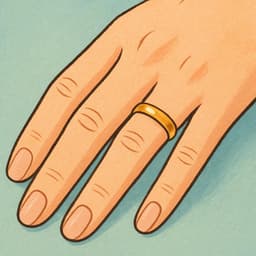
In Spanish, you say 'Estoy casado' if you're a man and 'Estoy casada' if you're a woman. The ring is universal!
I am married — in Spanish
soy kah-SAH-doh / soy kah-SAH-dah
This is also extremely common and essentially interchangeable with 'Estoy casado/a'. Using 'Soy' (from the verb 'ser') treats being married as a more permanent identity or civil status, while 'Estoy' (from 'estar') views it as a current state. In everyday conversation, the difference is very subtle and both are widely accepted.
TEN-go ehs-POH-soh / TEN-go ehs-POH-sah
This literally translates to 'I have a husband / I have a wife'. It's a slightly less direct and more conversational way to communicate that you're married by mentioning your spouse.
TEN-go mah-REE-doh / TEN-go moo-HAIR
Similar to the previous variation, 'marido' is another common word for husband. 'Mujer' (literally 'woman') is very common for 'wife' in Spain, but can sound a bit too informal or possessive in some parts of Latin America, where 'esposa' is often preferred.
ehs-TAH-mohs kah-SAH-dohs
This means 'We are married'. It's used when you are speaking for yourself and your spouse together. The ending is plural '-os' by default, even for a male-female couple.
Here’s a quick comparison of the most common ways to say you're married.
| Phrase | Formality | Best For | Avoid When |
|---|---|---|---|
| Estoy casado/a | Neutral | Directly and clearly stating your marital status in any conversation. | Never, this is always a safe and correct option. |
| Soy casado/a | Neutral | Stating your civil status on forms or as a core part of your identity. | Never, this is also a perfectly valid and common alternative. |
| Tengo esposo/a | Neutral | Mentioning your spouse conversationally without it being a formal declaration. | When you need to be very direct, like on a legal form. |
| Tengo marido/mujer | Casual | Informal chats. 'Tengo mujer' is especially common and normal in Spain. | Using 'tengo mujer' in more formal settings in Latin America; 'esposa' is better. |
The sounds are straightforward for English speakers. The 'd' in 'casado' is soft, almost like the 'th' in 'the'.
The main challenges are remembering to change the ending for your gender ('-o' vs '-a') and understanding the subtle difference between 'ser' and 'estar'.
Usage is mostly direct, but knowing the regional preference for 'esposa' vs. 'mujer' is a helpful nuance.
No gracias, no me interesa. Estoy casado.
No thank you, I'm not interested. I'm married.
En el formulario, para 'estado civil', escribí que soy casada.
On the form, for 'marital status', I wrote that I am married.
¿Vives solo? — No, vivo con mi esposa. Estamos casados desde hace diez años.
Do you live alone? — No, I live with my wife. We've been married for ten years.
Mi hermana no puede venir a la fiesta, tiene un compromiso porque está recién casada.
My sister can't come to the party, she has a commitment because she is recently married.
In Spanish, there are two verbs for 'to be': 'ser' and 'estar'. 'Estoy casado' (using estar) treats marriage as a current state or condition. 'Soy casado' (using ser) treats it as a more permanent characteristic or identity. While linguists love this debate, in real life, both are used and understood everywhere, so don't stress about choosing the 'wrong' one.
'Estado civil' (marital status) is a standard field on official documents, job applications, and medical forms throughout the Spanish-speaking world. Being asked this is completely normal and not considered intrusive in these contexts.
In Spain, calling your wife 'mi mujer' ('my woman') is extremely common and perfectly normal. However, in many parts of Latin America, it can sound a bit rough or possessive. 'Mi esposa' is generally considered more respectful and is a safer bet if you're unsure.
Mistake: “A woman saying 'Estoy casado' or a man saying 'Estoy casada'.”
Correction: A woman must say 'Estoy casada'. A man must say 'Estoy casado'.
Mistake: “Saying 'Estoy cansado' when you mean you're married.”
Correction: Estoy casado.
Mistake: “Trying to say something like 'Yo soy marriado' or 'Estoy marriado'.”
Correction: Estoy casado / Soy casado.
The number one rule is to make the ending of 'casado/a' match you. If you're a man, it's always '-o'. If you're a woman, it's always '-a'. This is a fundamental concept in Spanish that applies to many adjectives.
If you're ever frozen trying to decide between 'Soy' and 'Estoy', just go with 'Estoy casado/a'. It's slightly more common in everyday conversation for describing your current status and is always correct.
Instead of just stating 'I am married', you can weave it into the conversation more smoothly by saying 'I have a husband/wife'. This often sounds more natural than a blunt declaration of your marital status.
Using 'mi mujer' to refer to one's wife is extremely common and not considered informal or impolite, unlike in some other regions. The distinction between 'soy' and 'estoy' is perhaps more strictly observed here in formal grammar, but both are used in speech.
Both 'soy' and 'estoy' are very common. There is a general preference for 'esposa' over 'mujer' in polite or mixed company as it's seen as more respectful.
The 'cheísmo/sheísmo' accent is the most notable feature. 'Mi mujer' is quite common in casual, everyday speech, similar to Spain.
¿Ah, sí? ¿Cuánto tiempo llevan casados?
Oh, really? How long have you been married?
Llevamos cinco años casados.
We've been married for five years.
¿Y tienen hijos?
And do you have children?
Sí, tenemos un hijo y una hija. / No, no tenemos hijos.
Yes, we have a son and a daughter. / No, we don't have children.
¿A qué se dedica tu esposa/o?
What does your wife/husband do for a living?
Mi esposo es ingeniero.
My husband is an engineer.
This links the word for married ('casado') to the Spanish word for house ('casa'), helping you remember its meaning.
This silly sentence helps you distinguish 'casado' (married) from the similar-sounding 'cansado' (tired) by linking them in a memorable way.
The biggest difference is that 'married' is an adjective in Spanish ('casado/a') that must change to match the speaker's gender. English has no gendered adjectives, so 'married' is the same for everyone. Additionally, Spanish offers two ways to say 'I am' ('soy' or 'estoy'), which adds a layer of meaning (identity vs. state) that doesn't exist with the single English verb 'to be'.
Why it''s different: The Spanish word 'cansado' (tired) sounds very similar to 'casado' (married).
Use instead: Be careful with your pronunciation. 'Casado' has a sharp 'a' sound in the first syllable, while 'cansado' has a nasal 'an' sound. Mixing them up is a classic beginner mistake.
It's the natural opposite and another key piece of personal information.
A logical next step after saying you're married is to introduce your partner.
This is a very common follow-up question in conversations about family.
Learning to refer to your spouse is essential for talking about your life.
Question 1 of 3
A woman named Ana wants to tell her new friend that she is married. What should she say?
Knowing a phrase is one thing — using it at the right moment is another. Read 200+ illustrated and narrated Spanish stories to see phrases in the contexts where they actually belong.
Think of it this way: 'Soy casado' is like saying marriage is part of your fundamental identity, like your nationality. 'Estoy casado' describes your current marital status. In daily conversation, they are used almost interchangeably and everyone will understand you either way. Don't worry too much about it!
Yes, 100%. This is a non-negotiable rule in Spanish. Adjectives must agree in gender with the person they describe. If you are a woman, you must use 'casada'. If you are a man, you must use 'casado'.
The simplest way is to ask, '¿Estás casado?' (to a man) or '¿Estás casada?' (to a woman). If you're speaking to someone in a formal context (e.g., an older person), you would use the formal version: '¿Está usted casado/a?'.
Generally, no. It's a common question in small talk, similar to asking what you do for a living, especially among people over 30. However, like in any culture, it's always good to gauge the situation and the person's comfort level.
'Esposa' is the standard, neutral, and universally respectful term for wife. 'Mujer' (literally 'woman') is also used, especially in Spain where it's very common and normal. In some parts of Latin America, 'mujer' can sound a bit too casual or even possessive, so 'esposa' is often the safer choice.
Strengthen the grammar behind this phrase:
Dive deeper into related topics:
Find similar phrases to expand your Spanish vocabulary:
Browse our complete collection of Spanish phrases organized by situation, from basic greetings to advanced conversations. Perfect for travelers, students, and anyone learning Spanish.
View All Spanish Phrases →