





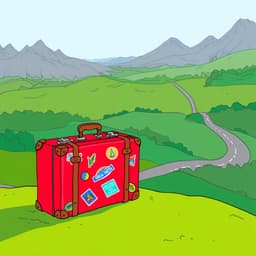
Using 'Ser' instead of 'Estar'
Mistake: “Soy de vacaciones.”
Correction: Estoy de vacaciones.
ehs-TOY deh vah-kah-see-OH-nehs
This is the most direct, common, and universally understood way to say you're on vacation. It's the perfect default phrase for any situation, from checking into a hotel to making small talk at a cafe.

Whether you're relaxing on the beach or exploring a new city, telling someone 'Estoy de vacaciones' is the perfect way to share your happy news.
I'm here on vacation — in Spanish
ehs-TOY ah-KEE deh vah-kah-see-OH-nehs
This version adds 'aquí' (here), which slightly emphasizes your location. It's extremely common and sounds very natural, often used to answer the question 'What brings you here?'.
AHN-doh deh vah-kah-see-OH-nehs
A more relaxed and conversational alternative. The verb 'andar' (to walk, to go around) gives a sense of being out and about, enjoying your time off, rather than just stating a fact.
VEE-neh deh vah-kah-see-OH-nehs
This translates to 'I came on vacation.' It uses the past tense to explain the purpose of your trip. It's a very common way to answer why you are in a particular place.
ehs-TAH-mohs deh vah-kah-see-OH-nehs
The essential plural version, meaning 'We are on vacation.' Use this whenever you're speaking on behalf of a group, whether it's your family, partner, or friends.
ehs-TOY deh vee-AH-heh
This means 'I'm traveling' or 'I'm on a trip.' It's a bit more general than 'vacaciones.' While a vacation is a trip, not every trip is a vacation (e.g., work trips).
ehs-TOY pah-SAHN-doh OO-nohs DEE-ahs ah-KEE
A softer, more descriptive phrase meaning 'I'm spending a few days here.' It implies a short, leisurely stay and sounds very friendly and conversational.
Here's a quick comparison of the most common ways to say you're on vacation to help you choose the best one for your situation.
| Phrase | Formality | Best For | Avoid When |
|---|---|---|---|
| Estoy de vacaciones | Neutral | Almost any situation; it's the perfect all-purpose choice. | Never. It's always a safe and correct option. |
| Ando de vacaciones | Casual | Informal chats with peers, other travelers, or at a bar in Latin America. | Very formal settings, like speaking with an immigration officer or a hotel manager. |
| Vine de vacaciones | Neutral | Answering the question 'Why are you here?' or explaining the purpose of your trip. | It can sound slightly less conversational than 'estoy' if you're just making a general statement. |
| Estoy de viaje | Neutral | General situations or when your trip isn't purely for leisure. | If you specifically want to convey that you are relaxing and not working. |
Fairly easy. The word 'vacaciones' is long but the sounds are straightforward for English speakers. Just remember the 'c' sounds like an 's' in Latin America.
The main challenge is remembering to use 'estar' instead of 'ser' and the preposition 'de' instead of 'en'. The fact that 'vacaciones' is always plural is another key point.
Very straightforward. The concept of being on vacation is universal, and this phrase is used in a very similar way to its English counterpart.
El taxista me preguntó, '¿Viene por negocios o por placer?' y yo le respondí, 'Estoy aquí de vacaciones'.
The taxi driver asked me, 'Are you here for business or pleasure?' and I answered, 'I'm here on vacation.'
Conocimos a una pareja en el bar del hotel y nos dijeron, 'Nosotros también andamos de vacaciones, somos de Colombia'.
We met a couple at the hotel bar and they told us, 'We're on vacation too, we're from Colombia.'
Cuando llegamos a la casa de mis tíos, mi papá anunció, '¡Ya llegamos! Estamos de vacaciones por dos semanas'.
When we got to my aunt and uncle's house, my dad announced, 'We're here! We're on vacation for two weeks.'
No te preocupes por el trabajo, solo vine de vacaciones para relajarme y desconectar de todo.
Don't worry about work, I just came on vacation to relax and disconnect from everything.
Saying you're on vacation is a fantastic icebreaker in Spanish-speaking cultures. People are generally curious and friendly towards visitors, and it often leads to questions about where you're from, what you've seen, and recommendations for things to do.
Unlike the English singular 'vacation', the Spanish word 'vacaciones' is almost always used in its plural form, even when talking about a single trip. Think of it like the English word 'pants' – it's one item, but the word itself is plural.
When you tell someone you're traveling or on vacation, a very common and polite response is '¡Buen viaje!' (Have a good trip!) or '¡Que disfrutes!' (Enjoy!). It's a warm gesture that shows they wish you well on your journey.
Mistake: “Soy de vacaciones.”
Correction: Estoy de vacaciones.
Mistake: “Estoy en vacaciones.”
Correction: Estoy de vacaciones.
Mistake: “Estoy de vacación.”
Correction: Estoy de vacaciones.
To have a more complete introductory sentence, combine this phrase with where you're from. For example: 'Hola, estoy de vacaciones. Soy de Australia.' (Hello, I'm on vacation. I'm from Australia.)
Be prepared for the conversation to continue! After you say you're on vacation, people will likely ask where you're from ('¿De dónde eres?'), how long you're staying ('¿Cuánto tiempo te quedas?'), or if you like their city ('¿Te gusta la ciudad?').
If you're in a relaxed environment in Latin America and want to sound a bit more like a local, try using 'Ando de vacaciones'. It adds a friendly, laid-back flavor to your Spanish.
The verb 'veranear' is very common for talking about summer holidays, especially going to the coast. The 'c/z' pronunciation is the most distinct feature.
The casual use of 'Ando de vacaciones' is very characteristic of Mexican informal speech. It conveys a sense of being out, exploring, and having fun.
The pronunciation is the biggest giveaway. The vocabulary is largely the same as the standard, but the 'sh' sound for 'y'/'ll' is a key feature of the Rioplatense dialect.
The rapid pace of speech and the dropping of the final 's' are hallmarks of Caribbean Spanish. Understanding this will help you recognize the phrase when you hear it.
¡Qué bueno! ¿De dónde eres?
How nice! Where are you from?
Soy de [Your Country].
I'm from [Your Country].
¿Y cuánto tiempo te quedas?
And how long are you staying?
Me quedo una semana.
I'm staying for a week.
¡Qué disfrutes tus vacaciones!
Enjoy your vacation!
¡Muchas gracias!
Thank you very much!
This direct link between the Spanish and English words makes it one of the easiest nouns to remember for travel.
Learning 'Estoy de...' as a single unit helps you remember to use both 'estar' and the preposition 'de' correctly for this type of expression.
The biggest difference is structural. In English, we say we are 'on' vacation, but in Spanish, the correct preposition is 'de' (of), as in 'Estoy de vacaciones'. Also, the word 'vacaciones' is always plural in Spanish when referring to a trip, unlike the singular 'vacation' in English. You can't say 'una vacación' for a holiday.
Why it''s different: A direct translation using 'en' (in) is incorrect. The Spanish expression is fixed as 'estar de vacaciones'.
Use instead: Always use 'Estoy de vacaciones'.
This is the most common question you'll get after saying you're on vacation.
Another very frequent follow-up question that continues the conversation.
Learning the alternative helps you understand and answer the common question: 'Business or pleasure?'
A perfect way to respond when someone asks how you are enjoying your trip.
Question 1 of 3
You're chatting with a friendly local at a market in Mexico City. Which phrase would be the most natural and casual way to say you're on vacation?
Knowing a phrase is one thing — using it at the right moment is another. Read 200+ illustrated and narrated Spanish stories to see phrases in the contexts where they actually belong.
It's a great question because 'on vacation' seems to translate to 'en vacaciones'. However, in Spanish, 'estar de...' is a fixed structure used for temporary roles or situations. Think of it as a set phrase you just have to memorize, like 'estar de buen humor' (to be in a good mood). It's simply the way it's said.
Yes, when you're talking about a holiday or trip, it's always 'vacaciones'. The singular 'vacación' does exist, but it's a technical term meaning 'vacancy' in a job and is not used for travel. So for your trips, always say 'mis vacaciones'.
Think of 'Estoy' as stating a fact: 'I am on vacation.' 'Ando' is more about the action: 'I'm out and about, vacationing.' 'Ando' is more informal, common in Latin America (especially Mexico), and gives a feeling of movement and enjoyment.
You just change 'Estoy' (I am) to 'Estamos' (we are). The full phrase is 'Estamos de vacaciones'. The rest of the phrase stays exactly the same.
Absolutely. 'Estoy de viaje' means 'I'm traveling' or 'I'm on a trip.' It's a bit more general. All vacations are trips ('viajes'), but not all trips are vacations. In a tourist setting, though, everyone will understand you mean you're on holiday.
To talk about a past vacation, you would say 'Estuve de vacaciones' (I was on vacation) or 'Estaba de vacaciones' (I was on vacation, often implying a longer period or setting a scene).
Strengthen the grammar behind this phrase:
Dive deeper into related topics:
Find similar phrases to expand your Spanish vocabulary:
Browse our complete collection of Spanish phrases organized by situation, from basic greetings to advanced conversations. Perfect for travelers, students, and anyone learning Spanish.
View All Spanish Phrases →