
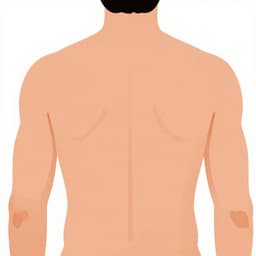



Using 'Mi' Instead of 'La'
Mistake: “Me duele mi espalda.”
Correction: Me duele la espalda.
meh DWEH-leh lah ehs-PAHL-dah
This is the most common and standard way to say 'my back hurts'. It uses the verb 'doler' (to hurt), which works a bit differently than in English, more like 'the back is hurting me'.

When your back is bothering you, 'Me duele la espalda' is the most common way to say it.
My back hurts — in Spanish
TEN-goh doh-LOHR deh ehs-PAHL-dah
This is another extremely common way to express the same idea, literally translating to 'I have back pain.' It's often used interchangeably with 'Me duele la espalda.'
meh ehs-TAH doh-LYEN-doh lah ehs-PAHL-dah
This version means 'My back is hurting me' and emphasizes that the pain is happening right now. It uses the present progressive, which is like the '-ing' form in English.
SOO-froh deh doh-LOHR deh ehs-PAHL-dah
This translates to 'I suffer from back pain.' It implies a chronic or recurring condition rather than a temporary ache.
AHN-doh mahl deh lah ehs-PAHL-dah
A more casual way to say you're having back problems, literally 'I'm doing badly with my back.' It's less clinical and more conversational.
meh MAH-tahn los ree-NYOH-nehs
A very expressive and dramatic way to say 'My lower back is killing me.' 'Riñones' literally means 'kidneys,' but it's colloquially used to refer to the lower back area.
ehs-TOY fahs-tee-DYAH-doh/dah deh lah ehs-PAHL-dah
This is a colloquial expression meaning something like 'I'm bothered by my back' or 'My back is bugging me.' The ending changes for gender ('-o' for male, '-a' for female).
Choosing the right phrase for back pain depends on whether it's a current ache, a general complaint, or a chronic condition.
| Phrase | Formality | Best For | Avoid When |
|---|---|---|---|
| Me duele la espalda. | Neutral | General, all-purpose statement for a current backache. | It's fine in almost any situation; no real avoidance needed. |
| Tengo dolor de espalda. | Neutral | Clearly stating you have the condition of 'back pain', great for medical contexts. | It's slightly less immediate-sounding than 'me duele'. |
| Sufro de dolor de espalda. | Slightly Formal | Describing a chronic, long-term, or recurring problem. | Talking about a minor, temporary ache, as it sounds too serious. |
| Ando mal de la espalda. | Informal | Casually telling friends or family you're having back issues. | In a formal or medical setting where precision is needed. |
The sounds are generally straightforward for English speakers. The main challenge is the rolled 'r' in 'dolor' for some variations, but it's not present in the primary phrase.
The verb 'doler' uses a 'gustar'-like structure which is a major conceptual hurdle for beginners. Remembering to use 'me' and 'la' instead of 'yo' and 'mi' requires practice.
The usage is fairly direct, but knowing when to use more dramatic or informal variations adds a layer of nuance.
No puedo levantar esa caja, me duele la espalda.
I can't lift that box, my back hurts.
Doctor, necesito una cita. Tengo un dolor de espalda muy fuerte desde ayer.
Doctor, I need an appointment. I've had a very strong back pain since yesterday.
Ayer estuve trabajando en el jardín todo el día y ahora me está doliendo la espalda sin parar.
I was working in the garden all day yesterday and now my back is hurting non-stop.
Mi abuelo sufre de dolor de espalda crónico, por eso camina con un bastón.
My grandfather suffers from chronic back pain, that's why he walks with a cane.
In English, you are the subject ('I hurt'). In Spanish, the body part is the subject that causes you pain. 'Me duele la espalda' literally means 'The back gives pain to me.' This structure is key to sounding natural and applies to many other verbs like 'gustar' (to like) and 'encantar' (to love).
In many Spanish-speaking cultures, it's common to be more expressive or even dramatic when talking about pain. Using phrases like 'me mata' (it's killing me) or 'un dolor terrible' (a terrible pain) is quite normal in casual conversation and doesn't necessarily mean it's a life-threatening emergency.
In many parts of the Spanish-speaking world, the 'farmacia' is the first stop for minor health issues. It's common for people to describe their symptoms, like back pain, directly to the pharmacist, who can often provide advice and over-the-counter medication without a doctor's prescription.
Mistake: “Me duele mi espalda.”
Correction: Me duele la espalda.
Mistake: “Yo duelo mi espalda.”
Correction: Me duele la espalda.
Mistake: “Me herí la espalda.”
Correction: Me duele la espalda.
To talk about someone else's pain, you just change the first word: 'Te duele' (Your back hurts), 'Le duele' (His/Her/Your formal back hurts), 'Nos duele' (Our backs hurt). The 'duele' part stays the same unless multiple things hurt ('duelen').
You can be more specific by adding adjectives. Say 'Me duele la espalda alta' for your upper back, or 'Me duele la espalda baja' for your lower back. This is very useful when talking to a doctor.
To say your back hurt in the past, you'll change 'duele' to 'dolió' for a completed action (e.g., 'Ayer me dolió la espalda' - Yesterday my back hurt) or 'dolía' for an ongoing pain in the past (e.g., 'Me dolía la espalda todos los días' - My back used to hurt every day).
The colloquial use of 'riñones' (kidneys) to mean the lower back is very characteristic of Spain and some other regions like Argentina. It's a very common, informal way to specify where the pain is.
The phrase 'Ando mal de...' ('I'm doing poorly with...') is a very common and versatile conversational structure in Mexico for talking about ailments, not just back pain.
Similar to Spain, 'riñones' is often used for the lower back. The expression 'estar hecho pelota' is a very common and colorful Argentine slang term for feeling terrible or being worn out.
The pronunciation is the most notable feature. Slang is also very rich, so you might hear more localized expressions for being in pain that are very specific to the island or country.
¿Desde cuándo te duele?
How long has it been hurting?
Desde esta mañana.
Since this morning.
¿Quieres que te dé un masaje?
Do you want me to give you a massage?
Sí, por favor. ¡Gracias!
Yes, please. Thank you!
¿Tomaste algo para el dolor?
Did you take anything for the pain?
Todavía no, pero voy a tomar un analgésico.
Not yet, but I'm going to take a painkiller.
This helps you remember the unique Spanish structure where the body part is the one doing the action, and you are the receiver of the pain.
This links the Spanish verb to a related English word, making it easier to recall the meaning of pain or aching.
The biggest conceptual leap for English speakers is the sentence structure. English uses a Subject-Verb-Object model: 'I (subject) feel (verb) pain (object)'. Spanish flips this for 'doler': 'Me (indirect object) duele (verb) la espalda (subject)'. Thinking of it as 'My back is giving pain to me' helps internalize this crucial difference.
Why it''s different: This English phrase implies you are actively in the process of injuring your back. 'Me duele la espalda' describes the state of feeling pain, not the action of causing it.
Use instead: To say you are in the process of injuring yourself, you would use a different verb, like 'Me estoy lastimando la espalda'. For the general sensation of pain, always use 'doler'.
It helps you practice the tricky verb 'doler' with another common ailment.
This is another essential phrase for expressing that you're not well.
This is the logical next step if the pain is serious or you need medical help.
A practical and necessary question when you need medicine for your pain.
Question 1 of 4
You just lifted a heavy box and feel a sudden, sharp pain. What is the most natural thing to exclaim?
Knowing a phrase is one thing — using it at the right moment is another. Read 200+ illustrated and narrated Spanish stories to see phrases in the contexts where they actually belong.
They are very similar and often interchangeable. 'Me duele la espalda' focuses on the immediate feeling of pain ('it hurts me'). 'Tengo dolor de espalda' is more like stating a fact or condition ('I have back pain'). Both are correct and universally understood.
It's easy! Just add 'baja' for lower and 'alta' for upper. You would say 'Me duele la espalda baja' for lower back pain, and 'Me duele la espalda alta' for upper back pain. This is very useful for being specific.
This is a common colloquialism, especially in Spain and Argentina. 'Riñones' means 'kidneys,' but in this context, it refers to the area of the lower back where the kidneys are located. It's an informal way to say 'my lower back is killing me,' but don't use it if you suspect an actual kidney problem with a doctor.
It's 'duele' when one thing hurts (like 'la espalda'). It becomes 'duelen' when multiple things hurt. For example, 'Me duelen los pies' (My feet hurt) or 'Me duelen los hombros' (My shoulders hurt).
While a native speaker might understand what you mean, it's grammatically incorrect and will immediately mark you as a learner. The verb 'doler' requires the indirect object pronoun ('me', 'te', 'le') and the structure where the body part is the subject. Sticking to 'Me duele la espalda' is the best way to sound natural.
You can add an intensifier. Say 'Me duele muchísimo la espalda' (My back hurts a whole lot) or 'Tengo un dolor de espalda terrible' (I have a terrible back pain). In casual settings, you could even use the dramatic '¡Me mata la espalda!' (My back is killing me!).
Strengthen the grammar behind this phrase:
Find similar phrases to expand your Spanish vocabulary:
Browse our complete collection of Spanish phrases organized by situation, from basic greetings to advanced conversations. Perfect for travelers, students, and anyone learning Spanish.
View All Spanish Phrases →