




The Extra 'por'
Mistake: “Estamos buscando por el hotel.”
Correction: Estamos buscando el hotel.
ehs-TAH-mohs boos-KAHN-doh
This is the most direct and widely used translation, perfect for almost any situation where you are actively searching for something or someone right now.
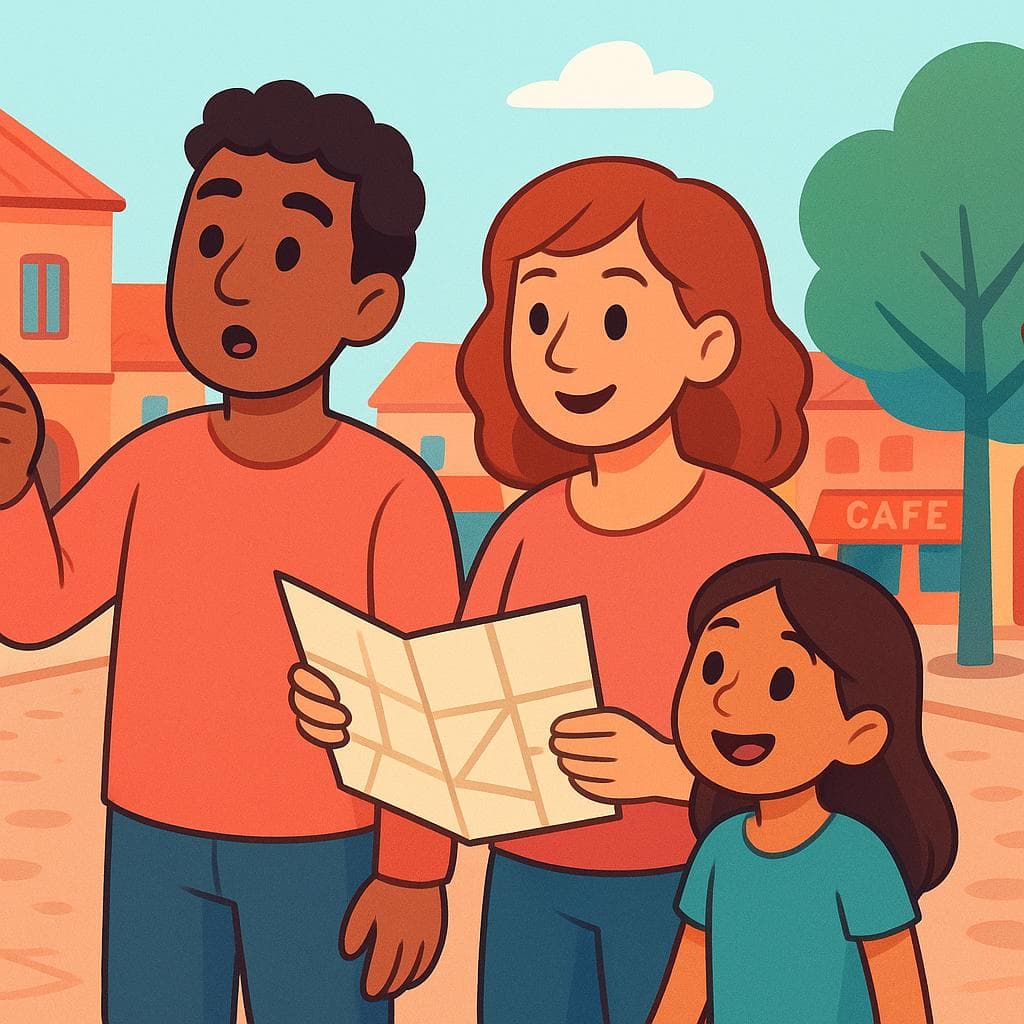
Whether you're looking for a landmark or the perfect souvenir, knowing how to say 'we are looking for' is essential for any traveler.
We are looking for — in Spanish
boos-KAH-mohs
This is the simple present tense version. In Spanish, it's often used exactly like the '-ing' form ('Estamos buscando') and is just as common, if not more so, because it's more concise.
ahn-DAH-mohs boos-KAHN-doh
A more casual and dynamic way to say 'we are looking for'. It uses the verb 'andar' (to walk around), which adds a sense of being actively out and about on a search.
ehs-TAH-mohs ehn BOOS-kah deh
A more formal and slightly more literary way to express the idea, translating literally to 'We are in search of'.
neh-seh-see-TAH-mohs ehn-kohn-TRAHR
This phrase shifts the focus from the action of 'looking' to the 'need to find' something. It highlights the goal or urgency of your search.
Here’s a quick guide to choosing the best way to say 'we are looking for' based on your situation.
| Phrase | Formality | Best For | Avoid When |
|---|---|---|---|
| Estamos buscando | Neutral | General, all-purpose use when you're actively searching for something right now. | Never wrong, but 'Buscamos' can be more concise. |
| Buscamos | Neutral | Stating your purpose clearly and concisely, like when entering a store. | You want to specifically emphasize the ongoing action of searching. |
| Andamos buscando | Informal | Casually searching while walking around, especially in Latin America. | Formal business settings or in Spain, where it's less common. |
| Estamos en busca de | Formal | Professional emails, job descriptions, or formal presentations. | Casual, everyday conversations where it would sound stuffy. |
The sounds are straightforward for English speakers. The main challenge is getting the rhythm of 'ehs-TAH-mohs boos-KAHN-doh' right.
The structure is simple, but the key grammatical challenge is internalizing that 'buscar' does not need the preposition 'por' (for).
Usage is generally direct. The main nuance is knowing the casual/regional flavor of 'andamos buscando' versus the standard forms.
Disculpe, estamos buscando las camisetas para niños.
Excuse me, we are looking for the children's t-shirts.
Hola, buenas tardes. Buscamos la estación de autobuses.
Hello, good afternoon. We're looking for the bus station.
Andamos buscando un buen lugar para comer tacos por aquí.
We're wandering around looking for a good place to eat tacos around here.
Como empresa, estamos en busca de soluciones innovadoras.
As a company, we are in search of innovative solutions.
In Spanish-speaking cultures, it's perfectly normal and not considered rude to enter a shop and immediately state what you're looking for, e.g., 'Buenas tardes, buscamos pantalones'. This is seen as efficient and respectful of the employee's time.
Using 'andamos buscando' instead of 'estamos buscando' in Latin America adds a layer of meaning. 'Estar' just describes your state, but 'andar' implies you're in motion, actively walking around. It makes you sound more dynamic and in-the-know.
English speakers often overuse the '-ing' form (gerund) in Spanish. While 'Estamos buscando' is correct, simply saying 'Buscamos' is often more common and natural for stating a general purpose or need, whereas the '-ing' form emphasizes the action happening at this very second.
Mistake: “Estamos buscando por el hotel.”
Correction: Estamos buscando el hotel.
Mistake: “Estamos mirando para un restaurante.”
Correction: Estamos buscando un restaurante.
Mistake: “Voy a buscar la palabra en el diccionario.”
Correction: Voy a buscar la palabra en el diccionario.
A simple trick is to remember that the verb 'buscar' has the word 'for' already built into its meaning. Think of it as 'to search-for'. This will help you avoid adding an extra 'por'.
Use 'Estamos buscando' to emphasize you're doing it right now. Use 'Buscamos' for a general statement of purpose. Use 'Andamos buscando' when you're physically moving around on your search (in Latin America).
To be more effective, always follow the phrase with the specific object or person. 'Estamos buscando...' is a great opener, but it needs a follow-up: '...un cajero automático' (an ATM), '...la calle Sol' (Sol Street), '...a nuestro amigo Juan' (our friend Juan).
The use of 'andamos buscando' is a key characteristic of this region. It's extremely common in casual speech and implies you are physically out and about on your search, making it a very vivid expression.
'Buscamos' is extremely common as a direct statement of intent. While 'andamos buscando' is understood, it's not a go-to phrase and might mark you as a speaker of a different dialect. The distinction between 'vosotros' and 'ustedes' is also key here.
The core phrases are the same, but the accent is very different. They use 'vos' instead of 'tú' for the singular 'you', which doesn't affect the 'we' form ('buscamos') but is a key feature of the dialect.
Claro, está a dos calles, a la derecha.
Of course, it's two blocks away, on the right.
¡Muchas gracias por su ayuda!
Thank you very much for your help!
¿De qué color o tamaño?
What color or size?
Buscamos un tamaño mediano, en color azul.
We're looking for a medium size, in blue.
Hay uno muy bueno cerca de aquí.
There's a very good one near here.
¿Nos puede decir dónde está?
Can you tell us where it is?
The two biggest differences are grammatical. First, Spanish often uses the simple present ('Buscamos') where English requires the present continuous ('We are looking for'). Second, the Spanish verb 'buscar' is transitive, meaning it acts directly on an object without needing a preposition like 'for', which is mandatory in English.
Why it''s different: A direct word-for-word translation might lead to 'Estamos buscando por...'. This is incorrect because 'buscar' already includes the meaning of 'for'.
Use instead: Simply say 'Estamos buscando...' or 'Buscamos...' followed directly by the noun.
Why it''s different: This implies visual observation. Using 'buscar' here would be wrong.
Use instead: For 'looking at', you should use the verb 'mirar'. 'Estamos mirando el menú' (We are looking at the menu).
This is the most logical next question after you say you're looking for something.
It's another fundamental way to express your needs and wants in various situations.
This is a polite and essential phrase for initiating a conversation when you're looking for something.
If you're looking for something in a store, this is the natural follow-up question.
Question 1 of 3
You and your family walk into a shoe store in Madrid. What's the most standard and effective way to ask an employee for help?
Knowing a phrase is one thing — using it at the right moment is another. Read 200+ illustrated and narrated Spanish stories to see phrases in the contexts where they actually belong.
Think of it this way: 'Buscamos' states your general goal ('We look for...'), while 'Estamos buscando' emphasizes the action happening right now ('We are currently looking for...'). In practice, they are used interchangeably most of the time, but 'buscamos' is often a more concise and common way to state your purpose when first approaching someone.
Because the Spanish verb 'buscar' is what linguists call a 'transitive verb' that doesn't need a helper word. Its definition is 'to search-for' all in one. Adding 'por' (for) is like saying 'we are searching-for for the hotel' in English—it's redundant and sounds unnatural to native speakers.
You need to add the 'personal a' when you are looking for a specific person or a pet. For example, 'Estamos buscando a María' (We are looking for María) or 'Buscamos a nuestro perro' (We are looking for our dog). You do not use 'a' for objects: 'Buscamos las llaves' (We are looking for the keys).
No, it's primarily a feature of informal speech in Latin America, especially Mexico and Central America. While it would be understood in Spain, it's not commonly used there and would mark you as someone who learned Spanish from a Latin American source. Stick to 'buscamos' or 'estamos buscando' in Spain for a more local sound.
You can, but it might sound overly formal or even a bit dramatic, like you're on an epic quest. It's best reserved for formal writing or business contexts. For asking for directions or help in a shop, 'buscamos' is a much better choice.
Strengthen the grammar behind this phrase:
Dive deeper into related topics:
Find similar phrases to expand your Spanish vocabulary:
Browse our complete collection of Spanish phrases organized by situation, from basic greetings to advanced conversations. Perfect for travelers, students, and anyone learning Spanish.
View All Spanish Phrases →