"Hoy es siempre todavía."
OY es SYEM-preh toh-dah-VEE-ah
Today is always, still.
💡 Understanding the Quote
"Hoy es siempre todavía."
🎨 Visual Representation
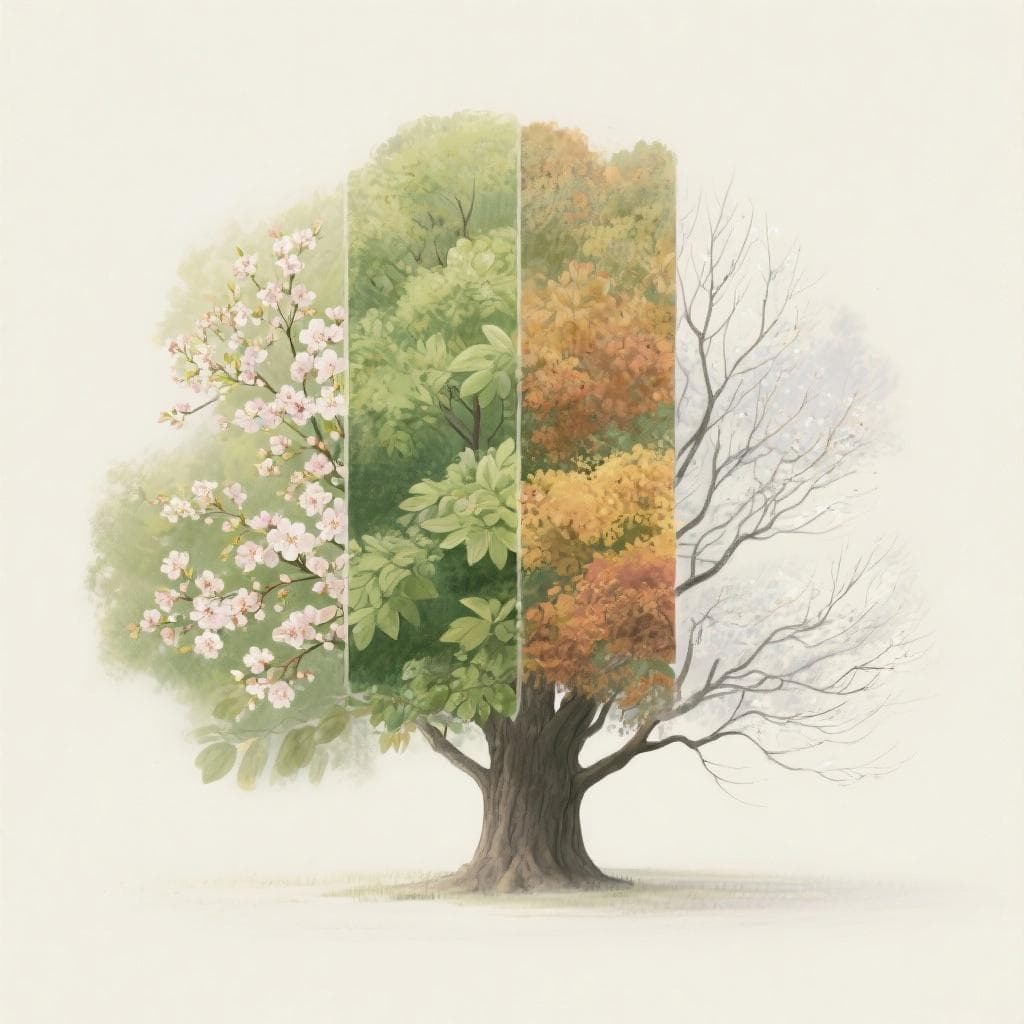
Machado's quote captures the idea that the present moment contains all of time, much like a single view can encompass all seasons.
🔑 Key Words


📖 Context
From a philosophical fragment in the posthumously published notebooks of Antonio Machado, titled 'Los complementarios'. It is not from a specific poem, but rather one of his recorded thoughts.
📝 In Action
A veces siento que el tiempo no pasa, como si el pasado siguiera aquí. Es como decía Machado, 'Hoy es siempre todavía'.
C1Sometimes I feel like time doesn't pass, as if the past were still here. It's like Machado said, 'Today is always, still'.
No te preocupes por el futuro. Concéntrate en el ahora, porque en cierto modo, 'hoy es siempre todavía'.
B2Don't worry about the future. Concentrate on the now, because in a way, 'today is always, still'.
✍️ About the Author
📜 Historical Context
This thought comes from Antonio Machado's private notebooks, published after his death. As a leading figure of Spain's 'Generation of '98,' a group of writers deeply affected by Spain's decline as an empire, Machado was preoccupied with themes of time, memory, and the Spanish soul. This quote reflects the era's deep introspection.
🌍 Cultural Significance
This phrase is a touchstone for Spanish intellectuals and artists, embodying a complex, almost mystical view of time. It's often quoted to convey the idea that the past is never truly past but continues to exist within the present, a concept that resonates in a country with such a long and layered history.
📚 Literary Analysis
The quote's power lies in its beautiful paradox. It forces two opposing concepts, 'hoy' (a single day) and 'siempre' (eternity), into a single idea. The word 'todavía' (still) acts as a bridge, suggesting a continuous, unfolding present. It's a verbal puzzle that captures the philosophical problem of time in just four words.
⭐ Usage Tips
For Deep Conversations
Use this quote during philosophical or introspective discussions about time, existence, or the feeling that history is alive in the present. It’s not for everyday small talk.
Show Literary Knowledge
Referencing this quote correctly demonstrates a sophisticated appreciation for Spanish literature and philosophy, showing you know one of the most beloved poets beyond his most famous works.
🔗 Related Quotes
✏️ Quick Practice
Quick Quiz: Hoy es siempre todavía.
Question 1 of 2
What is the source of the quote 'Hoy es siempre todavía'?
🏷️ Categories
Themes:
Go from quotes to whole stories
A quote can move you. A story can change how you think in Spanish. Read 200+ illustrated and narrated Spanish stories tailored to your level.
Frequently Asked Questions
Why is this quote considered so profound?
Its profundity comes from its ability to express a massive philosophical concept—the nature of time and eternity—in just four simple words. It creates a paradox that makes you stop and think deeply about your own perception of time.
Is 'todavía' the most important word in the quote?
While every word is crucial, 'todavía' (still/yet) is what makes the phrase so unique. Without it, 'Hoy es siempre' is a stark contradiction. 'Todavía' softens it, suggesting an ongoing, unfolding process, making the abstract idea feel more immediate and personal.