"Mucha gente pequeña, en lugares pequeños, haciendo cosas pequeñas, puede cambiar el mundo."
MOO-chah HEN-tay peh-KEH-nyah, en loo-GAH-res peh-KEH-nyos, ah-SYEN-doh KOH-sahs peh-KEH-nyahs, PWEH-deh kahm-BYAR el MOON-doh
Many small people, in small places, doing small things, can change the world.
💡 Understanding the Quote
"Mucha gente pequeña, en lugares pequeños, haciendo cosas pequeñas, puede cambiar el mundo."
🎨 Visual Representation
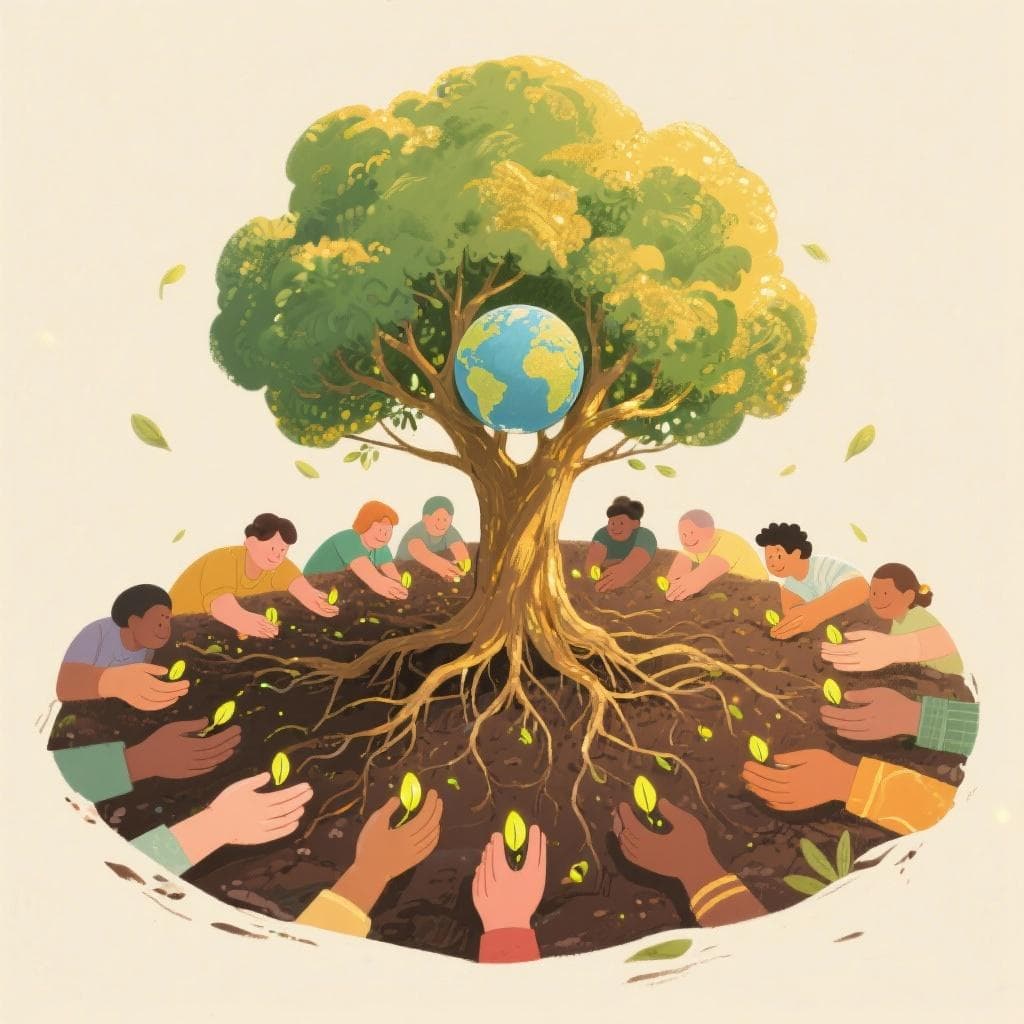
The quote celebrates how countless small, individual actions can combine to create massive, world-changing impact.
🔑 Key Words

📖 Context
This phrase is most famously attributed to the Uruguayan writer Eduardo Galeano, who helped popularize it. It captures the essence of his political and social philosophy, although its precise origin is a subject of debate.
📝 In Action
No te desanimes, recuerda lo que decía Galeano: 'mucha gente pequeña, en lugares pequeños... puede cambiar el mundo'. Cada pequeño gesto cuenta.
B2Don't get discouraged, remember what Galeano said: 'many small people, in small places... can change the world'. Every small gesture counts.
El lema de nuestra organización ecologista se inspira en la famosa frase sobre la gente pequeña que puede cambiar el mundo.
B2The motto of our environmental organization is inspired by the famous phrase about small people being able to change the world.
✍️ About the Author
📜 Historical Context
While often attributed to Eduardo Galeano, who popularized it in the late 20th century, the sentiment has roots in earlier social movements. Galeano, a prominent voice of the Latin American left, used his writing to highlight stories of the oppressed and advocate for social justice. This quote perfectly encapsulates his belief in the power of ordinary people to challenge powerful structures.
🌍 Cultural Significance
This quote has become a global mantra for activists, environmentalists, and community organizers. In Latin America especially, it resonates deeply with a history of social movements and collective resistance. You will see it on protest signs, in community centers, and shared widely on social media as a symbol of hope and empowerment.
📚 Literary Analysis
The quote's power lies in its rhythmic repetition and parallelism—the structure of '...pequeña, en lugares pequeños, haciendo cosas pequeñas'. This literary device, called a tricolon, builds momentum and emphasizes the scale of the collective effort. The final clause, 'puede cambiar el mundo,' creates a powerful contrast, showing how the accumulation of 'small' things can lead to an immense outcome.
⭐ Usage Tips
Inspiring Collective Action
Use this quote to motivate a group or to argue for the importance of small, consistent contributions. It's perfect for discussions about volunteering, environmentalism, social change, or any large-scale project.
Countering Cynicism
This is the perfect response when someone feels their actions are too insignificant to make a difference. It’s a poetic and powerful reminder that every contribution matters.
🔗 Related Quotes
✏️ Quick Practice
Quick Quiz: Mucha gente pequeña, en lugares pequeños, haciendo cosas pequeñas, puede cambiar el mundo.
Question 1 of 2
Which writer is most famously credited with popularizing this quote?
🏷️ Categories
Themes:
Go from quotes to whole stories
A quote can move you. A story can change how you think in Spanish. Read 200+ illustrated and narrated Spanish stories tailored to your level.
Frequently Asked Questions
Is this quote only about political activism?
Not at all. While it's very popular in social and political movements, its message is universal. It applies to environmentalism, local community projects, corporate culture change, and even personal development—any area where small, consistent efforts lead to big results.
Why is the word 'pequeño/a' repeated so many times?
The repetition is a key literary device. By repeating 'pequeña', 'pequeños', 'pequeñas', the quote builds a rhythm that emphasizes the sheer quantity of these 'small' things. This makes the final, contrasting phrase—'puede cambiar el mundo' (can change the world)—even more powerful and dramatic.