Clara aclara el cloro.
CLA-ra a-CLA-ra el CLO-ro
Clara clarifies the chlorine.
🔊 Listen & Practice
Start with slow speed to master pronunciation, then gradually increase to challenge yourself.
🎨 Visualization
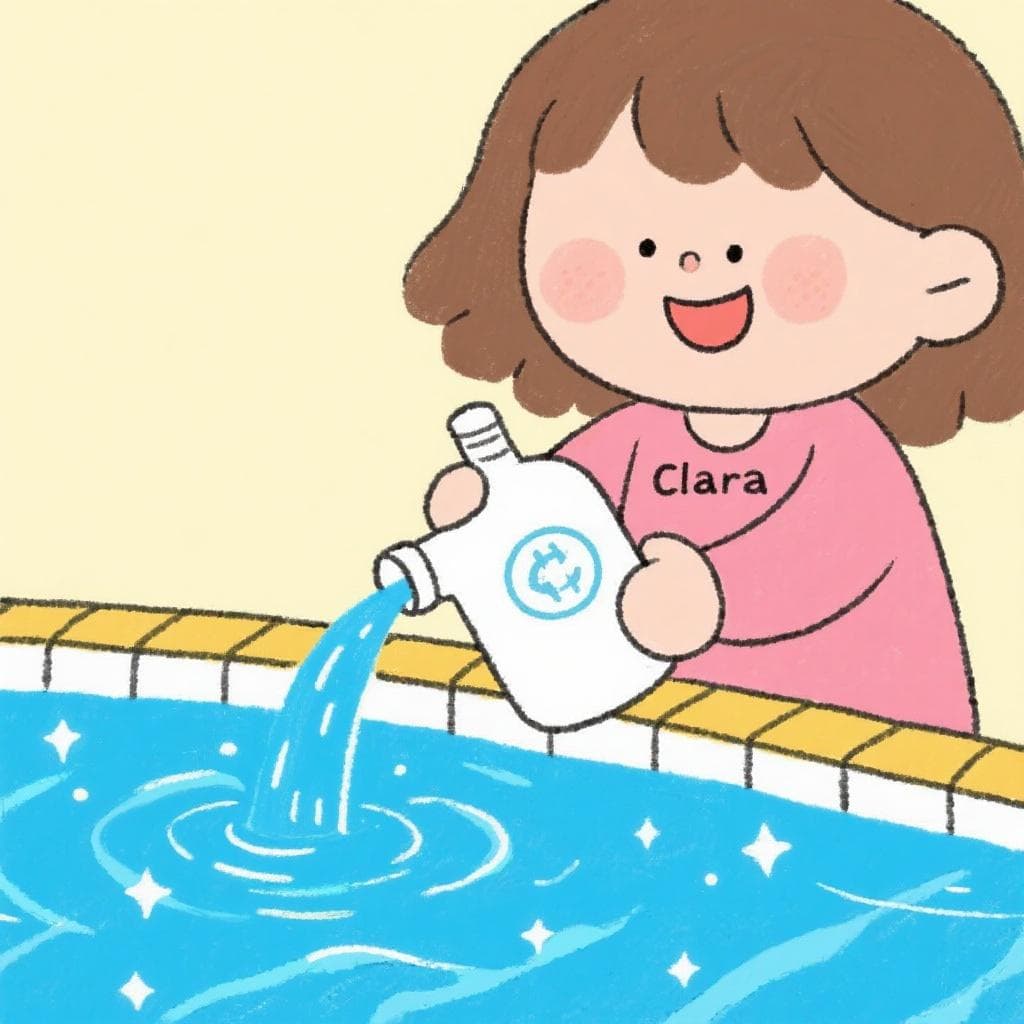
Clara is making the chlorine clear! Can you say it?
🎯 Pronunciation Focus
The 'cl' Consonant Blend
klThis focuses on the crisp, quick transition from the hard 'c' sound (like 'k') to the 'l' sound. Your tongue starts near the back of your mouth for the 'c' and quickly moves to touch behind your top teeth for the 'l'.
The Soft 'r' (vibrante simple)
ɾPractice the single tap 'r' sound in 'cloro'. It's a very quick tap of the tongue against the roof of your mouth, right behind your teeth. Think of the sound in the middle of the American English word 'butter'.
📝 Practice Breakdown
Start with the first two words. Focus on making the 'cla' sound identical in both. The 'a' vowel should be open and clear: 'ah'.
Now for the ending. The 'o' sounds are pure, like 'oh' in 'boat'. Make sure the 'r' in 'cloro' is a quick tap, not a long English 'r'.
Key Words in This Tongue Twister:


📚 Background
This is a short, classic 'trabalenguas' perfect for beginners. It's designed to drill the 'cl' consonant blend and the transition between similar-sounding words, helping to build muscle memory for clear articulation.
❌ Common Pitfalls
Using a 'Dark L'
Mistake: “Letting the 'l' sound become lazy or swallowed, like the 'l' at the end of the English word 'pool'.”
Correction: The Spanish 'l' is always a 'light l'. The tip of your tongue should firmly touch the ridge right behind your top front teeth. It should be a crisp, clear sound every time: 'cla', 'clo'.
Using the English 'R'
Mistake: “Pronouncing the 'r' in 'cloro' like the English 'r' in 'roar', where the tongue curls back in the mouth.”
Correction: The Spanish 'r' here is a quick tap. The tip of your tongue should flick against the roof of your mouth just once. It's the same sound many American English speakers use for the 'tt' in 'butter' or 'water'.
🌎 Where It''s Used
General Spanish
This is a universally known and simple tongue twister used for pronunciation practice across the entire Spanish-speaking world.
🔗 Related Tongue Twisters
The Chlorine Challenge
Say 'Clara aclara el cloro' five times in a row as fast as you can. Can you keep the 'cl' sound crisp and clear each time without stumbling?
🏷️ Tags
Frequently Asked Questions
Why is 'aclara' used? What does it mean?
'Aclarar' means 'to clarify', 'to clear up', or 'to lighten'. In this context, it's a playful way of saying Clara is 'clearing up' the chlorine, which is a bit nonsensical and adds to the fun of the tongue twister.
Is the 'c' in 'clara' always a 'k' sound?
Yes. In Spanish, the letter 'c' makes a hard 'k' sound when it comes before the vowels 'a', 'o', or 'u' (like in 'clara' and 'cloro') or before a consonant like 'l'. It only makes an 's' or 'th' sound before 'e' or 'i'.