Un viaje en un viejo velero.
un VIA-je en un VIE-jo ve-LE-ro
A trip in an old sailboat.
🔊 Listen & Practice
Start with slow speed to master pronunciation, then gradually increase to challenge yourself.
🎨 Visualization
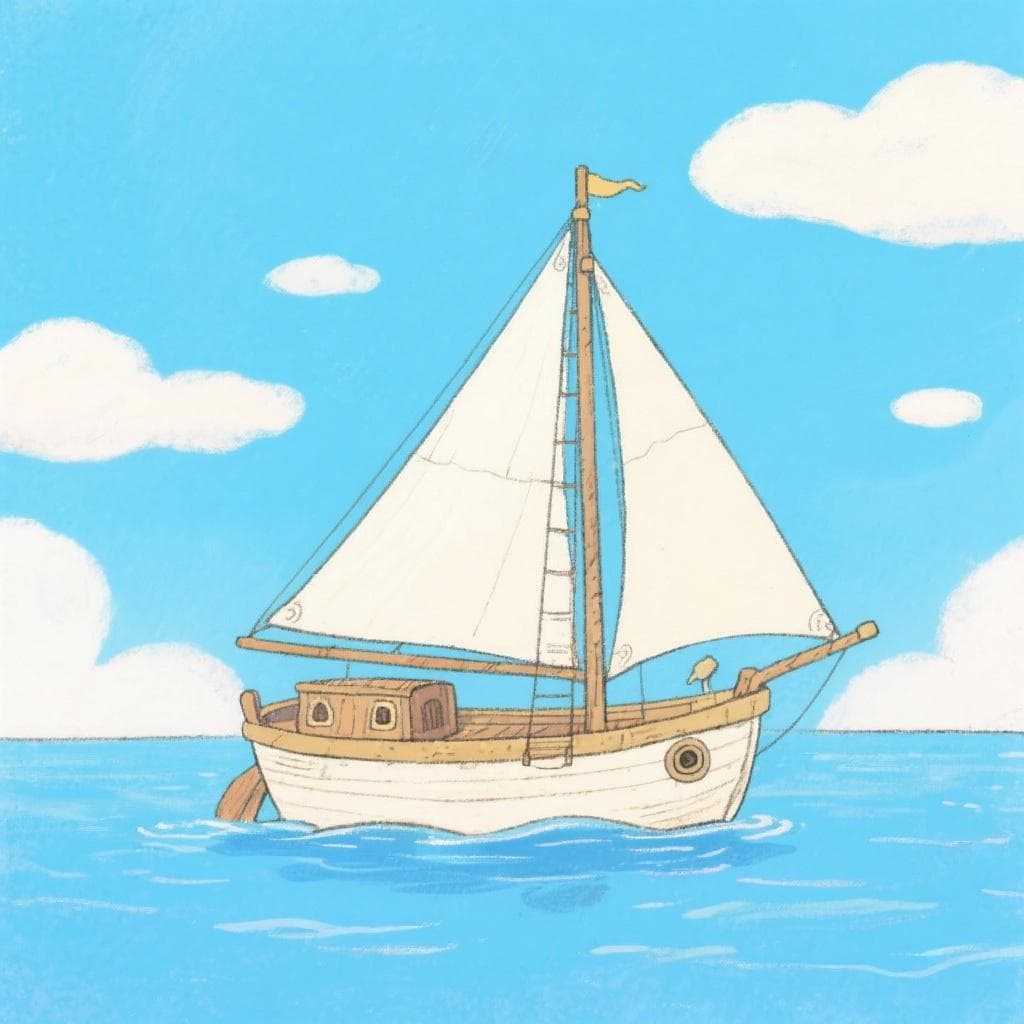
Let's take a trip on an old sailboat - ¡Un viaje en un viejo velero!
🎯 Pronunciation Focus
The Spanish 'b'/'v' Sound
bIn Spanish, 'b' and 'v' make the exact same sound! It's made by lightly pressing your lips together, similar to the English 'b' but often softer. Avoid making the English 'v' sound where your top teeth touch your bottom lip.
The Spanish 'j' Sound
xThis is a throaty, raspy sound made at the back of your mouth. It's similar to the 'ch' in the Scottish word 'loch' or the German 'Bach'. It's much stronger than the English 'h' in 'hello'.
📝 Practice Breakdown
Start here. For 'viaje', make the 'v' sound like a soft 'b' by gently touching your lips. Then, make the 'j' sound from the back of your throat, like a light, scratchy 'h'.
Now for the rest. Notice that 'viejo' and 'velero' also start with that same soft 'b' sound. The challenge is to be consistent and not slip back into the English 'v' sound.
Key Words in This Tongue Twister:

📚 Background
This short and simple phrase isn't a traditional, complex tongue twister, but it's a fantastic practice tool for two of the most fundamental sounds in Spanish that often challenge English speakers: the unified 'b'/'v' sound and the throaty 'j'.
❌ Common Pitfalls
Using the English 'v' sound
Mistake: “Pronouncing 'viaje', 'viejo', or 'velero' with the English 'v' sound, where your top teeth touch your bottom lip.”
Correction: Remember, in Spanish, 'v' sounds just like 'b'. Gently press your lips together to make the sound. Think 'biaje', 'biejo', 'belero'. It's a much softer action than the English 'v'.
Making the 'j' too soft
Mistake: “Pronouncing the 'j' in 'viaje' and 'viejo' like the 'h' in the English word 'hat'.”
Correction: The Spanish 'j' has more friction and comes from deeper in your throat. Imagine you're clearing your throat very gently or trying to fog up a mirror with your breath. That's the sound you're aiming for.
🌎 Where It''s Used
General Spanish
The pronunciation rules for 'v' and 'j' in this phrase are standard across virtually all dialects of Spanish.
🔗 Related Tongue Twisters
The Sailboat Challenge
Say it five times in a row. The goal is consistency! Make sure every 'v' sounds like a 'b' and every 'j' is strong. Can you do it without any English sounds sneaking in?
🏷️ Tags
Frequently Asked Questions
Do Spanish speakers ever pronounce 'v' differently from 'b'?
In standard modern Spanish, no. They represent the exact same sound. While some very isolated regional dialects might have slight variations, for learners, the golden rule is: 'b' and 'v' are pronounced identically.
Is the Spanish 'j' sound the same as the 'g' sound?
Sometimes, yes! The Spanish 'g' makes the same throaty 'j' sound when it comes before an 'e' or an 'i', like in the words 'gente' (people) or 'gigante' (giant). Mastering the 'j' helps you with the 'g', too!