
Cada vs Todo
Cada = each one, individually. Todo = all of them, together.
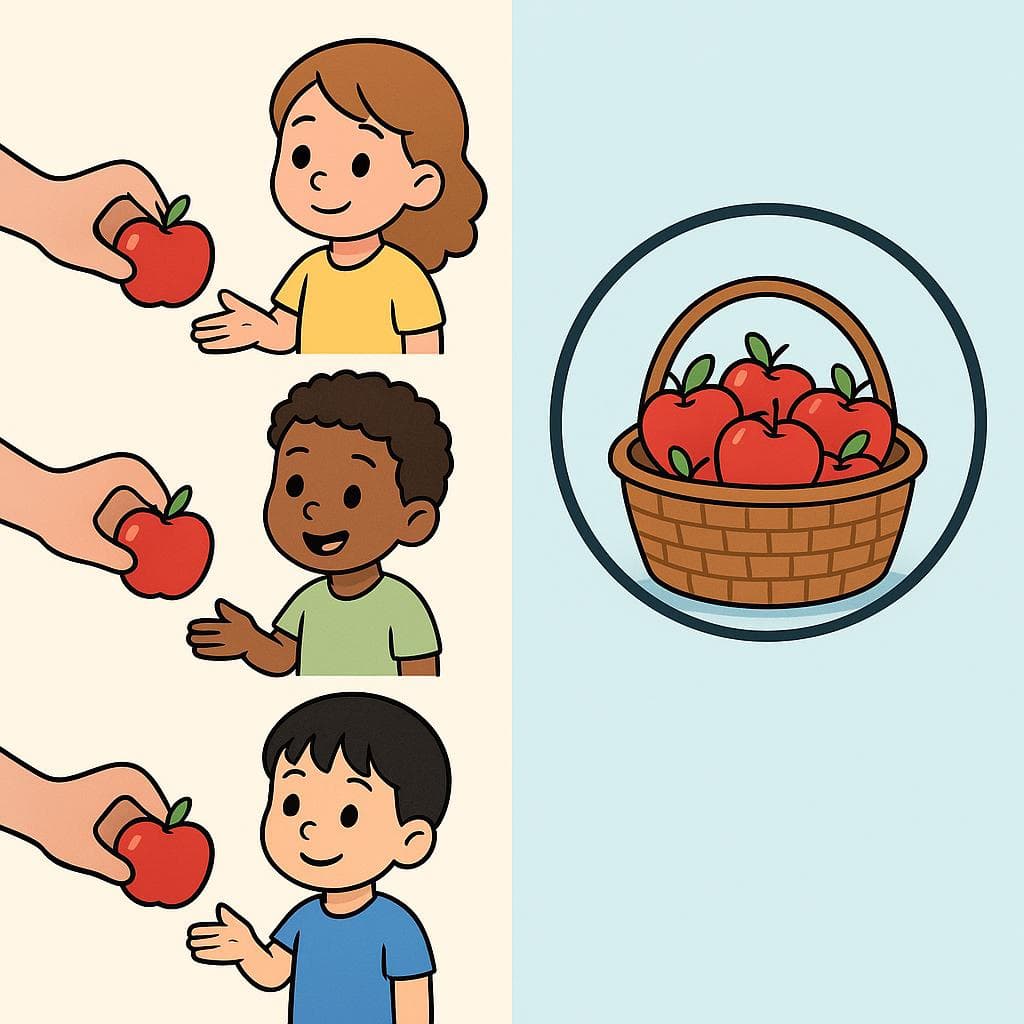
cada
Each, every (focusing on individual items in a group separately)
KAH-dahtodo
All, every, the whole (referring to the entire group or quantity as one unit)
TOH-dohQuick Rule
Cada = each one, individually. Todo = all of them, together.
Think: Cada = Countable (one by one). Todo = Total (the whole group).
- For frequency, 'cada día' and 'todos los días' both mean 'every day'.
- Remember 'todo' needs an article (el, la, los, las), but 'cada' never does.
Comparison Table
| Context | cada | todo | Why? |
|---|---|---|---|
| Students in a class | Cada estudiante recibió un premio. | Todos los estudiantes recibieron un premio. | Cada focuses on them one-by-one. Todos focuses on the entire group as a whole. |
| Talking about a day | Cada día aprendo algo nuevo. | Trabajé todo el día. | Cada día = every single day (a habit). Todo el día = the entire 24-hour period (duration). |
| Referring to a country | Cada ciudad tiene su encanto. | Todo el país celebró la victoria. | Cada picks out individual cities within the country. Todo treats the country as one single unit. |
When to Use "cada / todo"
cada
Each, every (focusing on individual items in a group separately)
KAH-dah
Singling out individual items
Cada estudiante tiene un libro.
Each student has a book.
Frequency (like 'every')
Voy al gimnasio cada día.
I go to the gym every day.
With numbers for intervals
Tomo la pastilla cada ocho horas.
I take the pill every eight hours.
todo
All, every, the whole (referring to the entire group or quantity as one unit)
TOH-doh
The entire group (plural)
Todos los estudiantes tienen libros.
All the students have books.
The whole of something (singular)
Comí todo el pastel.
I ate the whole cake.
Everything (as a pronoun)
Todo está listo.
Everything is ready.
Contrast Examples
With "cada":
Cada camisa cuesta veinte euros.
Each shirt costs twenty euros.
With "todo":
Todas las camisas cuestan veinte euros.
All the shirts cost twenty euros.
The Difference: Both sentences can be true, but 'cada' emphasizes the price per item, while 'todas' makes a statement about the entire collection of shirts.
With "cada":
Trabajo cada lunes.
I work every Monday.
With "todo":
Trabajo todos los lunes.
I work every Monday.
The Difference: This is a key point: for frequency with days of the week, 'cada [día]' and 'todos los [días]' are often interchangeable and mean the same thing.
With "cada":
Cada día es una nueva oportunidad.
Every day (each day) is a new opportunity.
With "todo":
Pasé todo el día en la playa.
I spent the whole day at the beach.
The Difference: Here the meaning is completely different. 'Cada día' refers to a series of individual days. 'Todo el día' refers to the full duration of one specific day.
Common Mistakes
Cada los estudiantes tienen un libro.
Cada estudiante tiene un libro.
'Cada' is always followed by a singular noun and never uses an article like 'los'. To talk about the group, you'd say 'Todos los estudiantes'.
Estudié cada día de ayer.
Estudié todo el día de ayer.
To talk about the entire duration of a single day, use 'todo el día'. 'Cada día' means 'every day' and refers to a repeating habit.
Me gusta todo tipo de música.
Me gustan todos los tipos de música.
When 'todo' means 'all' with a plural noun, it must also be plural ('todos' or 'todas') and include the article ('los' or 'las').
Quick Practice
Quick Quiz: Cada vs Todo
Question 1 of 3
Which is correct? 'Fui a la playa ___ el día.'
Related Grammar
Want to understand the grammar behind this pair? Explore these lessons for a deep dive:
Key Words





Tags
Build the instinct, not just the rule
Rules help you get it right; context makes it automatic. Read 200+ illustrated and narrated Spanish stories to see confusing pairs chosen correctly — over and over — until you stop thinking about it.
Frequently Asked Questions
Can 'cada día' and 'todos los días' mean the same thing?
Yes, often they can! When you're talking about a recurring action, like 'I study every day,' both 'Estudio cada día' and 'Estudio todos los días' are correct and mean the same thing. This is a common point of confusion, but in this specific context, they are interchangeable.
Why does 'todo' change to 'toda', 'todos', 'todas' but 'cada' doesn't?
'Todo' is a standard adjective, so it has to change to match the gender (masculine/feminine) and number (singular/plural) of the noun it describes. 'Cada', however, is an invariable adjective, which is a fancy way of saying it's a special case that never changes its form.