
Calentar vs Calentarse
Calentar = you heat something else. Calentarse = something (or someone) gets hot/angry.
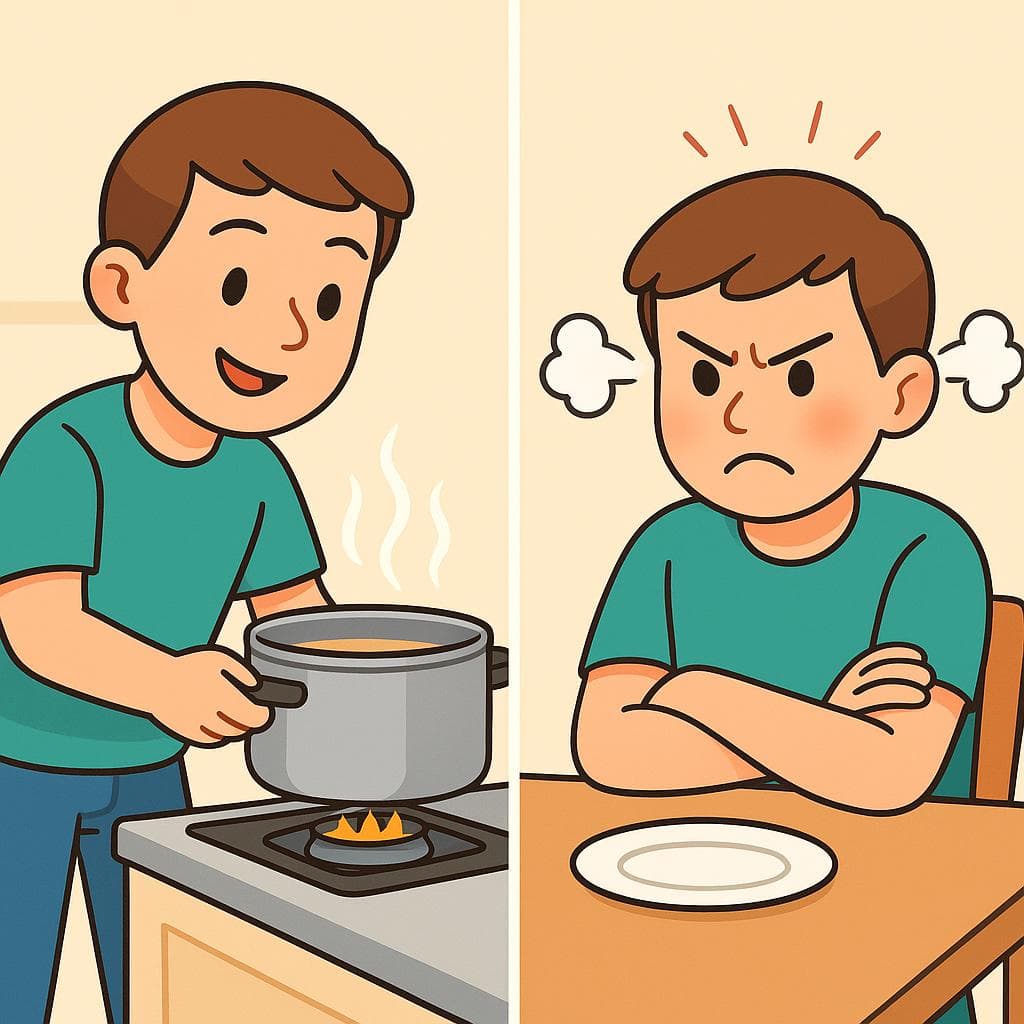
calentar
To heat up an external object or person.
kah-len-TARcalentarse
To get warm/hot, or to get angry/worked up (the action happens to the subject).
kah-len-TAR-sehQuick Rule
Calentar = you heat something else. Calentarse = something (or someone) gets hot/angry.
You 'calentar' the coffee, but you tell a friend '¡No te calientes!' (Don't get angry!).
- For food, 'la sopa se calienta' means 'the soup is heating up' (getting hot on its own).
Comparison Table
| Context | calentar | calentarse | Why? |
|---|---|---|---|
| In the kitchen | Caliento la sopa. | La sopa se calienta. | Calentar: You actively heat the soup. Calentarse: The soup is the thing getting hot. |
| Dealing with emotions | Ese tema calienta el debate. | Él se calienta en el debate. | Calentar: A topic makes a situation intense. Calentarse: A person becomes angry in the situation. |
| Body temperature | La manta me calienta los pies. | Me caliento junto al fuego. | Calentar: An object (blanket) heats you. Calentarse: You are the one getting warm. |
When to Use "calentar / calentarse"
calentar
To heat up an external object or person.
kah-len-TAR
Heating food or drinks
Voy a calentar la leche para el café.
I'm going to heat the milk for the coffee.
Warming a space or thing
El sol calienta las piedras de la playa.
The sun heats the rocks on the beach.
Warming up for exercise
Los futbolistas necesitan calentar antes del partido.
The soccer players need to warm up before the match.
calentarse
To get warm/hot, or to get angry/worked up (the action happens to the subject).
kah-len-TAR-seh
Getting angry or agitated
Mi padre se calienta cuando habla de política.
My dad gets worked up when he talks about politics.
Getting physically warm
Acércate a la chimenea para calentarte.
Come closer to the fireplace to warm yourself up.
When an object heats up on its own
El motor del coche se calentó demasiado.
The car's engine got too hot.
Contrast Examples
With "calentar":
Sus comentarios van a calentar la reunión.
His comments are going to heat up the meeting.
With "calentarse":
No te calientes, es solo una opinión.
Don't get angry, it's just an opinion.
The Difference: 'Calentar' means to make something else (the meeting) intense. 'Calentarse' is about a person's internal emotional state of getting angry.
With "calentar":
El sol me calienta la espalda.
The sun is warming my back.
With "calentarse":
Me estoy calentando con una taza de té.
I'm warming myself up with a cup of tea.
The Difference: 'Calentar' is used when an external force heats you. 'Calentarse' describes the process of your own body getting warmer.
Common Mistakes
Yo caliento cuando mi equipo pierde.
Yo me caliento cuando mi equipo pierde.
To describe getting angry (an emotion you feel), you need the reflexive form 'calentarse'.
La comida calienta en el microondas.
La comida se calienta en el microondas.
When an object is the thing getting hot, use 'calentarse'. You could say 'Yo caliento la comida' (I heat the food), but the food itself 'se calienta'.
Quick Practice
Quick Quiz: Calentar vs Calentarse
Question 1 of 2
Para la cena, voy a ___ las sobras de ayer.
Related Grammar
Want to understand the grammar behind this pair? Explore these lessons for a deep dive:
Key Words
Tags
Build the instinct, not just the rule
Rules help you get it right; context makes it automatic. Read 200+ illustrated and narrated Spanish stories to see confusing pairs chosen correctly — over and over — until you stop thinking about it.
Frequently Asked Questions
Can I say 'El sol se calienta'?
Not really. You would say 'El sol calienta' (The sun heats/is hot). The sun is the source of the heat, so it performs the action of 'calentar' on other things. You would say 'La tierra se calienta por el sol' (The earth gets hot because of the sun).
Is 'calentarse' always about getting angry?
No, but it's a very common meaning. The core idea is 'to get hot'. This can be literal ('Me caliento las manos' - I warm my hands) or figurative ('Se calentó la discusión' - The discussion got heated). Context is key!