
Caliente vs Caluroso
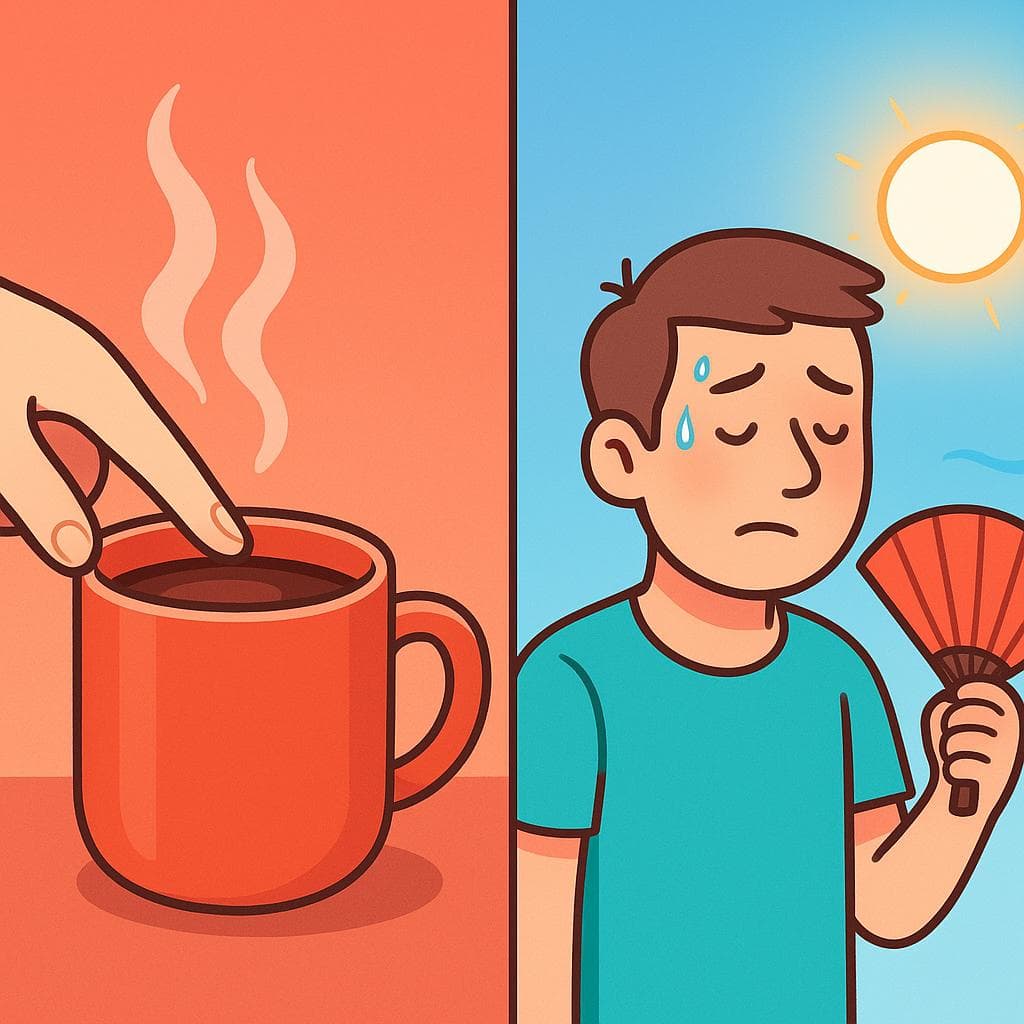
Caliente is for things you touch. Caluroso is for weather you feel.
caliente
Hot to the touch; refers to the temperature of a specific object or substance.
kah-lee-EHN-tehcaluroso
Hot in terms of weather, climate, or an environment that produces heat.
kah-loo-ROH-sohQuick Rule
Caliente is for things you touch. Caluroso is for weather you feel.
You touch a CALIENTE coffee cup. You feel a CALUROSO day.
- To say 'I am hot' (as a person), you use neither. You say 'Tengo calor'.
- Be careful: calling a person 'caliente' is slang for 'horny' or 'hot-tempered'.
Comparison Table
| Context | caliente | caluroso | Why? |
|---|---|---|---|
| Describing a Drink | El café está caliente. | (Incorrect) | Use 'caliente' for the temperature of an object you can touch, like a cup of coffee. |
| Describing the Day | (Incorrect) | Es un día caluroso. | Use 'caluroso' to describe the ambient temperature of the weather. |
| Describing a Place | La estufa está caliente. | El desierto es caluroso. | 'Caliente' for a specific object's temperature. 'Caluroso' for a place's general climate. |
| Describing People | Es una persona caliente. | Es una persona calurosa. | Be careful! 'Caliente' can be slang for 'horny', while 'calurosa' means warm and affectionate. |
When to Use "caliente / caluroso"
caliente
Hot to the touch; refers to the temperature of a specific object or substance.
kah-lee-EHN-teh
Food and drinks
La sopa está muy caliente.
The soup is very hot.
Objects
Cuidado, el motor del coche está caliente.
Be careful, the car's engine is hot.
Water temperature
Me gusta ducharme con agua caliente.
I like to shower with hot water.
Body temperature (a part of the body)
Tienes la frente caliente, creo que tienes fiebre.
Your forehead is hot, I think you have a fever.
caluroso
Hot in terms of weather, climate, or an environment that produces heat.
kah-loo-ROH-soh
Weather and days
Hoy es un día muy caluroso.
Today is a very hot day.
Climate and places
Sevilla es una ciudad muy calurosa en verano.
Seville is a very hot city in the summer.
Ambiance or environment
Esta habitación es calurosa porque no tiene ventanas.
This room is hot/stuffy because it has no windows.
Figurative: a warm person or welcome
Gracias por la calurosa bienvenida.
Thank you for the warm welcome.
Contrast Examples
With "caliente":
El radiador está caliente.
The radiator is hot (to the touch).
With "caluroso":
La habitación es calurosa.
The room is hot (the air is warm/stuffy).
The Difference: 'Caliente' describes the object *making* the heat. 'Calurosa' describes the overall feeling of the space.
With "caliente":
Es un hombre muy caliente.
He's a very horny/passionate man. (Warning: This has a strong sexual connotation.)
With "caluroso":
Es un hombre muy caluroso.
He's a very warm/affectionate man.
The Difference: This is a critical distinction to avoid embarrassment. 'Caliente' for a person is physical or sexual, while 'caluroso' refers to a friendly, welcoming personality.
Common Mistakes
El día está muy caliente.
El día está muy caluroso. (or 'Hace mucho calor.')
Although some native speakers might say this informally, 'caluroso' is the correct adjective for weather. The phrase 'Hace mucho calor' (It's very hot) is even more common.
La pizza está calurosa.
La pizza está caliente.
Food is an object. To talk about its temperature, you must use 'caliente'.
Estoy caluroso.
Tengo calor.
To say that you feel hot, the correct expression in Spanish is 'tener calor' (to have heat). Neither 'estar caliente' nor 'estar caluroso' is correct for this.
Quick Practice
Quick Quiz: Caliente vs Caluroso
Question 1 of 2
Choose the correct word: 'En el desierto, los días son muy ___.'
Related Grammar
Want to understand the grammar behind this pair? Explore these lessons for a deep dive:
Key Words





Tags
Build the instinct, not just the rule
Rules help you get it right; context makes it automatic. Read 200+ illustrated and narrated Spanish stories to see confusing pairs chosen correctly — over and over — until you stop thinking about it.
Frequently Asked Questions
Can I ever use 'caliente' for weather?
While 'caluroso' is the grammatically correct and preferred term, you might hear native speakers in some regions say 'el tiempo está caliente' informally. However, as a learner, it's best to stick with 'caluroso' for weather to sound correct and clear.
What's the difference between 'caluroso' and 'cálido'?
They are similar, but 'caluroso' means 'hot', implying a strong, sometimes uncomfortable level of heat. 'Cálido' means 'warm', which is usually pleasant. A 'día caluroso' makes you sweat; a 'día cálido' is perfect for a T-shirt.