
Confundir vs Confundirse
Confundir = to confuse someone/something else. Confundirse = to get confused yourself.
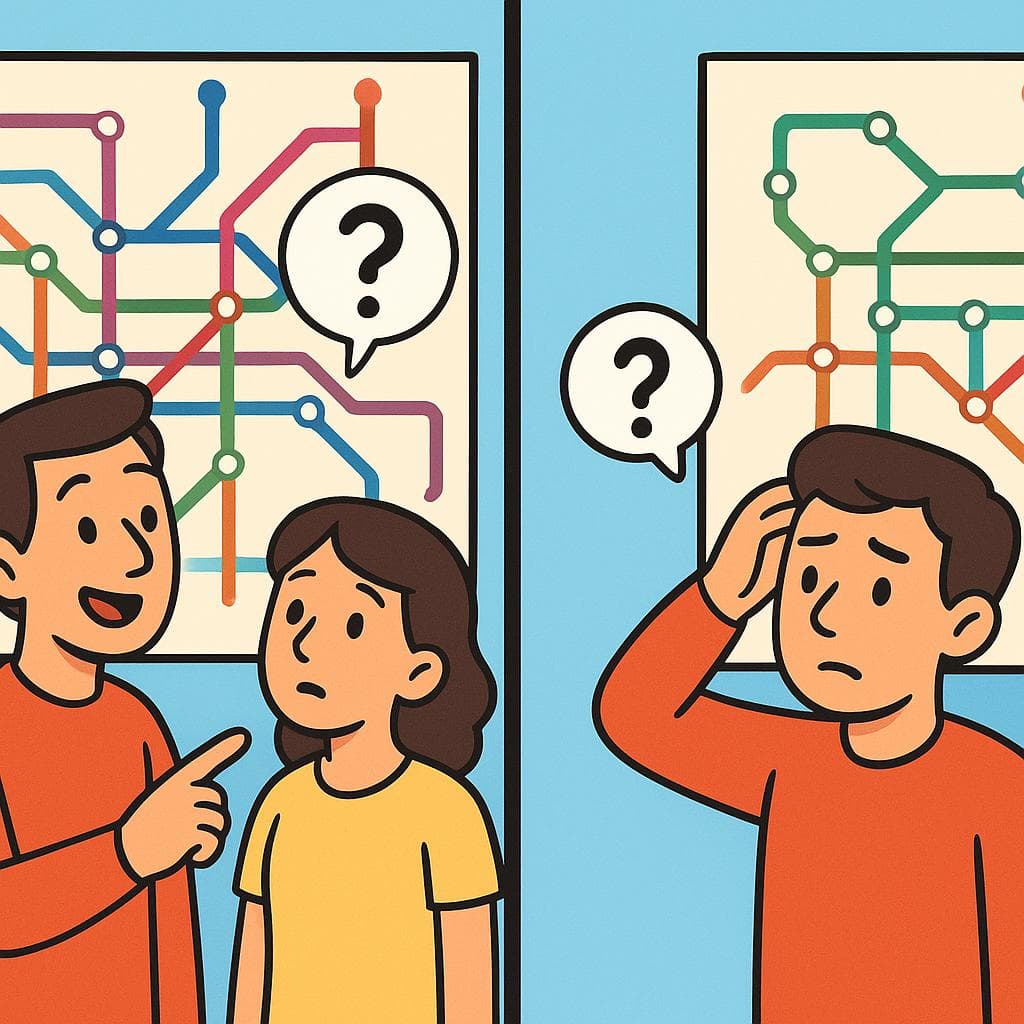
confundir
To confuse someone else, or to mix up two or more things.
kohn-foon-DEERconfundirse
To get confused, to become mixed up, or to make a mistake.
kohn-foon-DEER-sehQuick Rule
Confundir = to confuse someone/something else. Confundirse = to get confused yourself.
Think: `confundir` is an action you do TO something. `confundirSE` is something that happens to yourSELF.
Comparison Table
| Context | confundir | confundirse | Why? |
|---|---|---|---|
| Focus of the action | El mapa me confundió. | Me confundí con el mapa. | `confundir` focuses on the thing CAUSING confusion (the map). `confundirse` focuses on the person EXPERIENCING confusion (me). |
| Mixing up items | Confundí tu maleta con la mía. | Me confundí de maleta. | `confundir` specifies the two items being mixed up. `confundirse de` is a general way to say you made a mistake and got the wrong one. |
| Giving instructions | No me confundas con tantos detalles. | No quiero confundirme. | `confundir` is a command to someone else ('Don't confuse me'). `confundirse` expresses a desire about your own mental state ('I don't want to get confused'). |
When to Use "confundir / confundirse"
confundir
To confuse someone else, or to mix up two or more things.
kohn-foon-DEER
Causing confusion in someone
Tus explicaciones me confundieron más.
Your explanations confused me more.
Mixing up two items
Siempre confundo la sal con el azúcar.
I always mix up the salt with the sugar.
When something is confusing (as the subject)
El final de la película confunde a todos.
The end of the movie confuses everyone.
confundirse
To get confused, to become mixed up, or to make a mistake.
kohn-foon-DEER-seh
Expressing that you are confused
Me confundí con las nuevas reglas.
I got confused with the new rules.
Making a mistake (getting the wrong thing)
Perdón, me confundí de número de teléfono.
Sorry, I got the phone number wrong.
Being mistaken about a fact
Se confundió al pensar que la tienda estaba abierta.
He was mistaken in thinking the store was open.
Contrast Examples
With "confundir":
Esa película confunde a la gente.
That movie confuses people.
With "confundirse":
La gente se confunde con esa película.
People get confused by that movie.
The Difference: Both sentences express a similar idea, but the focus shifts. Using `confundir` makes the movie the 'actor' doing the confusing. Using `confundirse` makes the people the 'actors' who are getting confused.
With "confundir":
¡Cuidado! Vas a confundir mis llaves con las tuyas.
Careful! You're going to mix up my keys with yours.
With "confundirse":
¡Ay, me confundí! Estas no son mis llaves.
Oh, I made a mistake! These aren't my keys.
The Difference: `confundir` describes the action of mixing up two specific things. `confundirse` describes the personal realization of having made a mistake.
Common Mistakes
Yo confundo con este tema.
Yo me confundo con este tema.
When you are the one getting confused, you need the pronoun 'me'. 'Confundo' requires an object that you are confusing, like 'Confundo los términos' (I mix up the terms).
La situación se confundió a mí.
La situación me confundió.
The situation is the thing causing the confusion, so it's the subject. 'Me' is the direct object (the person being confused). The reflexive 'se' isn't needed here.
Quick Practice
Quick Quiz: Confundir vs Confundirse
Question 1 of 2
Choose the correct verb: 'El profesor ___ a los estudiantes con su pregunta.'
Related Grammar
Want to understand the grammar behind this pair? Explore these lessons for a deep dive:
Key Words

Tags
Build the instinct, not just the rule
Rules help you get it right; context makes it automatic. Read 200+ illustrated and narrated Spanish stories to see confusing pairs chosen correctly — over and over — until you stop thinking about it.
Frequently Asked Questions
Is 'confundirse' a totally different verb from 'confundir'?
Not exactly. It's the pronominal (often called reflexive) version of the same verb. Adding the pronoun 'se' (which changes to me, te, se, nos, os, se) shifts the meaning so the action of getting confused happens to the subject of the sentence.
Can I say 'La película me se confundió'?
No, that's a common error trying to combine both ideas. You have to choose one structure: either the movie confuses you ('La película me confundió') or you get confused by the movie ('Yo me confundí con la película').